
Finding a career that gives you the best of both worlds can be challenging to find, but former Valley resident Dana Terry, has been able to do just that. Terry is trained both as a paramedic and firefighter and combining those two positions has led him to take on a new leadership role as well as be of service to others.
“My parents are Marg and Gordon Terry and when we moved to the Valley, we lived in the Lenswood area,” said Terry. “Part of my years growing up were there and I attended Minitonas Junior High, and later on to the Swan Valley Regional Secondary School, where I graduated in 1989.
“I wanted to become a Fish and Wildlife Officer, so I moved to Lethbridge to take a college program there to be a Conservation Officer. Unfortunately, there were no jobs for those positions or very few and far between, with lots of competition for them. I finished the first year of the program and then met my wife.
“After I got married, I worked on a dairy farm because I was raised around working with cattle. That focused me on finding another career path,” said Terry. “My father-in-law was a Captain on the Lethbridge Fire Department and I asked him how I could get on the department. He told me I would have to become a paramedic first and go from there.
“So I quit the dairy farm and went to school to take my EMT course through the college in Lethbridge. I worked some rural ambulance shifts in Alberta. From 1995 to 1997, I went to paramedic school at NAIT in Edmonton. I took my Advanced Care Paramedic course, and at the same time I was working for the City of Edmonton as a paramedic.
“It was a really good experience to work in that field while upgrading in school,” said Terry. “As a new paramedic, I was really busy and saw a lot of different things. I got lots of experience from that and was eventually hired by the City of Lethbridge.”
Once Terry was set on his career path, he was able to merge his paramedic knowledge with firefighting. In the area that Terry lives and works in, the combination of firefighting and paramedic services comes in handy due to the environmental surroundings.
“Back then, the City of Lethbridge was a fire department and also an ambulance service,” said Terry. “Outside of Alberta, Brandon has an integrated system like this, where they cross-train firefighters and paramedics. One day you could be working on the ambulance, the next day on the fire truck.
“I stayed working with the City of Lethbridge for about 24 years and then I moved up into a Deputy Chief position. My career then took a little bit of a turn, as my position moved to a Deputy Chief position with Strathcona County in 2021, which is on the east end of Edmonton. Strathcona County is a specialized municipality that provides for the unique needs of a municipality that includes a large urban centre and a significant rural area and population.
“The challenge of being in a service like this is the number of refineries there are in the area,” said Terry. “There is a high risk involved in that. Then you have an urban side to provide fire protection services to that has about 88,000 people. There are also lots of rural properties and acreages in that mix too. It’s a unique system.
“Both services are focused on public service. That is what often brings people to work in this field. It attracts those individuals who are interested in the integrated service. There is a level of pride when someone can identify as a firefighter and a paramedic. When we respond to a call, it doesn’t matter which truck we show up on; we have kits on every one of our trucks and any of our staff knows what they need to do. We work as a team, so the team atmosphere is huge. There are times we get some pretty big incidents that we respond to, and we are able to switch from one task to another.
“There have been so many times throughout my career where I’ve used those skills interchangeably,” said Terry. “It’s very valuable, rewarding and what attracts people to the work we do.”
Terry notes that this kind of job can be heavy at times in terms of the things a person sees and experiences when getting called out. Fortunately, there are more mental health resources today geared to help first responders.
“We deal with people on the worst days of their lives,” said Terry. “I think that the hardest for me, over my career, is responding to incidents that involve children. Those are really tough calls to have to deal with. Sometimes, those children in incidents are the same age as my own children and that is really hard for me as a dad to come to terms with.
“The training I received helped to address those types of calls. I’m fortunate to have a good support system at home. In today’s emergency services, we have more mental health supports. In the service I have, we have a peer support team that is made up of other firefighter paramedics. They are trained to talk to their co-workers and address any issues that arise from a call. They can also refer them to our department psychologist. We have one on retainer that is available to us.
“We also have debriefings and meetings after the call and try to unpack challenges that we faced from that call,” said Terry.
Terry enjoys the line of work he is in because he really is focused on helping others.
“I’m very passionate about public service,” said Terry. “I like the ability to serve the public and think it’s a noble cause. It’s something to be proud of and you can certainly make a difference in people’s lives. I’ve seen this many times.
“Every so often, I will see people whom I remember from picking them up in the ambulance or responding to their emergency. Seeing that people do recover and become resilient is amazing. I’ve had some really good conversations with some of them after these types of incidents. I remember meeting a baby I delivered and she was in her 20s when I met her. That was a really cool experience.”
Terry has literally worked his way up in the department from the ground up. From there, he was able to build a foundation to set him towards more of a leadership role.
“When I first started, what I liked about the fire service and EMS was that you never knew what you were going to next,” said Terry. “It was always something new. You showed up to work and whatever came in, we responded to it. I really liked that, so I never thought of myself having to work in an office at some point.
“There was a point in my career where I needed to be challenged more. So I was part of the Union Executive for seven years and started expanding my leadership in certain areas. I had a discussion with one of the chiefs at the time, and he encouraged me to consider looking forward in my career and not just be content with what I was doing.
“He told me that if I wanted to really help influence direction within a department, he said I was going to need to do that from a higher position,” said Terry. “He coached me on which education to take, what courses to do, and what positions and responsibilities to take on to do that. I found it very rewarding to be able to see how much you can influence the direction of an organization by putting yourself out there and taking responsibility.
“That is where I have taken it. I’m ok to make decisions and taking care of people. I do care about the firefighters and paramedics we have and want them to be successful and taken care of. I remember what it’s like to be on that frontline, so I have a passion for the work and what they do on a day-to-day basis. I want to make it better for them and move our organization forward.
“It’s about how we improve and get better. I always tell people that they should always be coachable and teachable. I always tell my kids that too,” said Terry.
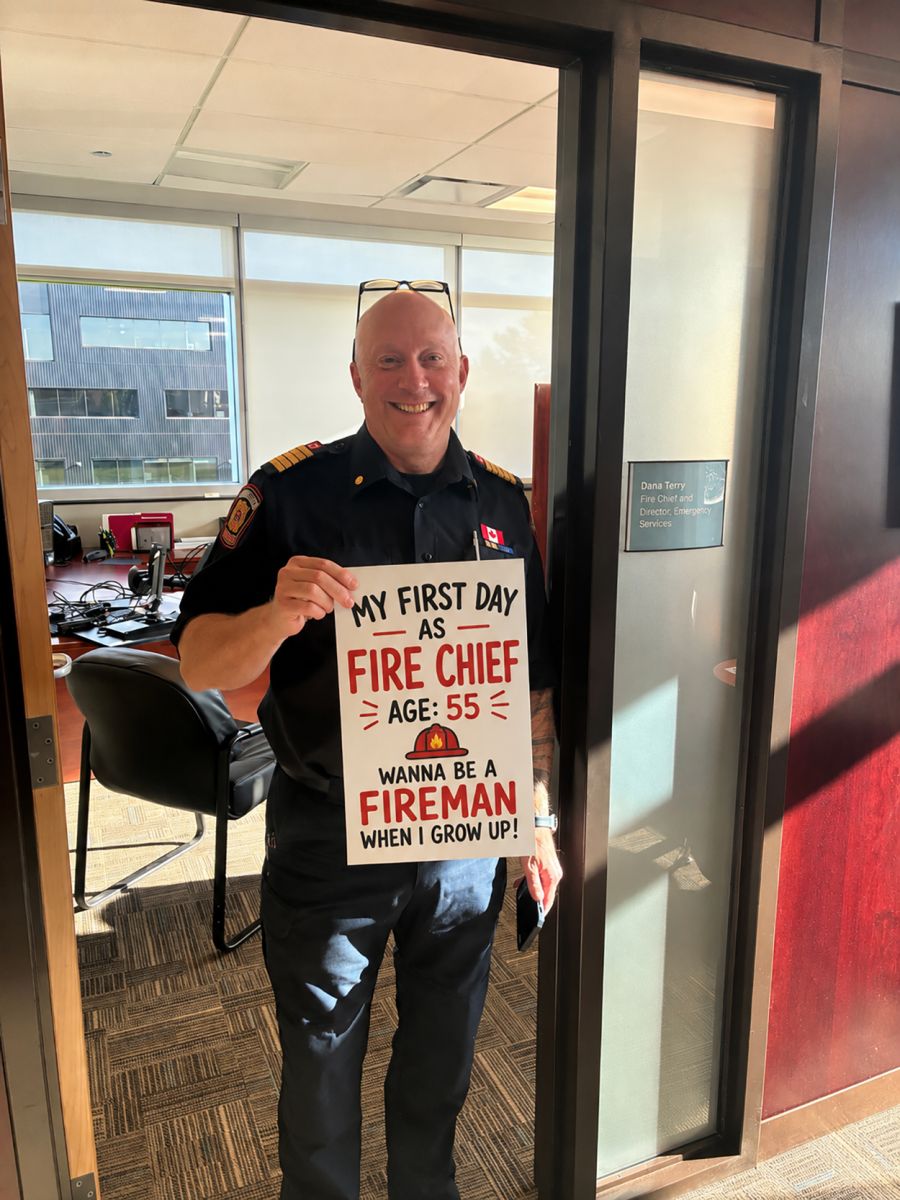
“I have recently been promoted to the position of Chief. I’ve only been in my current position for over a month, so I have some messaging I am sharing with my staff about the direction I want to see this department move towards. Over the next five years, there will be priorities we will focus on and set. It will be about understanding the needs and challenges our organization and community have, and how we can better serve them. My job right now is to set priorities and move us forward; it’s about progressing.”
Terry credits having some strong role models and supports in his life, while he pursued a career of helping others. It all started with his roots in the Valley.
“My dad, for sure, was the greatest influencer for the path I’ve chosen,” said Terry. “The work ethic he taught us and stuck with me. My parents raised four sons and we’ve all gone on to different careers, but I see the work ethic he put forward and encouraged us to work by. We grew up on the farm, so we raised our food, hilled potatoes, picked rocks, and did it all. I saw that in my dad and how he cared for and supported his family, which he continues to do today. He’s created a good legacy and I credit my dad for my drive and work ethic.
“My father-in-law certainly played a role by setting me on my career path. He was a good mentor and ended up being the Chief of the Lethbridge Fire Department for several years before he retired. He set a good example for me.
“Also, my wife, Marilee, has been my biggest partner and supporter throughout my career,” said Terry. “I wouldn’t be the person I am without her support and encouragement. Together we have raised four children into contributing members of society and now get to enjoy seven grandkids, so far.”
Establishing a career in helping others
Published in Swan Valley Star and Times Community
Published in
Swan Valley Star and Times Community
Tagged under
