
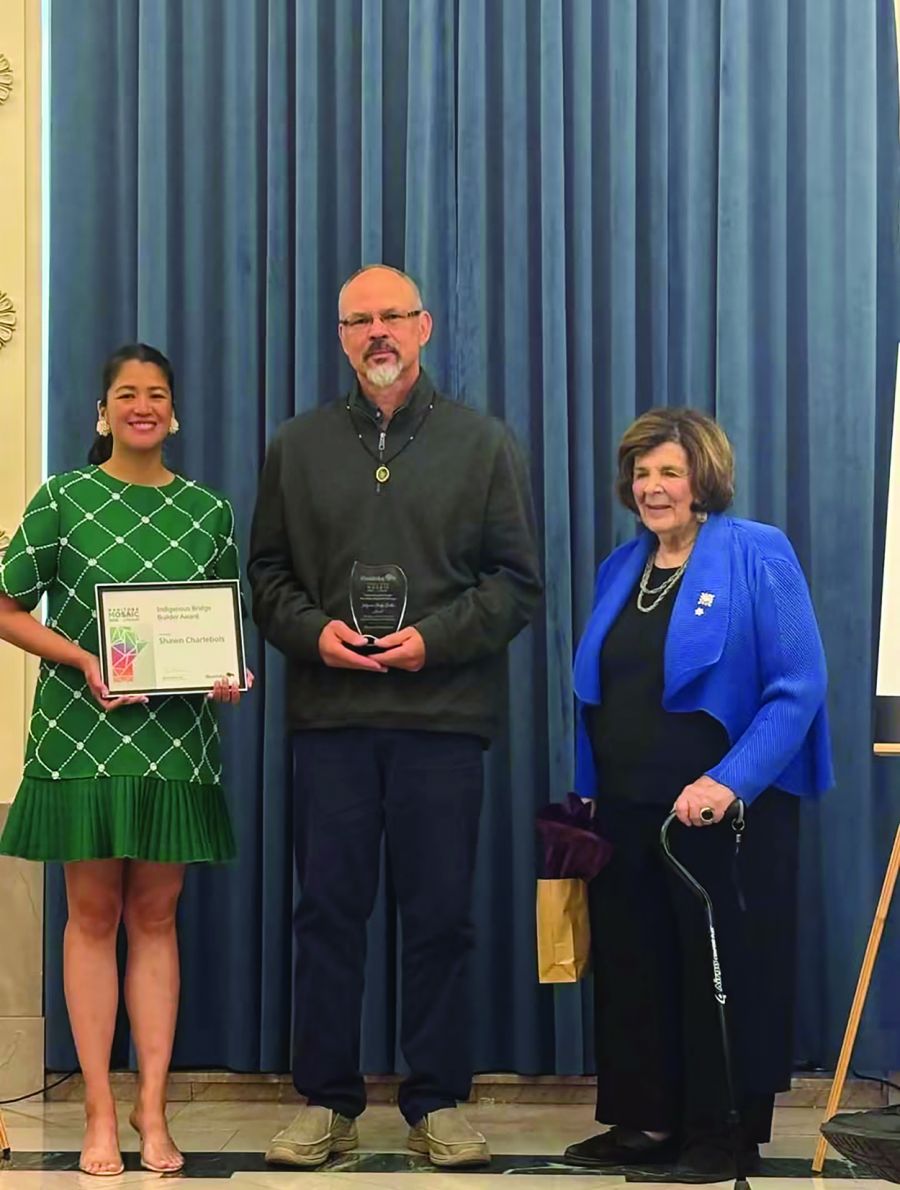
A local community member has recently been awarded a 2026 Manitoba Mosaic Award under the Indigenous Bridge Builder Award. Shawn Charlebois has dedicated his time and efforts to bridging gaps between different socioeconomic groups. This began with his vision for Red Road Compass: creating a safe place for marginalized people while connecting them to their culture and identity.
“Red Road Compass has been active in the community for about seven years,” said Charlebois. “Within that, I’ve really focused on four fundamental principles: affordable housing for people who are marginalized in our community, where I had two apartment buildings that were clean, safe, secure and low in rent. I’ve now left that fundamental because of the increased use of methamphetamines; the whole dynamic of the business wasn’t economically sound. I wasn’t charging more than I needed to; however, the damages were beginning to accumulate, and I could no longer afford it.
“The second fundamental was around food, and I felt that people wouldn’t think about healing if they were hungry. We started a soup kitchen in partnership with CMHA. We started it as an organization that we paid for out of our pockets. It was from contributions and my own personal earnings. All of a sudden it grew to a hundred meals a day. There was no way one person could sustain that. So CMHA stepped in and then that had to close because of certain circumstances around insurance.
“The third fundamental was land-based and how do we get people connected back to the land,” said Charlebois. “We placed them into an environment that just allowed them to breathe and relax, to feel safe, sit by the fire or water. The trees, clouds and water don’t judge people, so we did lots of that. However, this flood has impacted our setup, so now that is under reconstruction.
“The fourth fundamental was employment and training. One of the things I really wanted to do back in my previous role with PMH was to come up with creative ways to engage community members to seek employment in healthcare. I really tried my best, but there was so much opposition on so many fronts. When I retired in November 2025, I was able to find some freedom to sit down and reflect on our community and how do we help people in a more intimate way.”
The fourth fundamental is what led Charlebois to discover a way to help marginalized Indigenous people find employment, but also a sense of purpose and connection to the land.
“Employment is one of those things and it just so happened that many moons ago, working with WSFN Elder Buddy Brass, he took me up to The Pas and introduced me to an individual who came up with this initiative called The Non Timber Harvesting Initiative,” said Charlebois. “There are so many other things in the bush other than timber that have value on the international market.
“This person would go to communities and do an environmental scan to identify what plants had value on an international market and teach Indigenous community members how to harvest sustainably, process it, bring it to market and get fair market value. This was shared with me a long time ago, and then this person contacted me about three years ago and said he followed what Red Road Compass had been doing.
“He told me he was reaching a point in his life that he wanted to pass this initiative off and asked me if I wanted to do it,” said Charlebois. “After a whole bunch of conversations with him, I felt really interested in it. He had harvesters on the land coming to him, but I immediately thought of that population of people who were coming to the soup kitchen who would tell me they didn’t know what to do, so they did stuff that increased the probability of getting into trouble. These people would share this with me at the soup kitchen, where I would sit with them, listen to and counsel them. So often I would hear the same thing from many of them and that was that they were lost and didn’t know where to go.
“So he put me in contact with the international buyers, and they interviewed me to see if they wanted to do business with me in the same capacity.
“It was important to me that if I was going to do this, people would have meaningful employment, be paid what they were worth, as opposed to being taken advantage of,” said Charlebois. “Initially this company was paying $13 a dry pound for High Bush Cranberry Bark. High Bush Cranberry Bark is referred to as Cramp Bark, and it’s used as a women’s medicine for menstrual pains or urinary tract infections. I felt that it’s a lot of work to harvest this plant and that was not very much money.
“So I went into negotiations with this company and shared my vision with them. I pitched to them that there is a group of individuals in our community who are marginalized, good people with damaged spirits. My plan is to provide them with an opportunity to connect with the land and their culture, in a way that rekindles the Seven Sacred Teachings in them. As well, it would recognize the work they are doing and pay them accordingly that would allow them to feel pride and be able to support themselves. After negotiating with this company, they agreed to increase the price from $13 per pound to $31.47 per pound.
“What was interesting was that this company went to their buyers and told them about this initiative and how it would engage marginalized people who were underemployed, struggling with mental health issues, limited education, criminal charges that would have excluded them from employment,” said Charlebois. “These buyers then offered to pay more because they recognized the value in the community.”
The Non-Harvesting Timber Initiative has employed people who were often on the streets of Swan River, struggling to find the right pathway to supporting themselves and finding employment. Not only has this initiative helped these individuals earn an income, but it has also taught them a lot about respect and being stewards of the land.
“This is the third year the Non-Harvesting Timber Initiative has happened out of Red Road Compass,” said Charlebois. “The first year was a handful of us learning the process and making sure that we could meet the requirements of the buyers and get our shipping in order.
“When the second year came along, we got a few more harvesters, and then this year we just boomed. I suspect this year we had 15 harvesters and I think they harvested about 1,000 pounds of High Bush Cranberry Bark in a sustainable way.
“So how it works is that Red Road Compass is paid $31.47 per pound of High Bush Cranberry Bark by the purchaser, but Red Road Compass pays $26.47 per pound to the harvester,” said Charlebois. “Red Road Compass provides all the bags, and there are certain bags that have to be used, and then we do all the shipping. It removes the barriers for the harvesters to do this.
“We have had conversations with Natural Resources and High Bush Cranberry Bark is a plant that really does well when it’s trimmed. Red Road Compass teaches the harvesters how to use the tools and how to harvest the bigger stalk from the root site and leave the smaller ones. The smaller ones don’t have a thick enough bark yet and have less value.
“Then we teach them to snip off the little branches, which are like willows, and you stick them into the ground and it repopulates,” said Charlebois. “In essence, they are farming in a traditional way and are sustaining the land so they can harvest again next year. And if it’s done properly, they can harvest even more next year. The harvesters absolutely get it and Natural Resources loves this initiative.
“In talking with Employment and Training, they also support it because their clients are receiving employment training and skills. Then, Red Road Compass started working with Employment Income Assistance to help document what each harvester earned and got paid. Last year, an individual made $200 more than what they were getting on EIA.
“Some people will ask, well, what do they use the money for,” said Charlebois. “I have to say, I’m not naive and I’m sure they are using their money for whatever purposes they want. We can’t control that. Red Road Compass is providing support and we recognize that drug use is a coping mechanism for a deeper injury or trauma.
“We are providing this person an opportunity to remove themselves from a possible hostile environment, be on the land, harvest in a sustainable way, be surrounded by other people who are trying to make a positive change in their lives, follow guidelines and rules and then get paid fair market value. When we go through the process of making up their pay, we have scales and each harvester gets to see the weight of what they harvested. Everyone is part of the process in complete transparency.
“The other part of the win is here are people who are often not involved in business type transactions or conversations,” said Charlebois. “Now their opinions are being asked for and their words are being listened to. They are part of a community of harvesters and are being treated with respect and dignity. They connect themselves to memories of family who harvested and the feeling that comes with it, and that is hope.
“Now at the warm-up shelter, these individuals are no longer perpetrating lateral violence towards one another, but instead are sitting around, talking and healing, by sharing a common bond in harvesting. There is a sense of pride now within these folks and they feel like they are contributing to the larger picture.”
Charlebois knows how hard it can be when it feels like the deck is stacked against a person. This is an example of how building trust and adding kindness can go a long way in helping others to get back on their feet and find a sense of purpose.
“The very first thing that is the most difficult when working in community is establishing trust,” said Charlebois. “There’s a defence mechanism, especially with marginalized people because in many ways the system hasn’t been kind to them.
“They also take great satisfaction in knowing that the plant they are harvesting is helping people to get better. When we stopped harvesting the High Bush Cranberry Bark on Aug. 17, it was only a day later when these individuals came back to ask if there was something else they could do or another job they could work on.
“One of the misconceptions in our community is that people who are marginalized, homeless, dealing with addictions or mental health challenges are bad people,” said Charlebois. “I have been treated with nothing but kindness and respect by these individuals. I in turn show them nothing but kindness and respect back. I recognize they have value and they are not defined by their addiction. These people are human beings and extensions of my community.
“What I would love to see and find out is that in June, July and August, when our harvest was the most active, was there a reduction in shoplifting and minor crime in Swan River? Since we have stopped harvesting, there seems to be a slight uptick in those activities in Swan River in regards to break-ins and thefts.”
Whenever a new concept comes in and it is focused on helping individuals who are homeless or suffering from addictions, there is always criticism and skepticism of whether these initiatives are truly beneficial. Charlebois feels that despite some of the negativity this initiative has faced, there has been so much more positive that has come from it.
“We did have a couple of situations where someone in the community reported to the RCMP that harvesters going to the museum area,” said Charlebois. “The RCMP followed up on it and spoke to several of them.
“Another one of the criticisms I’ve received is that people shouldn’t be harvesting medicines for sale. I was raised that way too. Red Road Compass processes bear grease and other stuff away as gifts. It is all about what the definition of medicine is. I believe that harvesting in this capacity- giving people an opportunity to get away from critical environments, instilling purpose and meaning and creating part of a positive community- it all sounds like medicine to me.
“Never did I ever think that this cottage-industry could have the positive impact that it has had on people who in many ways have been deemed as hopeless by others,” said Charlebois. “The Non-Timber Initiative will resume harvesting of High Bush Cranberry in the spring.”
Helping others find purpose
Published in Swan Valley Star and Times Community
Published in
Swan Valley Star and Times Community
Tagged under
