
Candidates set for October vote

The candidate list for the Oct. 28 general municipal and school board election has been set and ballots are being printed.
City of Dauphin
In the City of Dauphin, three people are vying for the mayor’s chair left vacant by the retirement of David Bosiak. Hopefuls include current councillor Steve Sobering, along with Keith Durston and Carter Taylor-Luke.
There are 10 people attempting to secure six council seats on the next City council. Incumbents Christian Laughland, Devin Shtykalo, Ted Rea and Randy Daley are all seeking relection and will be joined by new candidates, including Amanda Novak, Michelle Nyquist, Jason Alf, Michael Winters, Scott McCallum and Richard Mitchell.
RM of Dauphin
Voters in the Rural Municipality of Dauphin will not have to make any decision regarding the municipal council as all candidates are acclaimed.
Ernie Sirski will return for a second term as reeve, while incumbent councillors Ken Plustwa, Ken Shewchuk, Tammy Koshowski, Todd Boguski and Midge Sametz are also all acclaimed.
The RM will be short one councillor, however, as no one stepped up to take the seat left vacant with the retirement of councillor Ron Ryz.
MVSD
The creation of a new board of trustees for Mountain View School Division will involve elections in three of four wards.
Incumbents Floyd Martens and Scott Lynxleg have been acclaimed in Ward 1, while Ward 2 will see Kyle Lylyk and Mindy Rickards compete for one seat on the board.
In Ward 3, five candidates are hoping to secure one of two seats on the board. They include incumbents Sonia Blanc, Gabe Mercier and Jason Gryba, along with newcomers Wanda Sime and Matthew Bayduza.
With four seats open in Ward 4, incumbent Jarri Thompson is joined on the ballot by Dan McKay, Rigby Devos, Michelle Smigelski and Rodney Juba.
Lakeshore
In the Rural Municipality of Lakeshore, Richard Kachur has been acclaimed reeve and three councillors - Cherie Robertson, Diana McIntyre and Michael R. Brunen - have been acclaimed in Ward 2.
Voters, however, will have to choose three councillors in Ward 1 from a list of candidates, which includes Claude Hykawy, Crystal Charlebois-Fiddler, Teddy Sraybash and Rick Paradis.
Ste. Rose
In Ste. Rose, Robert Killam has been acclaimed as mayor, but there will be an election for council with six people looking to fill four seats.
Candidates include Shari Maillard, Julie Peloquin, Darrel Deslauriers, Joey Frobisher, Steven Hopfner and Ivan Worrall.
Mossey River
Mossey River Municipality will see elections held for reeve and urban council positions, while three rural councillors - Greg Boyko, Alden Zurba and Leon Bergen - have been acclaimed.
Reynold Sahulka and John (Jack) Fleming are vying for reeve, while Justin Barsewsky, Angel Johnson, Rodney Grahn, Sherry (Harrison) Lytwyn, Roger Pilon and Ivan Fleming are squaring off to become urban councillors.
Gilbert Plains
Election interest in the Gilbert Plains Municipality is high with numerous candidates in the running.
James Manchur and Larry Malowski will square off for the reeve chair, while council positions will be contested by Raymond Rodgerson, Craig Von Bargen, Carsten Dykun, Aaron Klepak, Lyall Bates, Kristen Rubeniuk, Brett Ewanyshyn, Charles Jeffers, Leanne McKay, Grant Pope, Aaron Dykun, Drisen Harapiak and Vern Ellis.
Ethelbert
Voters in the Municipality of Ethelbert will have some choices to make on polling day with a full slate of candidates seeking election.
Mike Semeniuk and Kevin Boese are seeking to become reeve, while hopeful councillors include Bruce Podolsky, Greg Woytkiewicz, Cory Chymy, Dusty Rushinka, Debbie Jodouin, Wayne Pitura, Richard Evans, Randy Hancharyk.
Voting day in the 2026 general municipal election is Oct. 28.
CCC successful in secure much-needed funds
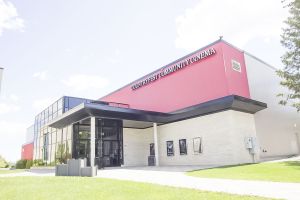
A successful fund-raising campaign has brought Countryfest Community Cinema back from the brink of financial disaster and has the organization excited about the future.
With customers slow to come back after the pandemic Countryfest Community Cinema launched a plan to raise urgently-needed capital, through a GoFundMe effort and a corporate fund-raising campaign, raising about 80 per cent of its $100,000 goal, said board chair Ron Hedley.
“We again got such good support,” Hedley said.
“I just appreciate how people have come and stepped up to help with the theater every time we ask.”
Hedley said the theatre has paid off in excess of $1.4 million from it’s mortgage in the 15 plus years it has been open, however, pandemic restrictions meant the organization had to drain its reserves to stay afloat during COVID. Getting the crowds back to not only cover operating cost, but to also build those reserves back up has been difficult.
“This is the second time where we said we’re kind of desperate right now,” Hedley said.
“It’s a tough market. We’re pretty self-sufficient, but we also know that we’re at the mercy of Hollywood and the movie quality. It’s going to be a struggle for a while, but we are holding our own.”
To help shepard the organization through the rebuilding, a new manager has been hired.
Angelena Neely brings a wealth of experience in the service industry, with staffing and running businesses.
“She’s been incredible so far,” Hedley said.
“So that combination, along with her excitement, has us feeling good.”
That does not mean the organization is resting on its laurels, Hedley said.
Although plans are still being worked out, Countryfest Community Cinema is planning a membership drive, selling monthly subscriptions to the theatre.
“Ask people to step up. That won’t be any big fund-raising campaign, but more about the same way you pay for Netflix or Amazon or whatever. That would be $20 to $25 a month that goes to the theater,” Hedley said, adding he would hope to sign up 200 to 300 people.
“I think it’s very attainable, because people have always stepped up to help.”
Paralympian’s perspective a gift for local trail developers, users
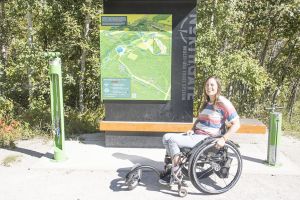
A Canadian paralympic world record holder spent the last two weeks at Northgate Trails, helping to assure the trails are wheelchair accessible.
When she was 14, Lisa Franks was diagnosed with arteriovenous malformation, a condition that caused clusters of blood vessels to prevent blood from properly passing by her spinal cord. As a result, Franks lost the use of her legs.
But that didn’t keep her down, as Franks began training as a Paralympian and went on to set world records in the 100m, 200m, 400m, 800m, 1,500m, 5,000m, and marathon events, winning six gold medals and one silver medal in her career.
Prior to her spinal injury, Franks was active in sports.
“And when I was going through rehabilitation, I actually met a bunch of Paralympians and got to try out different sports. And wheelchair racing, it turns out I had some skills in wheelchair racing,” she said, adding she participated in two Paralympic Games in 2000 and 2004.
After her success in wheelchair racing, Franks decided she needed a different challenge and turned her attention to wheelchair basketball, making Team Canada in 2006 and competing in the Paralympics in 2008.
“I would have kept going with that, but I had a pretty severe injury at the end of 2008 and just couldn’t. I had four shoulder surgeries and wasn’t competitive at that same level anymore. And then I discovered outdoors, and that’s been my new passion,” Franks said.
Franks is willing to do anything when it comes to outdoor activities, but her favourites are mountain biking, surfing, kayaking and hiking.
“I’ll try anything, like sky diving, paragliding, zip lining, snowmobiling, downhill skiing. I’m always looking for something new to try,” she said.
Franks was contacted by Parks Canada through Riding Mountain National Park (RMNP) to assist with the trail system in partnership with Northgate Trails.
“A few people with Parks Canada had heard me speak at a conference in the spring and it was all about accessible experiences and facilities are just better for the community overall,” she explained.
“And they were wonderful. They just realized that could really benefit the new trail system they were working on, so they asked me to come out and view the trails as an adaptive mountain biker and adaptive wheelchair user and see what advice I could give and what insights I could offer. I’m really excited that they’re being really inclusive right from the start. It makes their job that much easier in the long run.”
Franks rode the Northgate trails with the trail designer and volunteers using her own mountain bike, which gave them an idea of the capability of her equipment.
“They’re going to apply a lot of what they saw going into that. There’s an organization that has an adaptive mountain bike standard that they can fall back on,” she said.
Most of the trails are already wheelchair accessible, with a couple of areas that just need some tweaking.
“The boardwalks were pretty narrow, but I could make it across them, but don’t have much room for error on those. But it’s very much meeting in the middle between what the equipment we ride can do and what the trails offer. And when you get that in sync, there’s usually minimal changes that need to be done to make it more inviting,” she said.
Franks was impressed with the trails she has been on, noting a lot of upkeep has been done to rework some of the older trails in RMNP.
“I went to the Boreal Trail and then the bog trail or the boardwalk in there. It’s amazing that they’re just even thinking about it and trying to be more inclusive,” she said.
Franks used her regular wheelchair on the family loop at Northgate, which was flat and easy.
“But still a workout, just because you can add length with the different segments on it,” she said.
Franks has one wheelchair for every day use, with accessories that can be added to make it easier to use on the trails.
“There are lots of options for hiking wheelchairs. I just can’t travel with them all at the same time. In the summers I have my personal bike,” she said, adding she lives in a camper van, which is outfitted around her bike.
“I also have another bike on the outside on a bike rack that I let other people ride.”
Franks encourages anyone with disabilities that require them to use a wheelchair to get out and use the trails, especially the family loop.
“That family loop is really neat. There’s a lot of these different little nodes where you can see little things. There’s one clearing that has all these beautiful little tree houses. And even just getting out to the firepit in the communal area and watching everybody ride around or cook some hotdogs. It’s been a neat experience,” she said.
Franks sent a video of the Northgate Trails to people who work on trails in and around her hometown of Moose Jaw, Sask., to showcase what the Northgate trails are like.
While regular wheelchairs can be used on the family loop, more specialized wheelchairs would be needed for other trails.
Franks pointed out Parks Canada has a hiking wheelchair that people can borrow to use on the trails and enjoyed her time at Northgate.
“It’s wonderful Everyone here has been so excited about inclusion. What benefits myself might also benefit someone with a stroller or towing their kids in a trailer behind their bike. The wider boardwalks and things like that would also benefit everybody, I think,” she said.
Freedom and mobility, one tab at a time
For more than a quarter century the humble little tab found on the top of aluminum drink cans has meant freedom for young Manitobans facing mobility challenges.
The Tabs for Wheelchairs program began in the spring of 1998 when Holy Cross School in Winnipeg began saving tabs. By fall of that year, there were another seven schools that joined the cause.
The first specialized wheelchair was presented in the spring of 2000 to Carly, a five year old with cerebral palsy, who needed a specialized wheelchair to attend Kindergarten.
After the presentation was picked up by media outlets, participation in the program exploded and now there are approximately 200 schools and 300 business and organizations which collect the tabs across the province.
Locally, the Tabs for Wheelchairs initiative is championed by Rachel Goy
“For myself, I know personally how important it is for a child to have the proper equipment to meet their daily challenges, so I have been collecting tabs for this program for a very long time,” Goy said.
“Over the years, I didn’t always know where to leave them, so while I was employed with Dauphin Co-op, I decided to become more actively involved in the program. I started promoting the Tabs for Wheelchairs program through Co-op and I asked that collection bins be located at two of the stores. Then I began bringing bags of tabs to Winnipeg whenever I was making that trip.”
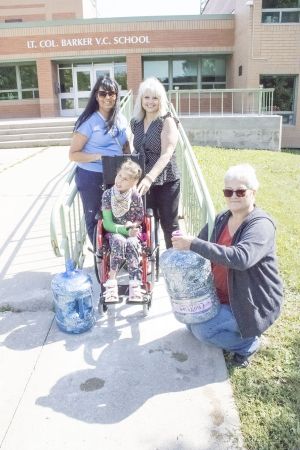
Recently, Goy accepted a sizeable donation of tabs from the family of eight-year-old Olivia Morrisseau, who lives with cerebral palsy.
The condition, Olivia’s grandmother Connie Morrisseau said, means that things most people take for granted, such as walking, talking or even putting on shoes takes Olivia a little longer to accomplish. She added the challenges have taught her granddaughter creativity and perseverance.
As Olivia grows, those challenges will increase, and that is why Connie decided to get more involved with the program.
“Five years ago I decided that I would collect tabs for a wheelchair,” she said.
“My thought then was that someday Olivia may need one to keep up with her friends when there is outings at school. Olivia loves being around her friends.”
Just recently, Olivia received her first wheelchair, a loaner from Specialized Services for Children and Youth (SSCY) through the Manitoba Possible Wheelchair Program.
“So Olivia and I would love to give back. Although she didn’t receive her wheelchair through tabs, it’s something we wanted to do,” Connie said.
“We collected two water jugs full of tabs. So many people have cheered Olivia on, family, friends and teachers, now Olivia and I want to be the people doing the cheering for someone else. Kindness doesn’t require running fast, or lifting heavy boxes. It just requires an open heart and this describes Olivia to a tee.”
The collection was not something the two undertook on their own as an army of family and friends joined the effort.
In fact, Olivia’s great aunt Talinna Kuchma from Sydney, B.C., was home for a visit and paid extra for her flight in order to transport a suitcase full of tabs.
“Last summer, I had the privilege of my granddaughters Leia and Amelia visiting from Europe. When they watched me removing the tabs from all the cans that came through the house, they asked why I was taking them off. I explained that I had a great niece, Olivia, who had cerebral palsy. I explained to them that what they find easy to do, she struggles with,” Kuchma said.
“I also explained that at some point there was a very good chance she would need a wheelchair and by saving these tabs it helped to supply wheelchairs. The girls are both very loving and empathetic, and immediately took on the cause on Olivia’s behalf. They are collecting them in England and Germany and sending them to me whenever somebody comes to visit. So some of the tabs that have been brought today are from them.”
Goy explained payment for the tabs has varied from 30 cents to 65 cents per pound, depending on the value of aluminum at the time.
There are approximately 1,500 tabs in a pound. The purchase of a $6,000 wheelchair requires approximately 14 million tabs, or about 9,500 pounds. For a $10,000 wheelchair, it’s approximately 24 million tabs, or about 16,000 pounds, she said.
Despite those large numbers, almost 70 chairs have been presented since the program began. The chairs are presented in June each year during an assembly at the Holy Cross School gymnasium.
Goy was lucky enough to attend the ceremony in 2024 where she met the two recipients and their families.
“It was an incredible and heartwarming experience,” she said.
“The bags of tabs are lined up along the walls. There are stacks of them everywhere and it is a pretty impressive sight to see.”
While Goy is no longer employed at Dauphin Co-op, the business remains as a drop off location for tabs for those wanting to contribute at both the Food Centre in Dauphin, and the Home and Agro Centre in Ste Rose. There are also collection containers at all schools in Dauphin, as well as Ste Rose School and the Watson Arts Centre.
Tabs can be removed from drink cans, canned fish, canned pet food and other food products. Any color of tab can be used, Goy said.
Since October of 2022, Goy has delivered more than 1,400 pounds of tabs to the Tabs for Wheelchairs Program. That’s approximately 2.1 million tabs.
“Removing and collecting the tabs is such a simple thing to do. I really appreciate that so many people are helping out, because every tab counts,” Goy said.
“So if you are having a gathering, a wedding, a backyard bonfire, please remember this important program and save those tabs.”
Anyone wanting more information on the program, or wanting to arrange a dropoff of tabs, can call Goy at 204-572-5102.
Fun facts about the program
• Donations of $20 or more can receive tax receipts.
• Tabs drop-off location and where all the tabs are bagged by the individuals at the Day Program is at Trailblazers Life Choices Inc. (1069 Autumnwood Drive).
• Western Scrap Metals Inc. (18 Sutherland Ave.) has a running account, so that any scrap brought in (any size from cans to old refrigerators) can be donated directly to Tabs for Wheelchairs.
• Wesman Salvage in Brandon (855 49th St. East) does exactly the same thing as Western Scrap Metals Inc.
• Average prize of wheelchairs is $4,000 - $6,000.
• YRC Freight transports all tabs from Holy Cross School to Western Scrap Metals Inc. every June at no cost to the Tabs for Wheelchairs program
• In 2018, the program received a generous donation of $30,000, which was used to purchase extra specialized wheelchairs for seven young people in Manitoba
• St. Boniface Bag Co. donates all the white bags.
• HT Mobility Medical (451 Henderson Hwy) is where all the wheelchairs have been purchased.
• Record single-year haul - a recent single-year drive brought in 23.5 million tabs (460 bags) collected by 188 schools.
Mavericks are one win away from rugby championship
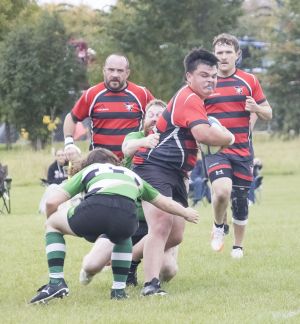
The Parkland Mavericks have already had a historic season, posting the best record in team history. Now they are on the verge of capping it off with the club’s first ever championship.
Joseph Lopez had two tries and Ronin Mouck had a try and three converts to lead the Mavericks to a 43-14 win over the Winnipeg Wanderers, Saturday, in the Manitoba Rugby Union Division 2 semifinal.
Daniel Evans had a try and one convert, while Matt Keena, Julien Lopez and Shawn Sarkonak also had tries.
The Mavericks had to overcome penalties in the early going, but Mavericks captain Jordan Campbell felt most of the team played a disciplined game.
“Everyone knows their role on the team. The veterans won us the game. Even though our speed got us a lot of tries, the veterans made the plays on defence to get us the ball back. It was really well played,” he said.
Playing as a unit was key to the team’s success, with every player sticking to the plan.
“Knew where they were supposed to be on offence and on defence. Guys were sacrificing their bodies. I’ve never seen Bundy (Sarkonak) so beat up before. Willi Budzinski, he was banged up,” Campbell said.
“It’s been a long season. We’re a hurting group of guys. We had 37 registered this season and right now we’re down to 20 guys that are able to play.”
The Mavericks will need all 20 players when they travel to Winnipeg, Saturday, to face the Winnipeg Assassins in the final at 11:30 p.m.
The Assassins upset the first-place Winnipeg Wombats, 43-7, to advance to the final.
“The guys that are coming are going to be ready,” Campbell said.
“I’m super proud of this group. A lot of guys put their egos aside. Coming off the bench sometimes isn’t easy. Sometimes coming off the field isn’t easy. But everyone was willing to sacrifice themselves for the betterment of the team.”
Kings earn a split with Stampeders with road win
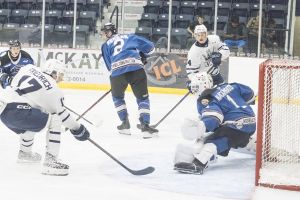
The Dauphin Kings earned their first win of the young Manitoba Junior Hockey League season on the weekend.
After the Swan Valley Stampeders scored four power-play goals en route to a 6-2 win, Friday in Dauphin, Collin Freidrich continued his hot start as his fifth goal of the season midway through the second period stood up as the winner in a 3-2 Kings victory, Saturday, in Swan River.
Kings head coach and general manager Bryan Kromm was pleased with the team for finding some success together.
“I think it brought them all on the same page and helped them understand what kind of group we have in the locker room. So it was kind of nice,” he said.
Dauphin’s lineup was bolstered by the return of Aidan Malone, Kale Pratte and Noah Smigelsky from injury, as well as Dylan Miko from a suspension.
“Having some of those guys that were injured back in kind of helped tighten the ship quite a bit. So I was pleased with all the guys that came back in and what they brought to the table,” Kromm said.
After the Stampeders scored four times on the man advantage, Friday, the Kings made some structural adjustments that they hadn’t quite dived into in Saturday morning’s skate prior to heading north. It resulted in Swan Valley going 0-2 on the power play.
“We’ve been focused more on five-on-five. I wanted to give them some more pieces to the PK, so I did that with them on Saturday morning and it helped,” he said.
Bryson Yaschyshyn had quite the bounce back game, Saturday.
He was pulled from Friday’s game after allowed four goals on 16 shots in 20:57 of action. On Saturday, he stopped 54 of 56 shots.
“He knew that he was off on Friday. He came and chatted with me after that game. I trust him. He’s been in the league, he’s got experience, so I knew he was going to bounce back and have a good game and he did (Saturday) night,” Kromm said.
Kromm added to his staff with Tyler Carefoot joining the team as an assistant coach.
Kromm felt he needed someone from the community to add a veteran presence on the bench.
“His name came across my desk, so I asked around, asked Scotty (McCallum) and a couple other guys and everything checked out,” he said.
“So I reached out to Tyler and he was able to make it work within his schedule. So that’s how that happened.”
The Kings are back on the road, Wednesday, against the Wolverines in Waywayseecappo at 7:30 p.m.
On Friday, Dauphin will host the Winnipeg Blues at 7 p.m., before heading to Portage, Sunday, for a game at 6:30 p.m.
Kromm said the focus this week will be rest and recovery, noting the schedule will be a bit busier in the coming weeks.
“Trying to work out our schedule and what works best for us is going to be imperative to keep us healthy and going on the right track,” he said.
Sunday’s game in Portage will be the first of six straight on the road for the Kings. That, Kromm said, will help with the team’s bonding.
“It’s been fun for them. When we played in Selkirk, it was a good atmosphere there and (Saturday) night in Swan, it was another good atmosphere,” he said.
“I think our guys actually relish when our backs are against the wall on the road. So I’m really excited to show what we can do coming up here.”
Kings court: With five goals in his first four games, forward Collin Freidrich is tied with three other players for the league lead and is 10th in scoring. Sam Swanton leads all defencemen in scoring with six points, all assists.
Kang’s celebrates 50th anniversary in Canada
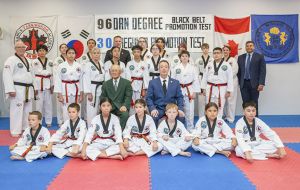
Kang’s Taekwondo Academy celebrated its 50th anniversary with a special evening, Aug. 15, at the Watson Arts Centre.
Founder of the academy Great Grandmaster J.W. Kang and Mrs. Kang were in attendance to celebrate the opening of the first Kang’s Taekwondo Academy in Winnipeg, Aug. 16, 1976.
Dauphin Grandmaster Joey Adamowski said the academy has been in Dauphin for 41 years and is now the provincial headquarters for the academy since the Kangs retired to the west coast.
Having the founders of the academy in Dauphin for the celebration meant a lot to members of all ages.
“With the exception of a handful of the members, this generation hasn’t seen Great Grandmaster Kang or Mrs. Kang in person. They see the history pictures on the wall, they hear the stories. They hear about 30, 40, 50 years ago. But for this generation, I think it was very meaningful,” he said.
“The sad part is that we probably won’t see him again unless we end up going that way. But the significance was a milestone. So it allowed everybody to see him, to hear him, to be a part of the celebration with him here. And when he left, everybody realized there’s a good chance he hadn’t been in this environment for seven or eight years. The next chance? I don’t think the opportunity will present itself again.”
For the academy to celebrate 50 years is a rare milestone, Adamowski said.
“The rarity here is for the club to actually be able to continue beyond 50 years and still hold the founder’s name. In Canada, that’s rare and that’s a common scenario of a traditional martial art that’s passed down through generation to generation,” he said.
“It allows us to not only hold and keep the name, but it also allows us to keep what’s known in the martial art realm as the root, meaning the system and the style that our instructor took.”
The celebration on Aug. 15, started with a colour belt promotion test with members from the Dauphin branch receiving awards:
• Most improved - Marcos V. Bardelli Fillo; Improved - Milana Khalabuzar and Jillian Liann Caraan; and Best Manner - Petra Rooks.
The following Poom and Dan Black Belt members from the Dauphin Branch received awards:
• Most improved - Kaela Perdito; Improved - Stanislav Horchak and Emmett Bartmanovich; and Best Manner - Gavin Berkvens.
Dauphin branch members also took home several academy awards:
• Taekwondo Perseverance Award: 14-and-under - Shilo St. Hilairel 15-and-over - Brayden Nelson.
• Taekwondo Spirit Award: 14-and-under - Dominic Pirie; and 15-and-over - Ben Muoneme.
• Taekwondo Family of the Year: 14-and-under - the Perdito Family; and 15-and-over - Rianne and Kaela.
• Scholastic Achievement Kindergarten to Grade 4 - Milana Khalabuzar.
• Scholastic Achievement Grades 5 to 8 - Kaela Perdito.
• Scholastic Achievement Grades 9 to 12 - Gavin Berkvens.
• Most Improved: 14-and-under - Peter Sebastian Isip; and 15-and-over - Harley Moore.
• Best Manner: 14-and-under - Shiloh Kalsi; and 15-and-over - Alice Racette Koe.
• Taekwondo Role Model of the Year: 14-and-under - Rianne Perdito; and 15-and-over - Justin Nelson.
• Member of the Year: 14-and-under - Mila Marczylo; and 15-and-over - Mark Symchych.
• Taekwondo Special Achievement - Jasmine Flett.
• Instructor of the Year - Master John Ter Horst.
• Branch Club of the Year - TCC/KTA H.Q. Dauphin.
For more information about the Kang’s Taekwondo Academy program, call 204-638-3265.
Gibbs helps Canada win ball hockey world title
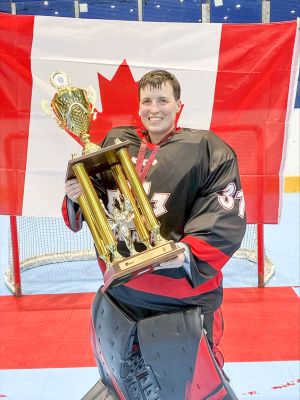
A Dauphin native helped Canada win a gold medal in the Legends Division at the International Street and Ball Hockey Federation’s world championships.
Held in Černošice, Czech Republic, July 28 to Aug. 1, Laura Gibbs helped backstop Canada to the gold medal, going 4-0 in the process, while Canada was undefeated at 5-0.
Canada opened the tournament with an 11-0 win over Great Britain, then beat Czechia, 8-0, and ended the round-robin with a 6-0 win over the US.
The Canadians then beat Great Britain, 10-0 in the semifinals and clinched the gold with a 9-0 victory over Czechia.
Gibbs started playing ball hockey not long after she moved to Edmonton about 15 years ago.
“I joined a team and have been playing ever since. So I’ve probably been playing for 15 years on and off,” she said.
Gibbs knew there were national championships for various age groups and put her name forward to play for a championship, but wasn’t selected.
“But this spring I was lucky enough to get selected with the women’s legends team to go join with them to go to Prague this summer and compete in the first ever women’s legends world championships,” she said.
A goaltender, Gibbs was not overly busy, having to make only seven saves in the four games she played.
“Canada was very dominant. We knew we would be strong going into it, but I feel like there were some teams that assumed because of the age group, they weren’t overly concerned about the skill level. But Canada definitely came to compete,” she said.
“Neither of the goalies on the Canadian team were very busy, because the team was just so strong ahead of us.”
Being a world champion still hasn’t sunk in for Gibbs yet.
“It’s unreal. I still feel in awe when I see the medal hanging up and some of the photos from the championship. It’s unbelievable. I think any kid, as an athlete, you dream of playing at the highest level possible whatever sport you’re in,” Gibbs said.
“So to be able to wear the Maple Leaf was a once in a lifetime, truly like a dream come true experience.”
Besides the lack of ice, the biggest difference between ice hockey and ball hockey is the amount of running involved.
“I think a lot of the players get a wakeup call with how much running is involved. You don’t realize how much you can glide when you’re playing ice hockey versus ball hockey. It’s a pile of running,” she said.
“As a goalie, the ball plays very differently than a puck. It curves and dips and dives and kind of does it’s own thing when some of those girls and guys hit it. It plays very differently.”
Equipment, Gibbs added, is minimal, but goalie equipment is pretty much the same as in ice hockey, other than the skates.
“A lot of the players just wear a soccer shin guard or ball hockey shin pads, a helmet and gloves and that’s about it,” she said.
The higher level you get, the rougher it gets, Gibbs said, but there is no body contact like there is in ice hockey.
“You can’t lay a hit on somebody. But it’s pretty close. The higher level you play, the more they let slide,” she said.
Gibbs encourages anyone interested to take up ball hockey, noting it is a great summer option in a lot of places where they pull the ice out of rinks in the summer.
“It allows you to keep playing. It forces you to increase your cardio and your endurance, because it’s a ton of running. But it’s a blast. I love it,” she said.
“I started playing a lot more ball hockey than ice hockey now.”
Gibbs played ringette while growing up in Dauphin and credits her growth in sport to all her coaches.
“They got me started and pushed me to never take no for an answer or stop believing in yourself. I’m super grateful for all of the support I received from all of those guys growing up and the friends and family that I had supported me through the tournament, watched all the games while I was overseas. I’ll never forget that,” she said.
Helping others find purpose
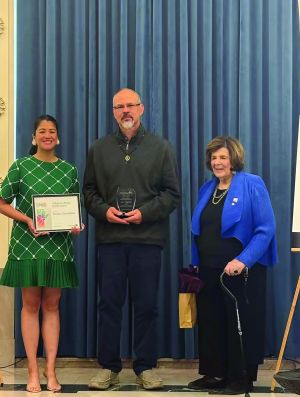
A local community member has recently been awarded a 2026 Manitoba Mosaic Award under the Indigenous Bridge Builder Award. Shawn Charlebois has dedicated his time and efforts to bridging gaps between different socioeconomic groups. This began with his vision for Red Road Compass: creating a safe place for marginalized people while connecting them to their culture and identity.
“Red Road Compass has been active in the community for about seven years,” said Charlebois. “Within that, I’ve really focused on four fundamental principles: affordable housing for people who are marginalized in our community, where I had two apartment buildings that were clean, safe, secure and low in rent. I’ve now left that fundamental because of the increased use of methamphetamines; the whole dynamic of the business wasn’t economically sound. I wasn’t charging more than I needed to; however, the damages were beginning to accumulate, and I could no longer afford it.
“The second fundamental was around food, and I felt that people wouldn’t think about healing if they were hungry. We started a soup kitchen in partnership with CMHA. We started it as an organization that we paid for out of our pockets. It was from contributions and my own personal earnings. All of a sudden it grew to a hundred meals a day. There was no way one person could sustain that. So CMHA stepped in and then that had to close because of certain circumstances around insurance.
“The third fundamental was land-based and how do we get people connected back to the land,” said Charlebois. “We placed them into an environment that just allowed them to breathe and relax, to feel safe, sit by the fire or water. The trees, clouds and water don’t judge people, so we did lots of that. However, this flood has impacted our setup, so now that is under reconstruction.
“The fourth fundamental was employment and training. One of the things I really wanted to do back in my previous role with PMH was to come up with creative ways to engage community members to seek employment in healthcare. I really tried my best, but there was so much opposition on so many fronts. When I retired in November 2025, I was able to find some freedom to sit down and reflect on our community and how do we help people in a more intimate way.”
The fourth fundamental is what led Charlebois to discover a way to help marginalized Indigenous people find employment, but also a sense of purpose and connection to the land.
“Employment is one of those things and it just so happened that many moons ago, working with WSFN Elder Buddy Brass, he took me up to The Pas and introduced me to an individual who came up with this initiative called The Non Timber Harvesting Initiative,” said Charlebois. “There are so many other things in the bush other than timber that have value on the international market.
“This person would go to communities and do an environmental scan to identify what plants had value on an international market and teach Indigenous community members how to harvest sustainably, process it, bring it to market and get fair market value. This was shared with me a long time ago, and then this person contacted me about three years ago and said he followed what Red Road Compass had been doing.
“He told me he was reaching a point in his life that he wanted to pass this initiative off and asked me if I wanted to do it,” said Charlebois. “After a whole bunch of conversations with him, I felt really interested in it. He had harvesters on the land coming to him, but I immediately thought of that population of people who were coming to the soup kitchen who would tell me they didn’t know what to do, so they did stuff that increased the probability of getting into trouble. These people would share this with me at the soup kitchen, where I would sit with them, listen to and counsel them. So often I would hear the same thing from many of them and that was that they were lost and didn’t know where to go.
“So he put me in contact with the international buyers, and they interviewed me to see if they wanted to do business with me in the same capacity.
“It was important to me that if I was going to do this, people would have meaningful employment, be paid what they were worth, as opposed to being taken advantage of,” said Charlebois. “Initially this company was paying $13 a dry pound for High Bush Cranberry Bark. High Bush Cranberry Bark is referred to as Cramp Bark, and it’s used as a women’s medicine for menstrual pains or urinary tract infections. I felt that it’s a lot of work to harvest this plant and that was not very much money.
“So I went into negotiations with this company and shared my vision with them. I pitched to them that there is a group of individuals in our community who are marginalized, good people with damaged spirits. My plan is to provide them with an opportunity to connect with the land and their culture, in a way that rekindles the Seven Sacred Teachings in them. As well, it would recognize the work they are doing and pay them accordingly that would allow them to feel pride and be able to support themselves. After negotiating with this company, they agreed to increase the price from $13 per pound to $31.47 per pound.
“What was interesting was that this company went to their buyers and told them about this initiative and how it would engage marginalized people who were underemployed, struggling with mental health issues, limited education, criminal charges that would have excluded them from employment,” said Charlebois. “These buyers then offered to pay more because they recognized the value in the community.”
The Non-Harvesting Timber Initiative has employed people who were often on the streets of Swan River, struggling to find the right pathway to supporting themselves and finding employment. Not only has this initiative helped these individuals earn an income, but it has also taught them a lot about respect and being stewards of the land.
“This is the third year the Non-Harvesting Timber Initiative has happened out of Red Road Compass,” said Charlebois. “The first year was a handful of us learning the process and making sure that we could meet the requirements of the buyers and get our shipping in order.
“When the second year came along, we got a few more harvesters, and then this year we just boomed. I suspect this year we had 15 harvesters and I think they harvested about 1,000 pounds of High Bush Cranberry Bark in a sustainable way.
“So how it works is that Red Road Compass is paid $31.47 per pound of High Bush Cranberry Bark by the purchaser, but Red Road Compass pays $26.47 per pound to the harvester,” said Charlebois. “Red Road Compass provides all the bags, and there are certain bags that have to be used, and then we do all the shipping. It removes the barriers for the harvesters to do this.
“We have had conversations with Natural Resources and High Bush Cranberry Bark is a plant that really does well when it’s trimmed. Red Road Compass teaches the harvesters how to use the tools and how to harvest the bigger stalk from the root site and leave the smaller ones. The smaller ones don’t have a thick enough bark yet and have less value.
“Then we teach them to snip off the little branches, which are like willows, and you stick them into the ground and it repopulates,” said Charlebois. “In essence, they are farming in a traditional way and are sustaining the land so they can harvest again next year. And if it’s done properly, they can harvest even more next year. The harvesters absolutely get it and Natural Resources loves this initiative.
“In talking with Employment and Training, they also support it because their clients are receiving employment training and skills. Then, Red Road Compass started working with Employment Income Assistance to help document what each harvester earned and got paid. Last year, an individual made $200 more than what they were getting on EIA.
“Some people will ask, well, what do they use the money for,” said Charlebois. “I have to say, I’m not naive and I’m sure they are using their money for whatever purposes they want. We can’t control that. Red Road Compass is providing support and we recognize that drug use is a coping mechanism for a deeper injury or trauma.
“We are providing this person an opportunity to remove themselves from a possible hostile environment, be on the land, harvest in a sustainable way, be surrounded by other people who are trying to make a positive change in their lives, follow guidelines and rules and then get paid fair market value. When we go through the process of making up their pay, we have scales and each harvester gets to see the weight of what they harvested. Everyone is part of the process in complete transparency.
“The other part of the win is here are people who are often not involved in business type transactions or conversations,” said Charlebois. “Now their opinions are being asked for and their words are being listened to. They are part of a community of harvesters and are being treated with respect and dignity. They connect themselves to memories of family who harvested and the feeling that comes with it, and that is hope.
“Now at the warm-up shelter, these individuals are no longer perpetrating lateral violence towards one another, but instead are sitting around, talking and healing, by sharing a common bond in harvesting. There is a sense of pride now within these folks and they feel like they are contributing to the larger picture.”
Charlebois knows how hard it can be when it feels like the deck is stacked against a person. This is an example of how building trust and adding kindness can go a long way in helping others to get back on their feet and find a sense of purpose.
“The very first thing that is the most difficult when working in community is establishing trust,” said Charlebois. “There’s a defence mechanism, especially with marginalized people because in many ways the system hasn’t been kind to them.
“They also take great satisfaction in knowing that the plant they are harvesting is helping people to get better. When we stopped harvesting the High Bush Cranberry Bark on Aug. 17, it was only a day later when these individuals came back to ask if there was something else they could do or another job they could work on.
“One of the misconceptions in our community is that people who are marginalized, homeless, dealing with addictions or mental health challenges are bad people,” said Charlebois. “I have been treated with nothing but kindness and respect by these individuals. I in turn show them nothing but kindness and respect back. I recognize they have value and they are not defined by their addiction. These people are human beings and extensions of my community.
“What I would love to see and find out is that in June, July and August, when our harvest was the most active, was there a reduction in shoplifting and minor crime in Swan River? Since we have stopped harvesting, there seems to be a slight uptick in those activities in Swan River in regards to break-ins and thefts.”
Whenever a new concept comes in and it is focused on helping individuals who are homeless or suffering from addictions, there is always criticism and skepticism of whether these initiatives are truly beneficial. Charlebois feels that despite some of the negativity this initiative has faced, there has been so much more positive that has come from it.
“We did have a couple of situations where someone in the community reported to the RCMP that harvesters going to the museum area,” said Charlebois. “The RCMP followed up on it and spoke to several of them.
“Another one of the criticisms I’ve received is that people shouldn’t be harvesting medicines for sale. I was raised that way too. Red Road Compass processes bear grease and other stuff away as gifts. It is all about what the definition of medicine is. I believe that harvesting in this capacity- giving people an opportunity to get away from critical environments, instilling purpose and meaning and creating part of a positive community- it all sounds like medicine to me.
“Never did I ever think that this cottage-industry could have the positive impact that it has had on people who in many ways have been deemed as hopeless by others,” said Charlebois. “The Non-Timber Initiative will resume harvesting of High Bush Cranberry in the spring.”
The race is on
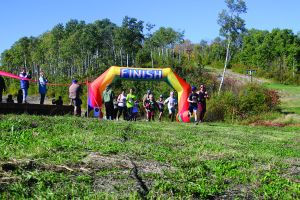
The municipal elections aren’t the only races that are happening in the Swan Valley, with the Thunderhill Ski Area hosting the Thunderhill Harvest Classic on Sunday (Sept. 27), featuring a 5K, 3K and 1K Fun Run, as well as a 3K Mountain Bike course, all roaming through the trails of the autumn-coloured Thunderhill. Pictured here, the participants of the 1K Fun Run take off from the starting line.