


Submitted
Picnic in the park
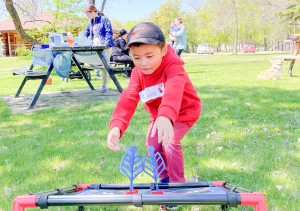
Regional Connections Immigrant Services held a potluck picnic with immigrant families at Meadowlark Park, June 4.
The picnic brought together newly-arrived families and others who have been settled in Dauphin for many years.
Everyone had a good time together with games and conversation.
Senior bowlers win gold

Parkway Lanes five-pin bowlers captured gold in the 65+ age category in the team competition at the Manitoba 55+ Games in Selkirk, June 7 to 9.
From left, the team consisted of Richard Cochrane and Marlene Cochrane, team captain Lynn Gray, Doris Derhak and Nestor Kalinowich. Derhak rolled a high game of 257, with four consecutive strikes in the team’s second game.
Marlene Cochrane also won a silver medal in the ladies 75+ singles and Derhak won a bronze medal in the ladies 65+ singles event.
Adventures in the woods a big part of growing up
By Ed Stozek
For the Herald
Set in the northeast part of my parent’s mixed farm, the bush was always an interesting place for a young boy to spend time in.
The bush was useful to the farm operations as the small herd of cows and the two work horses occupied the area during the non-winter months.
It was also the source of wood needed annually for fuel to heat our house.
A main trail ran through the centre of the wooded area, the reminder that pioneers used it before roads were built.
At the far end of the bush several dens were occasionally occupied by burrowing animals. My dog and I once caught a glimpse of a fleeing red fox. A large slough was also located in the bush and was home to a family of muskrats.
My sister recalled an interesting story when she was approximately nine years old and attended the one-room country school located near the family farm.
One spring day Alice and her older friend Nadia walked home from school. The girls asked my mother if they could go picking morels in the bush. After the two girls finished searching for morels they parted ways.
Nadia continued on her journey to her parent’s place located further east from the bush and Alice started on her half mile journey home. It started to rain and she lost her sense of direction. When she finally made it to a familiar gravel road she had ended up approximately two miles away from home.
By the time a tired and soaking wet sister finally made it to the yard, my father was in the process of harnessing the horses to go searching for her. To add insult to injury, she didn’t find any morels that day.
Morels are one of the most readily recognized of all the edible mushrooms and highly sought after.
If the conditions are right, morels “pop up” from the ground in late April and early May. They prefer to grow under and around the filtered light of deciduous trees and frequently appear before the trees have leafed out. Since the bush on my parent’s farm was predominately composed of white and black poplar it was an ideal spot for morels to grow.
My mushroom picking experiences started at an early age when I accompanied my mother and my older sisters.
Once the first morel was spotted it didn’t take long for us to pick a pail or two. When we got home we helped our mother clean the mushrooms and then she prepared them with cream and onions and we had a feast fit for royalty.
As I got older the forays into the bush made me appreciate the wonders of Mother Nature.
It was easy to enjoy a typical spring day when the frogs, wild ducks and blackbirds provided the background soundtrack that was often interrupted by crows warning us that we were in their domain. In mid-July we ventured into the bush to pick pin cherries and chokecherries. My mother used the fruit to make delicious jams and jellies. As we picked the fruit we made a great deal of noise to ward off any bears that happened to be interested in our activities.
During the fall we went to pick “peedpankas,” another favourite edible mushroom that grew along old stumps. Since my father harvested poplar trees from the bush, the “peedpankas” had ample spots to grow in.
Back in the day, picking mushrooms was a favourite activity enjoyed by folks from all walks of life.
A boyhood friend recently recalled that his mother had arranged for him to catch a ride with the local priest to attend catechism classes.
During the morel picking season the priest always stopped his car at a certain spot and they picked a pail or two of mushrooms prior to arriving at the church.
Never ask fellow mushroom pickers where they found their haul because no one is going to give up the location of their prized picking spots.
One day I plan to revisit the bush on the farm and check out the once-familiar mushroom picking spots.
Finalists
SVRSS Golf Coach Marni Zamzow celebrated the second place finalist banner with girls’ team members McKenna Gray, Crystal Zamzow and Laina Leadbeater.
Zone champs
The Ste. Rose Expos are Zone 8 champions after an 8-4 win over the Swan Valley Tigers, May 24, in Roblin. Shayne Shura Froese got the win for the Expos and Kayden Caumartin came on in relief.
Ryan Benson hit a grand slam home run and a solo shot.
The team will now head to the provincial championships in Brandon, June 2 to 4.
Team members include Benson, Caumartin, Shura Froese, Chris Szewczyk, Kyle Gilmore, Jeff Gilmore, Jacob Martin, Mathew Vandepoele, Isaac Walker, Daenen Delaurier, Ashley Scott, Liam Musgrave (not pictured) and Brooke White (not pictured).
National champion
Breanna Sakal tries to get past a tackle during a rugby match in Nicaragua. Earlier this month she travelled to Nicaragua to play rugby for a national title with the Dog River Howlers team.
Dogs have played an important role in RCMP history
By Ed Stozek
For the Herald
The RCMP’s association with canines dates back to the 1890s when the North-West Mounted Police stationed in the Yukon used sled dogs to deliver mail during the winter months along a 600-mile route between Dawson City and across the border to Skagway, Alaska.
From 1938-55, Challenge of the Yukon was a long running radio adventure show set during the Klondike gold rush of the 1890s.
The show introduced listeners to the Mounties and their use of a police dog. Sergeant Preston and his trusty Alaskan Malamute dog, Yukon King, fought crime. In the initial episode Sergeant Preston searched to capture his father’s killer. In 1955 the radio show evolved into a television series, Sergeant Preston of the Yukon. There were also Sergeant Preston of the Yukon comics. Each show and comic always ended with Preston saying, “This case is closed, King.” Preston’s other iconic sayings in every episode included “You’re under arrest in the name of the Crown” and “On, you huskies.”
Privately-owned dogs were used until 1935 when the RCMP saw their value and created the RCMP Dog Section.
The first three Police Service Dogs were Black Lux, Dale and Sultan.
These purebred German Shepherds were used for general duty and special detection teams. In 1940 evidence seized with the help of Black Lux secured a conviction for the very first time.
In the Commissioner’s Report of the RCMP in 1940 it was noted, “As this is the first of this nature, it has been necessary to touch upon the achievements of our trained dogs during previous years whilst we were undergoing the experimental stage.”
It had been established that a trained dog was a most valuable assistant to the force and that requests were made from almost every division to send a dog or increase the existing numbers.
Some of the dogs received their training at the Rockecliffe Kennels near Ottawa and then were sent where they were most needed. In 1940, 10 dogs were in active service including one in Alberta, four in Saskatchewan, one in Manitoba, two in Nova Scotia, one in Prince Edward Island and one in New Brunswick. Of the remaining dogs at Rockecliffe, three had almost completed their training, two were females that had given birth to pups and two were owned privately by members of the force and would be used on police investigations by their owners.
The Commissioner also noted that the dog training centre at Rockecliffe would be difficult to duplicate anywhere in Canada as the conditions and surrounding countryside were ideal for the purpose.
Most of the dogs had been purchased young and untrained at $35 to $50 and once trained, their market value was $500 to $1,000. All dogs were personally handled and taught by their trainer, Special Constable C.R. Aichinger. He was also responsible for the training and instructions of the dog masters who were each detailed to a dog. “Our trainer has exemplified a thorough understanding of canine psychology and in addition is able to impart this knowledge to others with good results.”
Aichinger was also skilled as a veterinarian helping three dogs recover from pneumonia. Several of the stories that I have previously written have had references to the work of police dogs. For example, Major, a dog hero of many searches, was used in trying to track down 19 German prisoners of war who “disappeared’ from the confines of the Whitewater Camp on Oct. 31, 1943.
In another case, after footprints were discovered by the shore of Harold’s Lake in early November 1957, Tiny was called upon to help locate a 75-year-old Dauphin area woman who had been missing for several days. In 1968, Scout’s services were enlisted when a squad of RCMP came to the Dauphin area to search for an escaped convict, Percy Moggey.
Today there are more than 150 police dog teams in the force. They are an important part of frontline policing in the search for missing people, tracking down criminals, removing illicit drugs from the street and sniffing out explosives and human remains.
Thanks to the police dogs, Sergeant Preston’s words were true when he noted, “This case is closed, King.”
Dancing for a cause
Young dancers from the Bratstva Ukrainian Dance Studio had an opportunity to show off all they have learned as the group held its spring recital, May 8.
All proceeds from the admission and raffle have been donated toward humanitarian aid in Ukraine.
Concerts of the past are “Always On My Mind”
By Ed Stozek
For the Herald
Television, the radio and a collection of vinyl records provided an avenue of escape from the relatively uneventful life of living on a farm.
Watching the Beatles and a host of other popular musical acts on The Ed Sullivan Show sparked an interest to see entertainers in my adult years at “live” concert settings.
With a seating capacity for 1,684 patrons, the Western Manitoba Centennial auditorium was an excellent venue for popular entertainers passing through Brandon.
My first visit to the auditorium occurred in 1970 when the newly-opened facility was used to host the freshmen students attending university for that school year. We spent several hours listening to speakers welcoming and informing us of campus-related activities.
One of the first concerts that I attended at the auditorium featured the First Edition with lead singer and bass player Kenny Rogers. The set list included their hits, “Just Dropped In To See What Condition I Was In” and “Ruby, Don't Take Your Love to Town.”
When the band broke up in 1975 Kenny Rogers launched a very successful solo career with over 20 number one hits. “You got to know how to hold them, know when to fold them, know when to walk away and know when to run.”
At another concert, Bruce Cockburn performed as a solo artist. His guitar playing and singing were amazing. For an encore he played one of my favourite songs, “One Day I Walk.”
After the concert it was time to rush to my dorm room and try to figure out the guitar chords. My friends and I later discussed the concert highlights including the lyrics, “One day I walk in flowers, one day I walk on stones, today I walk in hours, one day I shall be home.” That song was later covered by various recording artists including Anne Murray, The Rankins, and K.D. Lang.
Formed in 1968 the rock band, Lighthouse, put on a great show playing their hits “One Fine Morning”, “Sunny Days” and “1849.” One of my classmates and I later used “1849” as part of a presentation for an Education class showing how songs could be utilized to enhance history lessons. “They came for gold in 1849. Sixty-one wagons, two miles long in a line.”
Lighthouse, winners of several Juno awards, included 11 musicians and featured horns and string instruments. Some of the group members were familiar as they had previously appeared as house musicians on Let’s Go, a teen show that I had watched in 1964-65.
Many years later, Janice and I enjoyed attending the Minot State Fair and its great line-up of entertainers.
Two concerts still remain as favourites. Willie Nelson played a one-hour show. The thunderous applause brought him back for a 60-minute encore that included one of my all-time favourite songs, “Always On My Mind.” Along with the band, his sister Bobbi accompanied him on the grand piano. In 1982-83 the song garnered several Grammy Awards including song and album of the year. Throughout the concert my binoculars were focused on Willie’s famous Martin guitar and his unique playing style. He named his guitar after Roy Roger’s horse, Trigger.
Once our sons Warren and Troy got older, they also attended the fair. Along with spending the day doing the usual kid’s activities, we purchased tickets for the Garth Brooks concert. Released in 1990 on the No Fences album, “Friends in Low Places” and “The Thunder Rolls” were his early hits. Brooks put on a great show and as he started singing “There’s a storm movin’ in, he’s headin’ back from somewhere, that he never should have been, and the thunder rolls,” a storm rolled through Minot. Amid the thunder and lightning Brooks finished the set.
Troy recently recalled, “I remember feeling so small and awestruck by the enormity of the event. It seemed big but that was likely because I was so little and the crowds were a new thing to my small-town boy world. I remember an actual thunder storm rolling in as he played ‘Thunder Rolls’.”
Many years later, I have many memories from attending concerts at various venues. They are still “Always On My Mind.”
Board request reinforces concerns
By Floyd Martens
MVSD Board Chair
We asked for your feedback.
In one of the March articles of Mountain View Matters, the board indicated your perspective was needed. We needed to hear your views on school board representation. We currently have nine trustee positions elected in four wards. Each trustee needs to represent an equal number of voters. With the changes in population across the division, we are close to requiring adjustments to create balance.
The question was whether the current number should be nine in four wards or whether we should reduce the number to seven in three wards? We asked for your perspective and you gratefully provided it.
Almost 150 responses to the survey were received. It is always great to hear from our community and gain your perspective on issues. It is what makes the school board system effective.
The survey provided more than just an answer to this question – it also provided us with a number of comments that we are continuing to examine.
In terms of whether to reduce the number of trustees from nine to seven, the results were slightly higher in favour of reducing the number.
However, as the board looked at the additional comments and concerns about making this change, it reinforced one of the concerns the board had in initiating this process. Trustee representation is based on population. Smaller communities, particularly if they face declining numbers, have a smaller voice. Larger communities have a larger one. It is based on the number of people and where the majority of the population resides in the school division.
Once elected as trustees, we represent the whole division, regardless of where we live. Wards are for election purposes only.
However, the main concern the board had about reducing the number of trustees was whether our communities would feel unrepresented if a reduction took place. If they felt their voice was represented, we could proceed. If not, we would not move forward.
In examining the results of the survey, there were a number of concerns expressed about how a reduction could add to a sense of loss in the voice of our communities. This was never the intention and as a result, the board felt we should keep the number of trustees at nine for this election.
Following the election in the fall, we will see what the population is in our various wards and whether we are still within the representation quotient we need to operate under according to the legislation governing school boards. At some point, we may have to make changes, but they will not happen for this fall.
Further to the question about the number of trustees, the other comments from the survey were referred to the Community Relations Committee of the board for additional discussion and recommendations.
Again, we are grateful for your response. We would also encourage you to consider becoming involved as school trustees. These are democratically-elected positions by our communities to represent them. Having people interested in serving our communities is essential. The Manitoba School Boards Association is providing information sessions for those interested in being involved.
There is a webinar on May 4 and 11 for those who are interested in running as candidates this fall.
Information is available at: www.mbschoolboards.ca.
You do not need to register to be involved.
We thank you for your participation in this survey and look forward to your engagement as we move forward with elected school boards.