


Submitted
Thousands seek relief at national park work camps
By Ed Stozek
For the Herald
One day in February 2008, I came home and checked the answering machine.
Ninety-one-year-old Henry Hlady left a message asking for my address as he wanted to send me information of his time spent as a relief worker during the Great Depression in the Riding Mountain National Park.
One week later I met Henry at a senior's complex in Brandon.
At the height of the Great Depression, thousands of jobless men were sent to relief camps. With 10 separate camps, Riding Mountain sustained the largest relief camp operation of Canada’s national parks.
The men were housed in old refurbished buildings or new tar and paper shacks constructed when they arrived. Between 1930 and 1936 the relief workers were responsible for erecting 86 buildings including administration and community buildings, garages, warden and staff headquarters. Others helped build highways and made significant improvements in the campgrounds to attract tourists to Canada’s newest national park.
In 1932, single unemployed men registered at the local employment bureau with the hopes of obtaining work for winter projects. In 1932 Henry was 15 years old when he left for his first relief camp job at Rivers. Using a pick and a shovel, wheelbarrows and two teams of horses, the men built about a quarter mile of road before the first snowfall of the year.
“Two months ago, there was hardly any preparation for the army of men that soon trouped into the Clear Lake district. Huts had to be built to house the men and stores erected to look after provisions needed to feed them. Neither was it planned that all of the men be congregated at one large camp. Smaller units were advisable to better carry out works situated near to the camp sites. Programs had to be provided for the men when they arrived, equipment found for the men to work with.” (January 5, 1932, Brandon Daily Sun)
In October 1933, Henry arrived at Camp 7. The first bunkhouse was an old logging camp hut left over by men who cut ties for the railroad. Several weeks later Henry moved to a new bunkhouse that soon filled up with 30 to 40 relief workers. Located on Highway 19 near Whirlpool Lake, Camp No. 7 was seven miles from the Wasagaming headquarters.
Numerous men complained about the housing as the bunkhouses were little more than tar paper shacks heated by a 45-gallon fuel drum cut in half. Henry slept on a straw mattress and shared a double bed. He mentioned that the food was good and the pay was a package of tobacco and $5 per month. All the winter clothes and boots that were needed were also supplied. Henry’s job included cutting and clearing bush on roadways and cutting logs for fencing and sign posts.
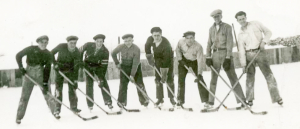
At the central camp at Wasagaming a bath house was available with 13 bath tubs. All men from the 10 camps were required to bathe at least once a week. A camp hospital took care of emergency situations. Sanitary arrangements were made for the men to send out their washing at least twice a month. A recreational room was provided at the Wigwam Cafe where there was a great need for cards and checkerboards. Football and hockey provided an outdoor sports opportunity with inter-camp games being played.
On May 14, 1934, it was noted in the Brandon Daily Sun that the winter program exceeded all expectations.
New roads, new buildings, enlargements of tourist accommodations and facilities were all improved upon. Work included construction of a 700-foot pier and expansion of the tourist camp with new streets and lanes cut in the bush. Danceland was torn down and replaced with a filling station. The new Danceland was now located on the west side of the road.
More than 1,200 men worked that winter. Henry was not one of the 525 men who were to be employed during the summer as he left in May and returned to Brandon. He rode the rails to other parts of the country to seek employment.
It was an honour to meet and talk with Henry who shed some interesting personal experiences of working at a relief camp.
Henry Hlady passed away in 2010.
Join Dauphin Citizens on Patrol

The Dauphin Citizens on Patrol is out and actively being the extra eyes and ears for our community.
If you are at least 18 years of age and want a feeling of personal satisfaction knowing you are proactively improving safety in your community, consider volunteering today.
Contact Frank Giesbrecht at the RCMP detachment at 622-5020, Rodney Juba at 204-638-4946 or Richard Ives at the Dauphin CO-OP 204-638-6003 or check them out at the Business Expo April 22-23.
Winnipegosis residents become community’s newest Canadians
Winnipegosis
By Alice Sahulka
The Winnipegosis and District Health Centre (WDHC) board of directors would like to congratulate Dr. Alison Carleton and Cyndie Blythe on becoming Canadian citizens on Feb 21.
The couple participated in their citizenship ceremony via Zoom, reciting their oath, cutting up their permanent residence card and singing the national anthem with their invited guests.
The next day, board members, staff and residents of WDHC gathered to celebrate the happy achievement with the couple.
Dr. Carleton and Cyndie moved to Winnipegosis in December 2017 and are proud to tell everyone they meet that they have always felt welcomed in the community and they are “living the dream.”
Cyndie and Dr. Carleton have built their dream home on an acreage outside of the community and enjoy all aspects of rural life, thoroughly embracing the moto live, work, play.
They have a home on the river bank, they have work at the Winnipegosis and District Health Centre and they can play right in their back yard, canoeing in the river and farming on their property.
The Royal Purple is supporting a national awareness and prevention campaign in March to raise awareness of the seriousness of brain injury.
The Winnipegosis Royal Purple will be holding information sessions in the Winnipegosis New Horizon’s Senior Centre, the Winnipegosis Elementary School and the Winnipegosis Collegiate to help bring awareness to this important topic.
The Winnipegosis Elementary school children have just completed a Brain Injury Awareness Poster Contest and winners will be announced shortly.
“Lost for five days” draws many to the radio
By Ed Stozek
For the Herald
Radio was an integral part in the lives of rural and urban residents.
When my parents got electricity on their farm in 1954, a brown tube radio was purchased for $20 and it replaced the old existing battery-operated radio. As a result, more time was spent by our family listening to CKDM.
“CKDM-1230” officially opened its radio station, Jan. 5, 1951. The station’s slogan, “A community radio station service for 96,000 Manitobans,” was very appropriate.
In 1955, the radio dial tuned to 1050 kHz. Daytime power increased from 250 to 1000 watts. In June 1957, CKDM made its final move to “730 on your radio dial.” In 1958, CKDM, “the heart of Manitoba,” broadcast a wide variety of programs 24 hours a day. News updates occurred 48 times per day.
My older sister recalled rushing home from school to listen to CKDM for news updates on the fate of a missing person near Dauphin. That story captured the attention of many radio listeners.
On the afternoon of Nov. 1, 1957, the missing person’s daughter realized that her mother was missing. The farm buildings were searched and neighbours were contacted. The RCMP arrived at 3 p.m.
The 75-year old missing person was of slight build and weighed 95 pounds. She was last seen wearing a short gray man’s jacket over a blue dress, brown cotton stockings, low felt type boots and a gray bandana.
“A call for volunteers was sent by radio appeal and 300-400 of them searched the immediate vicinity by flashlight until 11:30 p.m.” (Nov. 7, 1957, Dauphin Herald)
Eventually one thousand volunteers, RCMP, three dozen members of the 70th Field Battery, the Civil Defense and four aircraft from the Dauphin Flying Club joined in the search for the missing person.
The organization of the many volunteers took shape on Saturday when a concentrated methodical travel of more likely and accessible routes was made under a civil defense plan organized by Clifford “Bounce” Weir, who took over command of the air observation. Vic Gosman of the Manitoba Good Roads branch provided ground and air maps of the district.
On Saturday and Sunday afternoon small groups were making “probe” searches of specific areas under the direction of the RCMP. Major William McGowan of the 70th Field Battery relieved Mr. Weir on Sunday afternoon as tactical director of up to 300 volunteer and reserve army men.
Police dog Tiny was brought in from Saskatoon. as the Dauphin detachment was temporarily without a dog. The police dog from the Ste. Rose was unavailable as the handler was on holidays.
On Monday and Tuesday, along with Tiny, approximately 75 men divided into groups and went over some of the previously searched areas. After searching further afield, footprints were discovered at Harold Lake about 1-1/2 miles south from the farm.
The all-out search was suspended at noon Tuesday when the last of possibilities, Harold Lake, had been tracked completely around its perimeter. Approximately 70 miles of road and more than 15 square miles of land were searched on foot and a much wider area by plane.
On the fifth day, one of the neighbours, who lived three miles from the missing person’s farm, came home and found the elderly woman in a weakened condition.
After taking her into the house, she called for an ambulance. Suffering from fatigue and hunger, the elderly woman’s condition at the Dauphin General Hospital was reported as fair that evening.
At that time there was nothing definite to go on as there was no indication where she spent five days and nights in temperatures that dropped tas much as 12F below freezing. It was understood that she was without shelter and food the entire period.
Many organizations and private individuals were thanked for donations and preparations of food and coffee. Local businesses also contributed flashlights, batteries, cigarettes and chocolate bars.
Several years later, when I was old enough to appreciate the old brown tube radio, I spent many hours listening to CKDM.
The news reports of the escape of fugitive Percy Moogey from the Stony Mountain Penitentiary in 1960 was something that I followed.
That’s another story.
Early exposure made it fun to read
By Ed Stozek
For the Herald
Once a new semester started at the DRCSS, it was time for the students to receive their textbooks and other books related to their courses.
Some of the novels associated with the English courses that I taught included Great Expectations, The Night We Stole the Mounties Car, Animal Farm, and To Kill a Mockingbird.
Those novel titles recently made me think of the times in my formative years when I received my first Dick and Jane reader and learned to appreciate and love the written word.
Our teacher at the St. John one-room country school always read to the Grades 1 to 8 class for 15 minutes right after our lunch hour break. It was a great way to settle us down after we had participated in some vigorous outdoor activities. One year we followed Anne Shirley's adventures in Lucy Maud Montgomery’s Anne of Green Gables novel. Set in Prince Edward Island we were transported into the special world of Anne, an 11-year old orphan adopted by an elderly Matthew and his stern sister Marilla Cuthbert. They wanted a boy not a feisty red-headed girl.
Mrs. Kowalchuk spurred my interest in reading and encouraged us to read the books in our small school library. Lost in the Barrens by Canadian author Farley Mowat and other adventure filled books spurred one's imagination. We didn’t have many text books, however, in Grade 5, Canada Land of the Beaver and in Grade 6, Canada Then and Now gave us some basics of Canadian history. During my high school years, the textbooks relating to British history in Grade 9, the southern continents in Grade 10 and American history in Grade 11 all proved to be full of information for a budding historian.
My father kept well-documented records regarding his income and expenses relating to the farm operation. It is always an informative adventure to peruse those records. Recently in my conversation with my older sister, she remarked that our parents had to pay for textbooks and workbooks while she attended the St. John School and later at the high school at Oakburn.
For example, in 1954, when my sisters were in Grade 5 and Grade 8, an expense for $5 and $10.75 was entered for the cost of textbooks and workbooks. In an era of tough economic times some parents could not afford to pay for the textbooks and workbooks. One year my sister had to share her textbooks and workbooks with a schoolmate.
My friend Gerald mentioned that while attending Oukraina, a one-room country school in the RM of Dauphin, one could sell, buy or trade for used textbooks that were needed for the school year at Weselowski’s Store at Sifton.
Whenever my parents and I travelled to Brandon, one of my favourite stops included the Trade Fair and Exchange Store. Working with a very limited budget, used books were very inexpensive and one could spend a great deal of time searching for Louis L’Amour and Zane Grey westerns, as well as Ian Fleming’s James Bond series to add to my collection. Used comics also enhanced the reading repertoire.
Janice and I made it a habit to read a story to our children every night before bedtime. Today, our adult children do the same with their children. Whenever we have a chance, we read or tell a story to our grandchildren. Published in 1837, The Three Bears is still an all-time favourite.
One day last summer we watched an interview on television where author Jo Jakeman promoted her book, What His Wife Knew. It seemed like an interesting “whodonit” book so during the pandemic, we decided to take turns reading the book aloud to each other. We set aside some time each day to read a chapter and shared the experience of reading a book together. This year we have read The Girl They Left Behind and Tuesdays With Morrie.
From Dick and Jane to classics such as To Kill A Mockingbird, books provide many benefits for an individual.
Literature encourages one to use their imagination and appreciate the power of the written word.
Take note that February is I Love to Read Month.
Five and Dime store an anchor for downtown spaces
By Ed Stozek
For the Herald
A staple in downtown shopping districts across the United States for over 100 years, Woolworth’s catered to shoppers of all ages by offering affordably-priced merchandise. It was the first brand to go global, eventually building more than 5,000 nearly identical stores. Woolworth’s locations in the United States formally closed in 1997, however, stores still continue to operate in several countries including Woolworth Mexicana.
After several failed attempts, Frank Winfield Woolworth opened his first successful store in 1879 in Lancaster, Penn., with all merchandise at either five or ten cents, a pricing policy that stood for over 50 years. By 1932 the Woolworth company raised the limit to 20 cents and three years later abandoned the pricing policy.
During the 1920s the Woolworth Canada unit was founded and based in North York, Ont. By Aug. 16, 1935, the 141st Canadian store opened its doors at 116 Main Street North in Dauphin.
“The most complete addition to the Woolworth chain occupies the new Stelck building. Residents of Dauphin will see a new store built along modern lines with a frontage of 29’ and a depth of 90’. For the past two weeks a large staff completed preparations for the grand opening.” (Aug.15, 1935, Dauphin Herald)
The building erected by Stelck’s Limited had been constructed in two and a half months and provided the final link in a “solid block of business houses.” Stelck attained his goal of a completely solid block of businesses on the east side of Main Street between 1st Ave. and 2nd Ave.
All work with the exception of fixtures was done locally under the supervision of J. McLarthy, a superintendent for the F.W. Woolworth Co. The store featured two main entrances and three large show windows. The inside layout consisted of two centre squares and solid side counters.
The newly-appointed manager, A. Rusconi, had last been employed as an assistant manager at Saskatoon. Apart from the manager and assistant manager, all employees were local residents.
A full-page advertisement in the Dauphin Herald indicated that the store would open on Friday morning at 9 a.m. with exceptional values for a wide variety of products all priced at 20 cents or lower. A special upcoming school opening sale on a full line of student supplies for Aug. 24 was also advertised.
In early November 1960, construction began on a much larger new Woolworth store location at the corner of Main Street and 4th Avenue SW next to the Dauphin Theatre. With a frontage of 94 feet and a depth of 132 feet the one-storey building consisted of a sales floor area of 9,000-square feet and 3,200-square feet devoted to stock and service rooms. The store was set up with two service entrances providing admittance to the self-service unit for shopping convenience and fixtures with the latest merchandising counters.
The official grand opening occurred on Ap. 27, 1961, with the first 100 customers receiving a free half pound of coffee. Twenty-eight stools provided seating for the shoppers who wanted to sit and relax and whet their appetite. The lunch counter was a popular spot. One patron recalled that one winter day she bundled up her two children, pulled them on a sleigh to Woolworth’s, did her shopping and then ordered a coffee for herself and fries for the kids.
When the Dauphin Market Place Mall opened on Aug. 22, 1979, Woolworth’s general manager, Nick DiRienzo noted “a Woolworth store was put into the mall because the company which runs both Woolworth’s and Woolco stores is established in Dauphin. Opening day for the shopping mall was a very good day and for the downtown outlet as well. The downtown location will stay open.” (Aug. 22, 1979, Dauphin Herald)
On Wednesday, Dec. 1, 1982, a fire broke out at the Woolworth downtown location at 8:50 a.m. It was believed that the fire started in a deep fryer in the store’s kitchen, spread into the ventilation system and into the roof and was soon out of control. The store was in the midst of a clearing out sale.
The era of shopping at a Woolworth’s downtown location in Dauphin came to an end.
Pioneers did what it took to pursue their faith
By Ed Stozek
For the Herald
My mother cherished the prayer book passed down to her by her mother, Malania Hutsal. The prayer book provided solace for my mother’s faith during her lifetime.
Our son Troy attended the Smith-Jackson Ukrainian bilingual program in Dauphin and he often read her passages from the prayer book. To show her appreciation for reading in Ukrainian, she gave Troy her prayer book. Years later, when Troy was attending university in Winnipeg, we phoned to tell him that his grandmother had a stroke and was in the hospital. Troy noted that he hadn't read from the prayer book for several years, however, earlier that day something compelled him to take out the book and read several passages.
When the Eastern European settlers arrived in the Parkland during the late 1800s they first established themselves on their homesteads and then their efforts turned to building places of worship. Initially services were held in individuals' homes, especially when a priest passed through the area.
At Dolyny, located eight miles northeast of Oakburn, parishioners including my grandparents, Samuel and Malania Hutsal, donated lumber and funds to help build a new church.
“The first Ukrainian settlers arrived in 1899 from Halychyna, a province in Austria. They named the district Dolyny, which in the Ukrainian language means low spots or flats. Twenty-three members helped to organize the St. John the Baptist Ukrainian Parish.” (Our Story to 1984)
At the first parish meeting, one acre of land was donated by Mychaleo Bachewich. The members voted for a $30 levy to provide a building fund. Members who did not have $30 took out promissory notes at the Shoal Lake Lumber Yard so that supplies were immediately available. Designed by Reverend Phillip Ruh and led by local carpenters Ivan and Peter Koltusky, parishioners helped to construct the church between 1904-07. The church’s five domes were based on designs from Western Ukraine. It was one of the first churches in the province to incorporate a large structural centre dome that opened on to the interior, creating a light-filled space symbolic of heaven above.
In the early days church services were infrequent. “When a priest did visit a parish, it was not unusual to see as many as seventeen couples standing in a row in front of the altar waiting to be married. Similarly, there were ten families baptizing their babies one Sunday.” (From The Past to The Present)
One can visualize a Sunday morning when Sam and Malania and their children used the horse and buggy for the long journey from Horod to Dolyny. Their journey became much shorter when the Holy Eucharist Church at Horod was completed in 1922.
In 1900, 12 families came together to Canada on the same ship and settled in the neighbouring Seech district. They missed going to church on Sundays and for Ukrainian holiday services.
“On Good Friday Fred Barabush pruned the lower branches between two pine trees, hung a church bell that he had brought from the Ukraine and started to ring it. The toll of the church bell could be heard for several miles. His neighbours heard the bell and came to investigate. Barabush asked the neighbours to congregate at his place that Sunday. Barabush knew the whole Easter service by memory and led the service that day.” (From the Past to the Present)
The first death necessitated a cemetery and the need for a church building. A meeting was held at Barabush’s home. He agreed to sell several acres from his farm for 50 cents to establish the church and cemetery. With 13 members on the committee, money was donated and the first logs were cut. Wasyl Kuch, the chief architect, modelled the church from the one in his native village of Elawchi. Built in 1911 at a cost of $1,500, the main carpenters, Wasyl Kuch and Theodore Nowasad, were aided by many local volunteers.
Prayer books were treasured possessions in the lives of the Ukrainian settlers. Translated into English the title related to “the road to life.”
Even though the book is tattered and missing several pages, its passages are a testament to the faith that Troy’s great grandmother and grandmother exhibited.
Mail orders were once an important part of life
By Ed Stozek
For the Herald
For over a century Eaton’s department store’s main rival was Simpson’s. Through the pages of the first Simpson’s catalogue in 1893, the last Simpson-Sears catalogue in 1978 and the final edition of the Sears catalogue in 2016, the company offered its products to Canadians all across the country.
Long before the Internet it was common to place an order via the telephone or mail order. Looking at my parent’s expense records from their farm operation there were many entries regarding mail orders from Eaton’s and Simpson-Sears. For example, an entry in 1959 noted “$16.40, pay for Simpson’s order.”
As a young boy it was always exciting to receive the catalogues associated with the two rival companies. Catalogues that arrived in the mail included the Spring and Summer, Fall and Winter as well as the Christmas Book edition. There were many items in those catalogues that a young boy dreamed of ordering.
In 1855 an enthusiastic 21-year-old Scottish immigrant, Robert Simpson, settled in Newmarket, Ont. He eventually opened his own shop in Toronto directly across from his primary competitor, Eaton Co. Ltd.
By 1890 Simpson’s evolved from a dry goods retailer into a modern department store and the afore mentioned catalogue offered their wares across Canada. Simpson unexpectedly passed away in 1897. Without a Simpson heir, a group of Canadian businessmen purchased Simpson’s inventory and holdings for $135,000. Under new management Simpson’s opened a mail order building on Toronto’s Front Street and expanded nationally to Halifax and Regina in 1924.
By 1943, 1,000 employees worked in the Simpson’s mail order division. There were 149 mail order offices across Canada, 298 delivery trucks and 66 horses.
During WWII many goods were delivered by horse and carriage as gasoline was rationed. Simpson’s switchboards handled two million telephone orders per year in a nation of 12 million people.
The Robert Simpson Western Limited order office store opened in Dauphin on Sept. 1, 1949, at 214 Main Street. An advertisement in the Dauphin Herald extoled the many advantages of shopping at Simpson’s.
Shoppers had the option to purchase catalogue merchandise by phoning 184 and placing an order or coming down to shop personally where experienced salesclerks could assist in selecting the products and making the order. “You save money. Buy at low mail order prices. There are no money order or C.O.D. (cash on delivery) fees to pay, no postage, no inconvenience writing letters or buying money orders.” (August 30, 1949, Dauphin Herald)
Customers also had the choice to pay cash or use a Simpson’s charge account or monthly payment plan with an option to personally pick up their package at the office or have it delivered. Customers were also invited to pick up a copy of the Fall and Winter catalogue. Samples of merchandise were also displayed at the store. “You are protected by Simpson’s guarantee. Satisfaction or money refunded.”
In 1951 Simpson’s joined with American retailer, Sears. Canadians received their first Simpson-Sears catalogue in February 1953. The spring and summer edition had 556 pages featuring a wide variety of products including All-State car insurance, live baby chicks, saddles and even radiation detectors.
A grand opening of the Simpson-Sears furniture and appliance store was scheduled for 9 a.m. on Saturday, July 11, 1953, at the 214 Main Street location. The official opening ceremony was scheduled at 10 a.m. Shoppers had been encouraged to preview the merchandise on Friday from 7-10 p.m.
“Two great companies, Simpson’s and Sears have joined forces to bring you better merchandise and better sales. You’ll enjoy shopping at the Simpson Sears order office furniture and appliance store. You have complete buying service.” (July 9, 1953, Dauphin Herald)
By 1954, nine new Simpson-Sears stores had opened. A large catalogue centre was built in Burnaby and the catalogue centres in Halifax and Regina were enlarged.
Occasionally we took the nine-mile trip from our farm to Oakburn in the ‘51 Chevy. After buying needed supplies at one of the town’s stores we headed to the post office. Along with the usual mail we also eagerly anticipated a parcel from Simpson-Sears.
What did my parents order for $16.40 from the catalogue in April 1959?
Holiday fun and games

The weather outside was frightful, but the good food and laughs were delightful at Regional Connections’ annual holiday potluck party, Dec. 17, at Parkland Crossing.
To learn about the free get-togethers and information events planned for the New Year, contact Regional Connections Immigrant Services at 204-647-0693.
High school varsity basketball teams get off to strong starts

The DRCSS varsity boys basketball team got its season off to a solid start claiming the B-side championship at the Sanford Early Cat 16 Team Tournament.
Following an 81-69 first-round loss to a strong St. Maurice club, the Clippers rebounded and did not look back. The DRCSS team took charge in their final three games, defeating Grandview/Gilbert Plains 83-65, downing Stonewall 85-38 and beating the home team Sanford 49-38 in the B-side final.
Varsity girls
The DRCSS varsity girls basketball team brought home third place at its first tournament of the season, the Crocus Plains tournament.
The local team won its first game against Vincent Massey 61-32. With a short bench, they fell to Neelin 38-53 in the semifinal. The team then played Warren for third place and won 52-31. Tazz Genik was named a tournament all-star.