Not many of us take the opportunity to look up at the stars and the wonders in the sky. One former Valley resident, Grant Gussie, found a passion for astronomy at an early age and wound up getting an extensive education in the field.
“I was born in Beausejour, but my mother was a Cox and was born and raised in Swan River,” said Grant. “My parents are Cliff and Kay Gussie, and my father passed away a couple of years back. Our family moved to Swan River when I was quite young. I spent most of my childhood growing up on River Road.
“I fell in love with astronomy while my dad was still getting his university degree, so I was in Grades 1 and 2, and we were living in Gladstone at that time. During that time, I had a cool Grade 2 teacher, Mrs. Chandler, and she took us all into Winnipeg to see the Man of Nature Museum and the Planetarium. I still remember the Planetarium and I thought it was amazing.
“At that time, we lived out on a little farm, just outside of Gladstone,” said Grant. “I would go out and watch the stars. I remember seeing the Pleiades for the first time and trying to make some sense out of the star patterns. I would try to find the Big Dipper and Little Dipper. I just fell in love with that.
“When I was nine years old, I got my first telescope for Christmas. I quickly outgrew that one and got a serious telescope in grade 7. I saved up $150 and my parents put in the other $150, and I got this six-inch telescope, which for me was quite spectacular. That and a few books made me spend a lot of time in our yard, on River Road in Swan River, looking through my telescope.”
Grant was dedicated and passionate about looking up at the stars. During his younger years, he was fortunate to see many objects in the sky, some unique and some quite impressive.
“There is a list of objects in the sky, which is called the Messier List,” said Grant. “It came about with Charles Messier, who made a list of things to avoid looking at when looking for comets. If you find them all, you get this Messier Certificate. I wound up getting the Messier Certificate from the Royal Astronomical Society of Canada.
“The other thing that stands out for me was the first time I saw the Orion Nebula, the Andromeda Galaxy, and the Ring Nebula. The Ring Nebula is something called a planetary nebula, which is a gas cloud surrounding a dying star.
“I also discovered my own cluster of stars called the Coat Hanger,” said Grant. “I was 14 years old when I discovered it. But when I went to university, I found out I wasn’t the first person to discover the Coat Hanger, nor was I the first person to call it that, but I still discovered it.”
Grant took his love of looking through a telescope and fostered his education in science. He focused his post-secondary studies in the fields of mathematics, science and physics.
“I graduated from the Swan Valley Secondary School in 1981,” said Grant. “I won the Science Award for the highest mark in Science at my high school graduation. After I graduated, I went to the University of Manitoba for four years. I graduated at the top of my class and received the gold medal for the major course in Science and my degree was in Mathematics and Astronomy.
“Then in 1985, I attended the University of Victoria and got a Master’s Degree in Physics. That was quite difficult because I didn’t have a Bachelor’s Degree in Physics, so I had to do a lot of work to get a Masters in it. Then I went to the University of Calgary and got a PhD in Astrophysics. The topics of both my Master’s Thesis and Doctoral Dissertation involved the process of stars similar to the size of the Sun that are dying.
“For my Master’s Degree I did research from the Dominion Astrophysical Observatory just north of Victoria, BC,” said Grant. “My PhD was more involved with Radio Astronomy, and I did a lot of radio work. That was quite a bit more interesting as I got to travel more. I spent some time in the Netherlands working with the telescopes there. I went to New Mexico several times.
“I also really did like being in New Mexico,” said Grant. “When I was there, I was at the Very Large Array and it’s a series of radio telescopes. There are 27 of them and they are spread out along three railway tracks, each 21 kilometres long. One day I walked out along the tracks and plunked myself out in the middle of nowhere and looked up at the sky. It was amazing. There is a galaxy you can occasionally see with the naked eye in very dark skies. It’s called Messier 33. I saw it in New Mexico one night, when it was really dark.”
“I also went to Hawaii and the Mauna Kea Observatory and did some research there. In fact, I did radio stuff all over the world and then went back to the Dominion Astrophysical Observatory to do some more work with optical as well. I enjoyed that time immensely.”
Grant was able to find some research jobs in his field that took him all over the world. During some of these jobs, he saw some of the most incredible views in the skies.
“After my Ph.D., I got a job in post-doctoral research with the University of Tasmania from 1992 to 1995,” said Grant. “I continued working with radio on similar topics, with a little bit more involving star formation this time, rather than star death. I met my wife, who was a nurse at the large public hospital there.
“I also spent time in New South Wales, where the Australian Telescope Compact Array is. It’s a network of radio telescopes near Narrabri, in north-central New South Wales. And also at a large radio telescope near Parkes, NSW. It’s all grain land out there and it looks a lot like the Canadian Prairies, except it’s really hot. If you go out and lie out under the stars, the sky is spectacular.
“While in Tasmania, I applied for a job with the Commonwealth Scientific and Industrial Research Organization (CSIRO) after I had spent a year and a half in Antarctica. In the end, I didn’t wind up getting that job because my visa was tied to my job in Tasmania and I had to reapply for another one. The criteria for the job with the CSIRO required me to not be a foreigner in Tasmania. The only way they would consider me as an applicant was if no one else was qualified in that topic, so I had to withdraw my application. That was kind of disappointing.
“I returned to Swan River for a few months and then got a job in Calgary,” said Grant. “That was the end of my astronomical career. I only got offers for one or two-year contracts with small colleges, and then would have to look for another job. Those positions weren’t going to get me where I wanted to go.
Grant built himself a huge telescope as a hobby and a reminder of his passion for astronomy.
“I still have a telescope. When I lived in Calgary, I actually built a really nice telescope,” said Grant. “I made two of them so far, and one of them I donated to the Royal Astronomical Society of Canada. It was the prototype for the one I kept, which is the bigger of the two I built. The scale is about 8 ft tall. I brought it here with me.”
Now Grant works in a different field altogether, but he still enjoys looking up at the stars.
“I wound up working in the oil patch in Alberta,” said Grant. “When people search for oil, they send sound waves into the ground and have these geophones that listen for the echoes underneath the ground. From that, they construct an image. The mathematics of it is similar to how radio telescopes construct an image of the sky; it’s the same sort of thing. So I did some geophysics with that, but over the years I’ve done more computer programming.
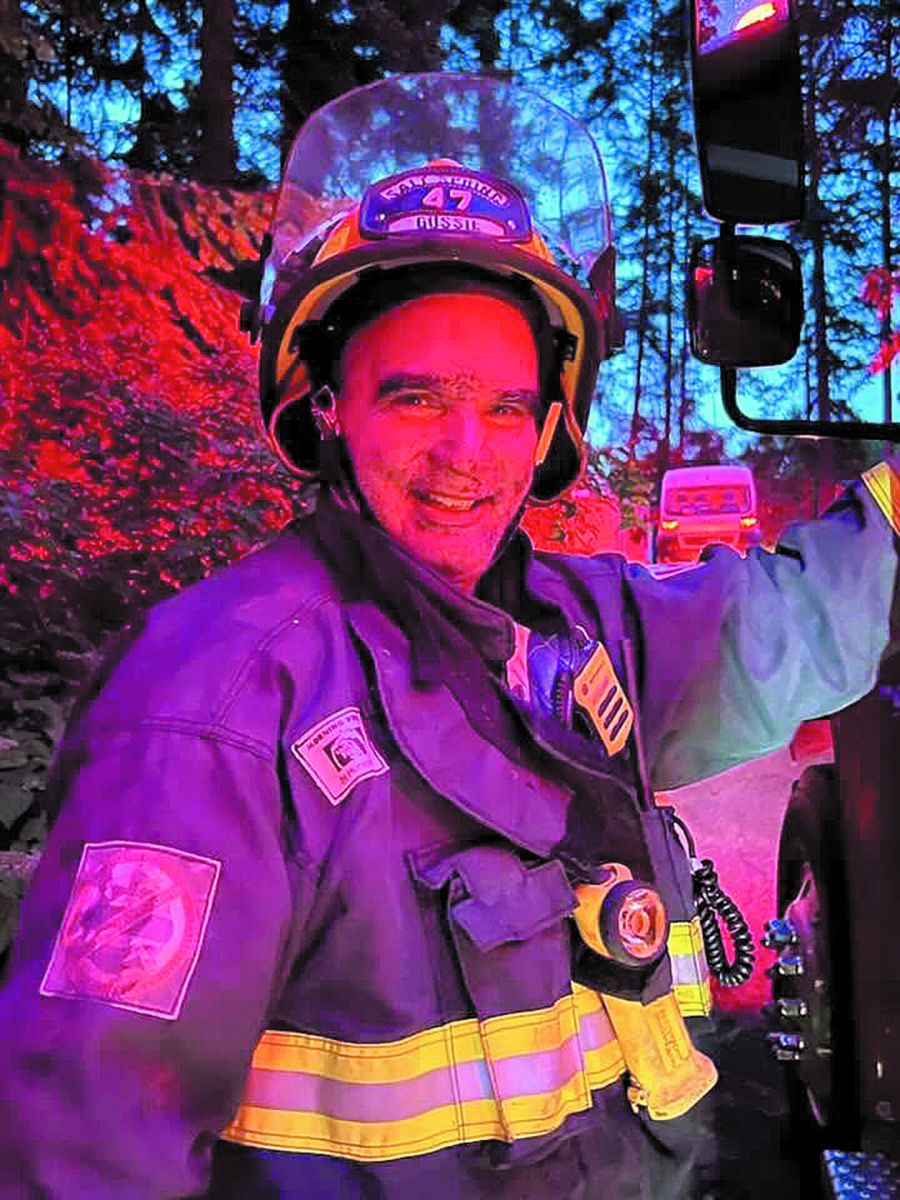
“In 2004, we moved to Salt Spring Island in B.C., where we still live today. I got involved with the local fire department in 2006 and became a fully qualified firefighter, which is something I still do. So I’m now a computer programmer and a firefighter.”
Setting his sights to the stars
Published in Swan Valley Star and Times Community
Published in
Swan Valley Star and Times Community
Tagged under