
Former Valley resident and world-travelled photographer Sujee Quon made a pilgrimage back to China. Her goal was to record her family history and connect to where she was born, and connect the stories her parents once told her to the actual places where they happened.
“I was in China this year for a month from January into February,” said Quon. “I have been back to China several times, but this was my first time back by myself without the guidance of mom and dad. My dad, Chuck, died only two years ago and my mom is starting to lose her memories. I have always wanted to record my past and my history. I knew it was time to record whatever I could now.
“I’ve travelled to several areas of China: Beijing, Yunnan, Shanghai, Suzhou, Hangzhou over the years. This time, I focused on the province of Guangdong, where I was born. I spent time in the country and in the cities.
“All these facts were a confluence that led me to go to China this year,” said Quon. “First, to start discovering my heritage, my village where I was born. I wanted to meet my cousins and connect with them.
“In 1949, during the communist takeover, uniting the country was imperative and the People’s Republic of China declared Mandarin as the official language of China in 1955. I do not speak Mandarin. I can speak Chinese, but only the Village Dialect or Toisanese. It is substantially different from Mandarin, especially the tones. It is not common to hear this dialect now. I have always wanted to learn to speak Mandarin. So, the trip became a trip of discovery and at the same time, I booked myself into a school and attended daily one-on-one Mandarin classes.”
It has been Quon’s dream to tell the story of her parents’ origin and how they came to Canada. She also wanted to see how much China had changed over the years, since her family had left the country.
“I have always wanted to tell the story of my mom and dad,” said Quon. “Their immigration story is not unlike thousands of other Chinese or other immigrants who survive the difficulties of adapting to a foreign land, a foreign language and different social standards. I have been recording their stories for a long time and as I mature into an elder, I see how their successes reinforce my view that Chuck and Jean were both resilient and creative people.
“My first trip was in 1979 with mom and dad, my husband, sister and 9-month-old daughter. Back then, we were given a three-day visa. It took almost a year to stretch that to five days. There was no tourism, no restaurants, no shops, only a sea of bicycles. Wherever we went, groups of Chinese people would surround us, follow us, stare at us. It was simple curiosity. We looked foreign and so different, but our faces were Chinese.
“Over several trips, I have observed the unprecedented rapid evolution of China,” said Quon.
“My second trip in 1993, China was just opening as a market economy. People were finally allowed to hold more than one job. The proliferation of small businesses on the sidewalks and every tiny booth was overwhelming. There was a distinct hum in the air. Even taxi drivers asked about jobs and business opportunities.
“By the time we returned in 2005, sightseeing tours were plentiful,” said Quon. “Hotels and wonderful food were readily available. People were dressing in fashionable clothes. Everyone on the streets walked with purpose. Shanghai was already large and bold. Cars were replacing the sea of bicycles.
“By 2015, I could see the change everywhere. The look of a better life with better living standards was evident. The cosmopolitan life was prevalent.
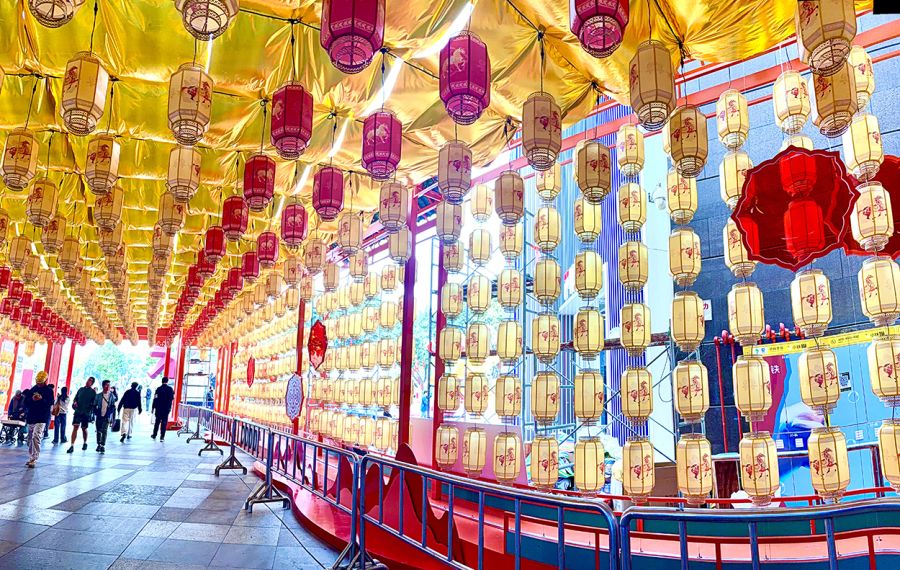
“My 2024 trip was like landing on another planet,” said Quon. “Roads, trains, flowers, parks, food, everything was easily available and plentiful. The cities were densely populated. We travelled through miles of towers of apartments. There was a sea of cars on eight-lane freeways. Architecture was glamorous, imaginative and bold.
“I did not expect this much change. Infrastructure, vast, clean roads and parks, flower-lined freeways. Pay by phone was the only way, from the fruit carts on the street to the luxury designer stores. There was so much to see. Technology was evident everywhere and provided a lifestyle for every level of the population.”
Quon was amazed at what she saw in China and how much it had changed over the years. Despite its high population, she marvelled at the country’s cleanliness, efficiency and safety.
“What impressed me most was the density of people both in the country and the city,” said Quon. “The towers and towers of apartments continued for miles. Yet things were amazingly organized, extremely clean. There was a sense of calm and efficiency. Despite the massive population, I never felt intimidated, scared or crowded.
“Subways, trains, airports, anything public was hyper clean and ran with precision. When the signs say the train is arriving at 10:15, that is the exact time it arrived. Sidewalks and roads were wide and well-maintained. I was very impressed that all signs everywhere, even in public washrooms, were in Chinese and in English.
“The safety and security in China were remarkable,” said Quon. “Even in Hong Kong, when I was visiting my Canadian cousins who also have homes in North America. They told me they felt safer in China than in Canada. It is very safe. I never felt threatened even when walking in crowds or at night.”
Quon came back to Swan River to share her stories, experience and photographs from China with others at a presentation called China 2026 Through My Lens, which she did at the Swan River Library on June 25.
“My stories from this trip come from people that I spent time with,” said Quon. “There were my country cousins, the city cousins, the teachers at the school, the wonderful service people in all the hotels where I stayed, from the shopkeepers, restaurant servers, and hair salon staff. I talked to everyone. Everywhere I went, I was treated with respect and kindness. In fact, I am overwhelmed at the kindness and help that was extended to me wherever I went.
“In the evenings, when I took my walks, people sauntered and chatted, and children played yet stayed close to their parents. I never felt unsure or unsafe. I have returned with an impression of happy and content people. My photo presentation will illustrate this.
“I’m not a political body or even a social activist,” said Quon. “I’m simply an artist, a photographer and a storyteller. What I will present will be what I saw, what I experienced and what I was told. Through my stories and images, I want people to make up their minds about the country.”
Quon has a big project in mind for her photographs and trips to China. It is something that she wants to do to pay tribute to her father. This will all tie into a new book and exhibit for her in the future.
“I have a project that is close to my heart,” said Quon. “It is also something I want to do to honour my father and his father. I want to return to my village to restore our home. This work is being documented through this first trip and the following trips as the project takes shape. The culmination of this will be a new book and an exhibit in Quebec.
“In August, I return to Quebec and then on to North Carolina, where I will be attending Beyond: The BBSI Experience, a 10th anniversary gala of a great nonprofit organization that I am proud to support called Ballet Boys Summer Intensive Program.
“In September, I return to China with a small team to begin the process of the village restoration,” said Quon.
Seeing China through a new lens
Published in Swan Valley Star and Times Community
Published in
Swan Valley Star and Times Community
Tagged under
