

Jennifer Laviolette
MBCI students demonstrate skills at the Skills Manitoba Competition

Every year, students across Manitoba have the opportunity to demonstrate employability-related skills in a competition, with the winners in each category advancing to compete on a national level. This year, a group of Margaret Barbour Collegiate Institute (MBCI) students participated in the Skills Manitoba Competition.
“This year, the Skills Manitoba Competition was held in Winnipeg on April 9, 2026,” said MBCI Instructor Lisa Gibb.
How to protect your home from wildfire

With winter behind us, it’s time to start thinking about warmer temperatures and what that all brings. Wildfires have become a constant concern for the north and the tri-community has been diligent about doing what it can to prevent another summer like the last one. Wildfires can start due to several factors, both weather-related and human-related.
“In the Gateway to the North, our landscape is a beautiful but volatile mix of boreal forest and muskeg, and understanding what sparks a wildfire in our backyard is the first step toward community safety,” said The Pas Fire Department Fire Chief Byron Shangraw. “Generally, we see two primary drivers: natural lightning strikes and human-caused ignitions.
A cosmetics company gets its start in the Valley

A new cosmetics and beauty company has started here in the Valley and its reach is growing to international levels. Newcomer Jossy Nelson and her family came to Canada and fell in love with Swan River during a visit. This led to them finding employment, a warm welcome, and a new place to call home. As a result, Nelson chose to open up her cosmetics company, Adaluxe Cosmetics, here in the community.
“My family and I came to Canada as Irish Citizens of African descent (Nigeria) to explore Canada and gain some international experience through working in our career paths and settling into the community,” said Nelson. “On arriving in Canada, my husband had a friend who invited him to come visit them in Swan River for a few days before returning to Ireland. Upon getting to Swan River, a job opportunity opened up for my husband and he took it. Within a couple of months, my husband returned to Ireland to bring us with him to Swan River and here we are.
“As new comers to Swan River, the lovely people in the community welcomed us with an open arm of love and care and embraced us, I got my first job at the CBF School in Swan River and later moved to work at the North West Immigration Services in Swan River, where I worked as a Settlement Worker in Schools, working with immigrant children by helping them settle into the new community.”
Nelson has an extensive background, education and experience in the cosmetics and beauty industry. Not only did she learn about the creation of beauty products, but she also gained valuable experience working in the industry before creating her own line of cosmetic products.
“Adaluxe Cosmetics started as a vision and a dream, because I studied my first degree in Biological Sciences, specializing in Botany, graduated with a degree in Manufacture of Medicinal Products at Dublin Institute of Technology in Ireland and culminated it with a Diploma in Beauty Therapy at the Tullamore School of Beauty, in Ireland,” said Nelson. “Through those years of learning and researching, my interest in skincare and beauty was sparked. I started thinking about how to contribute a solution to the human needs that exist within the global beauty industry.
“After graduating from the School of Beauty, I secured employment with some of the global beauty industries, like Elizabeth Arden and Estee Lauder, where I worked as a counter manager for some years in Ireland and gained tremendous experience. In the process of time, I engaged in research to know more about human needs that exist in the area of beauty and through my research findings, analysis and recommendations, I saw a niche that could make my products stand out in the midst of others.
“Adaluxe started because I had the entrepreneurial drive to create something,” said Nelson. “When we finally moved from Ireland to Canada, my passion for beauty increased even more, and I continued with my research, which I started a couple of years before moving to Canada. After researching the Canadian beauty industry and manufacturing companies, Adaluxe Cosmetics was born, and all our products are made in Canada.
“Adaluxe Cosmetics was launched in Swan River and since then, it has been progressively gaining ground, and we are still looking out for more opportunities to expand our distribution channel as wide as possible.
“Adaluxe Cosmetics is a premium quality brand, a one-stop shop for all skincare and makeup products,” said Nelson. “Our products are suitable for all ethnicities, all genders, all ages, all skin types and all skin tones. They are naturally derived, paraben-free, gluten-free, and animal cruelty-free.”
Nelson chose to do a brick-and-mortar storefront to open up Adaluxe Cosmetics, while still fulfilling online orders and distribution from that location.
“Adaluxe Cosmetics is currently located at 900 Main Street, beside Scales Pharmacy. Customers can come into our shop to buy products or order online from our website: www.adaluxecosmetics.com. When orders are received, we deliver locally and mail orders to distant locations across Canada and the rest of the world. Also, we do attend some trade and craft shows where we display and sell our products.
“We are currently creating awareness and letting customers and the general public know that we have distribution opportunities for businesses and individuals to sell and distribute Adaluxe Cosmetics’ premium quality products.”
Nelson is extremely grateful for the support the community has provided both upon her family’s arrival in the Valley and also for the overwhelming support with Adaluxe Cosmetics. She hopes to grow and expand her business to become a distribution one located in the Valley.
“The people in the Valley have been supportive and encouraging, and we are thankful and appreciate everyone for the support,” said Nelson. “As a small rural community, word of mouth goes far beyond. We have orders come from outside Swan River, and we are often told that their families in Swan River told them about Adaluxe skincare and beauty brand and they place orders to try the products and they keep returning for repeat orders. We are grateful. The community feels like one large family.
“We hope to source more funds, discover incentive programs, grow our production line and expand our distribution channels far and wide across Canada and beyond.”
Buck takes Swampy Cree Hand Drum to international audiences
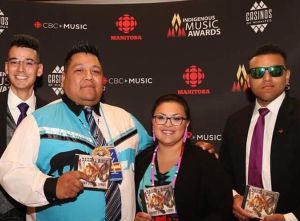
Many musically talented and culturally gifted individuals hail from the tri-community area. These talented folks share with others their gift of music and art, or share their culture with many people. Opaskwayak Cree Nation (OCN) member Darryl Buck has been singing and playing the hand drum as a young adult. He wants to share this cultural tradition with others.
“Growing up in the Mosakahikan and Opaskwayak Cree Nations (OCN), I was immersed in our culture,” said Buck. “In my early twenties, I began learning about the drum and singing within the local community of The Pas and the OCN. I had the privilege of witnessing the spiritual aspects of ceremonies and the drum. Being raised in a Cree-speaking home was a cornerstone of my identity, and I frequently saw the drum at gatherings, ceremonies, and performances.
The Storytellers’ Festival showcases Canadian films for free

If you love films, you will have the chance to take in some Canadian-made films at this year’s Storytellers’ Film Festival, being held in The Pas.
“The Storytellers’ Film Festival is being held on April 15, 2026, in The Pas Regional Library Annex beginning at 4 p.m.,” said Cheryl Antonio. “We will have refreshments, free admittance. It is being held in conjunction with Canada’s National Film Day.”
Every year, a selection of films is chosen for this event.
Turning a hobby into an international career

Many talented and creative people have come from the Swan Valley and have gone on to have remarkable careers in fields that many only dream of. Former resident Brad Caruk had an interest that he was passionate about from his days growing up in the Valley and took it to an international level.
“I was born in Swan River and moved around for a bit in Manitoba and Saskatchewan as my Dad worked in the mines,” said Caruk. “Then we came back to Swan River when I was in Grade 3. We lived on Third Street North, only a short walk to Swan Valley Regional Secondary School, which I graduated from in 1983.
“Immediately after graduating from the SVRSS, I moved to Winnipeg to attend Red River Polytechnical, Advertising Art, graduating from there in 1985. I wanted to go into film, but art was the most affordable option I had, and they had accepted my portfolio submission, providing me with an in-person interview.
“I received an acceptance letter to attend, so I was all in,” said Caruk. “It wasn’t easy. Classes were 8 a.m. to 5 p.m., with no spares and the homework was a little different from what it is today.”
What drew Caruk into creating experiences and design features stemmed from George Lucas’ cult classic movie – Star Wars. He was also very fortunate to have some very influential instructors both in Swan River and in his post-secondary studies.
“I sketched a lot through my school years, but honestly, seeing Star Wars in the local theatre in 1977 changed my life,” said Caruk. “Yes, as geeky as that sounds, it was the imagination and creativity of such visuals that I really wanted to be a part of.
“Once I entered high school, I enrolled in a course called Commercial Art, under Doug Stout. He was my mentor and honestly inspired me. I luckily had his twin brother, Andy, at Red River for graphic design; he led me to continue that pursuit. I had other very influential teachers as well, like Tony Klein for band, and music is also a big part of my career. Cliff Gussie, Mr. Yaroway, and others who were not even my teachers had an influence on me.”
Caruk’s career started on Manitoba soil and led him to work on some design concepts for museums in Winnipeg. From there, he worked on several projects on a global scale, many of them being world-renowned tourist attractions.
“In 1989, I had started my own company in Winnipeg, which several years later led to embellishments and designs for exhibits at the Manitoba Museum and another project for The Royal Aviation Museum of Western Canada,” said Caruk. “I remember the stress of those first multi-million-dollar budgets, but in parallel, the excitement and pride that followed. That was just the beginning; my ultimate goal was to get onto the world’s stage.
“I invented a technology to put on subway tunnel walls and installed the prototype in Kuala Lumpur, Malaysia, which led to travel to over a dozen other countries around the globe. We were about to go public, but then the stock market crashed. That was a tough life event.
“I went on to work on concepts for Moana and Tron for Walt Disney, Orlando, Florida; attractions for Universal Studios, Singapore and Beijing, China; and designed several attractions for Ocean Flower, Hainan, China,” said Caruk. “I’ve also developed a whole theme park in Jurong, China, another in Tokyo, Japan and a Panda VIP animal park.
“I travelled with my wife, Crystal, up the mountains of Chengdu to the Panda Research Base. Not many get that kind of opportunity and it was a very special project dear to us.
“More recently, I developed an aquarium in Khobar, The Line, The Mukaab and Six Flags Qiddiya City Park, all in Saudi Arabia,” said Caruk.
The projects that Caruk has worked on take years to complete. Like anything else, the bigger the project, the longer it takes to finish.
“A lot of blood, sweat and tears literally go into designing and developing these kinds of projects,” said Caruk. “You’re always thinking how to make it better. These days, I’m responsible for multi-billion-dollar projects. You need to get it right. It’s all about the guest experience.
“Starting with the concept, then leading disciplines in schematic design like architecture, structures, engineering, area development, audio, lighting, etc., then on into construction supervision. It’s like a symphony. I get to be that conductor. If we are not all in tune, it falls apart. You need to create something unique, entertaining, and especially memorable.
“It starts with the executive strategy, pre-concept, concept, schematic design, design development, construction drawings, then onsite there’s preliminary works, infrastructure, etc., until opening day,” said Caruk. “Some projects can be two years or so, while other larger ones take upwards of five to seven years. It’s a major commitment of time and travel.”
Caruk focuses on delivering the most enjoyable experience for guests. He strives to design an attraction or theme park that people want to come back to and experience it again. He finds inspiration in challenging himself to outdo what he has done in the past and from his spouse.
“I work with the most brilliant people on the world’s stage,” said Caruk. “I get to imagine and build things people have never seen before. Create worlds from within my head and make them a reality. I’ll hang out by an exit of an attraction and listen to the guests’ reactions. The ultimate compliment, when I hear someone say, ‘let’s go on it again’, then I know I did something right.
“I think the energy comes from the passion to outdo myself on the next project. It’s not so much what I have done, I’ve had my share, but more about what I am doing now. It’s in my DNA. I live, eat, and breathe it. My ideas come from everywhere, everything. I credit a lot of it to Crystal. She is my muse and the most creative person I know. And, she puts up with my crap, to some degree, which lets me do what I do best.”
Caruk has worked on many notable projects over the span of his career and each one has something about it that ties him to it.
“When it comes to having a favourite project that I’ve designed, that’s a tricky question, as I have favourites for different reasons,” said Caruk. “It’s like asking me my favourite movie, not a short answer. Six Flags Qiddiya was an opportunity unlike anything else. I was the only creative director on that entire project. That park is completely my world, from the stories to the characters I created, such as Professor Screamore, to even the design and painting of ride vehicles. Even the music. I was in Prague with the symphony orchestra recording original compositions for this project.
“It came with a huge sacrifice, though. We lived on Vancouver Island during the pandemic and worked remotely from 10 p.m. through the night, finishing at 9 a.m., almost seven days a week, for two years. Then we relocated to the Eastern time zone and I was in the air more than on the ground for the next three years. That’s a lot of time away from family.”
Caruk still has projects on the go and plans to continue doing what he loves for as long as he can.
“Unfortunately, I can’t say much about current or future projects, as we are under non-disclosure agreements, typical of this genre of work, but I can tell you there’s more to come,” said Caruk. “My plan is to do this as long as I can, so retirement really isn’t in my vocabulary. I am very fortunate to do this type of work. My job is my hobby, and my hobby is my job. It doesn’t get much better than that.”
Community wide effort to prepare for wildfire season

As much of northern Manitoba waits for the snow to melt and spring to arrive, the memories and aftermath of one of Manitoba’s worst forest fires in history are still on everyone’s minds. The tri-community has been very focused and dedicated to creating a wildfire plan to help protect the surrounding communities from the potential threat of wildfire, and this includes educating and training citizens.
“We’re seeing longer, drier burning seasons and more unpredictable fire behaviour across Manitoba,” said The Pas Fire Department Fire Chief Byron Shangraw.
Merging of law offices provides a stronger legal team

Two law offices in the Swan Valley will be combining practices to better serve and meet the legal needs of clients in rural and northern Manitoba. Ferriss Law and Oakes Law Office are working towards joining forces and working as one entity, starting June 1, 2026.
Rhodel Ferriss will be joining Oakes Law Office as an associate lawyer, helping ensure continuity and a smooth transition for all clients. Ferriss has been practicing law in the Valley for almost 30 years and remembers what drew her to practice law here.
“I decided that I wanted to be a lawyer early on in high school. I grew up in Ashern, which is a small town in the Interlake,” said Ferriss. “After high school, I attended the University of Manitoba and obtained an Arts degree with a major in political science and a minor in Canadian history. I worked several summers at the legislative building in Winnipeg in the Department of Justice office. This was shortly after the riots at the Headingly jail and it was a very interesting time to be in the Justice Department. I entered law school in 1995, also at the University of Manitoba, graduated in 1998 and received my Call to the Bar in 1999.
Keeping the community’s hub alive and strong

The Rall’s Island Community Park has been a hub in the community and there is a dedicated board in place that is committed to providing it a little TLC. The community park has been a great place for families, friends and youth to get together and engage in various physical and social activities.
“The Rall’s Island Community Park is a great drawing area for the community,” said Rall’s Island Community Park Board Chair Greg Hunter. “There are a lot of activities that kids can do throughout the park and it’s a nice place to meet up. On a weekend, it’s great to enjoy the equipment and facilities, from the outdoor skating rink to the ball diamond or playground. It’s just a nice spot for people to get out, meet up and get involved.
A little Irish rock is coming to the tri-community

The Pas Arts Council is bringing some Celtic rock to the tri-community area next month. The Derina Harvey Band will be performing their original songs as well as some traditional folk ones. Lead singer Derina Harvey’s powerful vocals earned her a 2025 Canadian Folk Music Award nomination for Contemporary Singer of the Year.
The Derina Harvey Band has been described as an edgier version of another Canadian band, Great Big Sea, if they had lead singer, Adele. Their music and performance brings a high-energy show that engages audiences.
The band has released three albums, the latest of which came out in 2023, called Waves of Home. In 2024, the Derina Harvey Band took home a 2024 East Coast Music Award for Fans’ Choice Entertainer of the Year.