

Jennifer Laviolette
Recycling centre moves toward full reopening
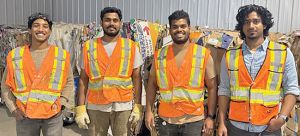
A phased reopening of the Tri Com Recycling Centre is underway, with curbside collection expected to resume by mid-August 2026. Milan Manu, the Centre’s new Recycling Manager, has been leading the effort to restore and improve recycling services for residents throughout the tri-community.
Originally from Kerala, India, Manu moved to Canada in 2023 to study Business Marketing at Algonquin College. After graduating, a friend he met at college was from Flin Flon and told him about all the opportunities in northern Manitoba. Encouraged by what he heard, Milan made the move to The Pas. “I was in The Pas for about six weeks when this opportunity came up,” said Manu. “It was a great chance to combine my experience in operations and community recycling with serving the community.”
What the Swan Valley needs right now
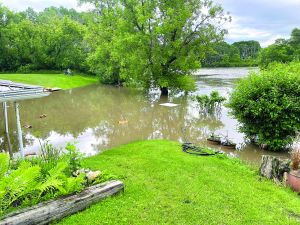
The news of the decision to postpone this year’s NorthWest Round-up and Exhibition was not an easy one and it sparked some diversity amongst the community. Some people felt that the event was just what was needed to get the community back on its feet. Others felt completely overwhelmed by the destruction and damage the flood created, along with the process of cleaning up and restoring things to normal.
The online debate sparked local resident Tanya Powell to post a message on Facebook about why right now is not the time to be divided on an issue when so many people are still hurting and struggling.
This is her post: “I’ve stayed quiet, but I feel it’s important to speak now. People throughout our valley are hurting. Families have been forced from their homes, many are dealing with devastating flood damage, and some have lost nearly everything. This flood is not over, and many of our neighbours continue to struggle each and every day. We also have neighbouring communities who are going through this flood as we speak.
Dave and I organize the Stampeder food booth for the rodeo, so we understand firsthand what it takes to make this event happen. Our booth alone requires approximately 200 volunteers—and that’s just one. The rodeo depends on hundreds more volunteers, many of whom have been directly affected by the flooding or are currently helping family, friends, and neighbours recover.
My own home has been destroyed by this flood. Like so many others, I am living through this disaster as well. When you’re without power or running water, when you’re unable to sleep in your own bed because your home has been devastated, it becomes clear that life cannot simply return to normal overnight.
I feel for the chuckwagon drivers, midway operators, vendors, and everyone facing financial losses. None of this is their fault, and I know how significant this event is for many of them. My heart goes out to them as well, but not as much as our community.
I am just one person doing the best I can, just like so many others. What we need right now is not criticism or hurtful comments, but understanding. I ask that we all show each other a little grace during one of the most difficult times our community has faced.
I love this community deeply. That’s why I’ve been doing everything I can to help, even while coping with the loss of my home. I want nothing more than to see our community back on its feet, celebrating together again—but now is not the time.
Thank you to the Ag Society for making the difficult decision to put our community and our infrastructure first. It was not an easy choice, but it was the responsible one.
We will have our time to celebrate again. For now, let’s continue to take care of one another. That is what makes our community strong.”
As someone who is not only a Valley resident impacted by the recent flooding, Powell is also a long-time dedicated volunteer who actively takes part in the NorthWest Round-up and Exhibition by setting up the Stampeders Food Booth every year.
“How could I possibly be able to do the rodeo booth three weeks from now? asked Powell.
“Dave and I have organized the Stampeders food booth for several years. It’s not something that comes together in a few days. It takes months and months of planning. You have to coordinate the ordering of food and volunteers, scheduling and equipment. The food booth alone requires 200 volunteers throughout the weekend over the course of the Round Up. It takes a massive community effort and we know firsthand how much work it takes to make it successful.
“We have some of our major volunteers who have had their homes severely flooded and, in some cases, consumed,” said Powell. “When you see your children’s handmade Christmas ornaments floating around or your children’s baby books, or whatever it may be, it’s devastating.”
Powell has experienced her own loss and devastation caused by the destruction of the flooding of her home. She has also seen how her neighbours and friends are also struggling to deal with the aftermath of the flooding.
“I’m sure I speak for so many other families, but our home was severely impacted,” said Powell. “We lost the comfort and security of our home. I look outside at this river and I haven’t really slept. Just to wake up and find it flowing into your backyard is something we never imagined. There are people still waiting in the water.
“There was no hydro or water. The emotional toll has been overwhelming. We spent countless hours cleaning up and there is no way we could do this by ourselves. I think about the people I know who are elderly and can’t do this process on their own without assistance and there are many like that in the Valley.
“I’m beginning the recovery process while I continue to serve the community and do my job,” said Powell. “Trying to keep everything together has been a lot.”
Powell wholeheartedly supports the difficult decision that the Swan River Valley Agricultural Society made in postponing this year’s event until next year. She knows it was an incredibly difficult decision to make and it was not easily made.
“Right now, the Valley just needs compassion and support,” said Powell. “We need to focus on helping neighbours recover before trying to return to normal. Families need assistance, businesses need support, municipalities need resources and we just need time to help those who have experienced a loss.
“Recovery has to come before celebration.
“I personally don’t believe Swan River could provide visitors and guests hospitality right now, given the situation and the loss we have experienced,” said Powell. “Many residents are still displaced, while others are trying to clean up their homes. Then people are dealing with insurance and simply trying to get through the day.
“The volunteers who made these events happen are now pumping basements, carrying out drywall, helping neighbours and supporting their families. Asking them to put on an event the size of the North West Round Up and Exhibition right now would place an enormous pressure on people who are already stretched to the limit.
Quesnel seeks the vote as the MB Liberal The Pas-Kameesak Candidate
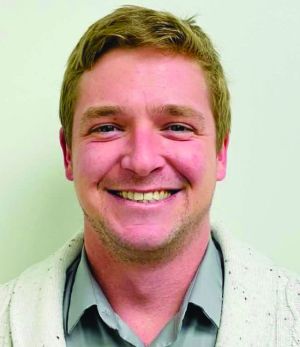
The Manitoba Liberal Party announced that Dan Quesnel is their candidate for The Pas-Kameesak By-election taking place on July 21, 2026. Although each party had a candidate running, Quesnel feels that it comes down to selecting a candidate who is going to advocate more for the north to get more done.
“Honestly, I just feel that this constituency doesn’t get a lot of support from the provincial government and it doesn’t matter which party is holding power,” said Quesnel. “The NDP have filled this seat for a long time and I think there is more that could be done to drive some results here in the north and help people.
Nabess runs as the PC The Pas-Kameesak Candidate
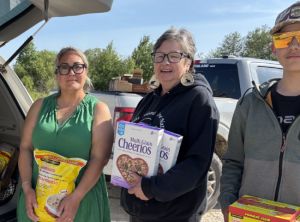
Just last week, the Manitoba Progressive Conservative Party announced that Edna Nabess would be their candidate to run in The Pas-Kameesak By-Election. Nabess is no stranger to running for the Manitoba PCs and wants people in the constituency to have options when it comes to voting for local representation.
“This is not the first time I’ve run for election as The Pas-Kameesak Candidate,” said Nabess. “I’ve run a few times just to try to get the word out that there are more options out there for people when it comes to voting in representation. I’ve had people ask why I run for the PCs because I’m not going to get in. I tell people that not winning the election doesn’t bother me. I would like to win it, but this still gives me the opportunity to go out and talk to people, and to give us a chance.
Flett is hot on the campaign trail for The Pas-Kameesak By-election
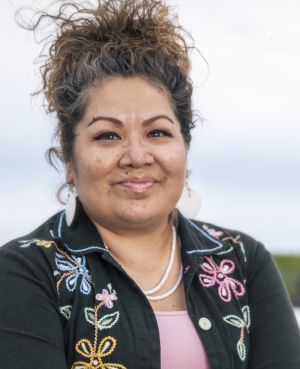
The NDP The Pas-Kameesak Constituency held an election to select its candidate for this upcoming by-election. Three strong, viable nominees came forward and after a second round of voting, Jennifer Flett was elected as the NDP Candidate for The Pas-Kameesak.
Flett is also no rookie when it comes to running for election. She has represented Opaskwayak Cree Nation (OCN) on different levels.
“I was a Public Servant with the Government of Canada for 20 years and was very familiar with what is expected of a government in terms of spending, transparency, responsibility to the public and following policy,” said Flett. “When I moved home to OCN/The Pas/RM of Kelsey area, I became involved in the local politics, starting with the OCN politics.
Seeing China through a new lens

Former Valley resident and world-travelled photographer Sujee Quon made a pilgrimage back to China. Her goal was to record her family history and connect to where she was born, and connect the stories her parents once told her to the actual places where they happened.
“I was in China this year for a month from January into February,” said Quon. “I have been back to China several times, but this was my first time back by myself without the guidance of mom and dad. My dad, Chuck, died only two years ago and my mom is starting to lose her memories. I have always wanted to record my past and my history. I knew it was time to record whatever I could now.
“I’ve travelled to several areas of China: Beijing, Yunnan, Shanghai, Suzhou, Hangzhou over the years. This time, I focused on the province of Guangdong, where I was born. I spent time in the country and in the cities.
“All these facts were a confluence that led me to go to China this year,” said Quon. “First, to start discovering my heritage, my village where I was born. I wanted to meet my cousins and connect with them.
“In 1949, during the communist takeover, uniting the country was imperative and the People’s Republic of China declared Mandarin as the official language of China in 1955. I do not speak Mandarin. I can speak Chinese, but only the Village Dialect or Toisanese. It is substantially different from Mandarin, especially the tones. It is not common to hear this dialect now. I have always wanted to learn to speak Mandarin. So, the trip became a trip of discovery and at the same time, I booked myself into a school and attended daily one-on-one Mandarin classes.”
It has been Quon’s dream to tell the story of her parents’ origin and how they came to Canada. She also wanted to see how much China had changed over the years, since her family had left the country.
“I have always wanted to tell the story of my mom and dad,” said Quon. “Their immigration story is not unlike thousands of other Chinese or other immigrants who survive the difficulties of adapting to a foreign land, a foreign language and different social standards. I have been recording their stories for a long time and as I mature into an elder, I see how their successes reinforce my view that Chuck and Jean were both resilient and creative people.
“My first trip was in 1979 with mom and dad, my husband, sister and 9-month-old daughter. Back then, we were given a three-day visa. It took almost a year to stretch that to five days. There was no tourism, no restaurants, no shops, only a sea of bicycles. Wherever we went, groups of Chinese people would surround us, follow us, stare at us. It was simple curiosity. We looked foreign and so different, but our faces were Chinese.
“Over several trips, I have observed the unprecedented rapid evolution of China,” said Quon.
“My second trip in 1993, China was just opening as a market economy. People were finally allowed to hold more than one job. The proliferation of small businesses on the sidewalks and every tiny booth was overwhelming. There was a distinct hum in the air. Even taxi drivers asked about jobs and business opportunities.
“By the time we returned in 2005, sightseeing tours were plentiful,” said Quon. “Hotels and wonderful food were readily available. People were dressing in fashionable clothes. Everyone on the streets walked with purpose. Shanghai was already large and bold. Cars were replacing the sea of bicycles.
“By 2015, I could see the change everywhere. The look of a better life with better living standards was evident. The cosmopolitan life was prevalent.
“My 2024 trip was like landing on another planet,” said Quon. “Roads, trains, flowers, parks, food, everything was easily available and plentiful. The cities were densely populated. We travelled through miles of towers of apartments. There was a sea of cars on eight-lane freeways. Architecture was glamorous, imaginative and bold.
“I did not expect this much change. Infrastructure, vast, clean roads and parks, flower-lined freeways. Pay by phone was the only way, from the fruit carts on the street to the luxury designer stores. There was so much to see. Technology was evident everywhere and provided a lifestyle for every level of the population.”
Quon was amazed at what she saw in China and how much it had changed over the years. Despite its high population, she marvelled at the country’s cleanliness, efficiency and safety.
“What impressed me most was the density of people both in the country and the city,” said Quon. “The towers and towers of apartments continued for miles. Yet things were amazingly organized, extremely clean. There was a sense of calm and efficiency. Despite the massive population, I never felt intimidated, scared or crowded.
“Subways, trains, airports, anything public was hyper clean and ran with precision. When the signs say the train is arriving at 10:15, that is the exact time it arrived. Sidewalks and roads were wide and well-maintained. I was very impressed that all signs everywhere, even in public washrooms, were in Chinese and in English.
“The safety and security in China were remarkable,” said Quon. “Even in Hong Kong, when I was visiting my Canadian cousins who also have homes in North America. They told me they felt safer in China than in Canada. It is very safe. I never felt threatened even when walking in crowds or at night.”
Quon came back to Swan River to share her stories, experience and photographs from China with others at a presentation called China 2026 Through My Lens, which she did at the Swan River Library on June 25.
“My stories from this trip come from people that I spent time with,” said Quon. “There were my country cousins, the city cousins, the teachers at the school, the wonderful service people in all the hotels where I stayed, from the shopkeepers, restaurant servers, and hair salon staff. I talked to everyone. Everywhere I went, I was treated with respect and kindness. In fact, I am overwhelmed at the kindness and help that was extended to me wherever I went.
“In the evenings, when I took my walks, people sauntered and chatted, and children played yet stayed close to their parents. I never felt unsure or unsafe. I have returned with an impression of happy and content people. My photo presentation will illustrate this.
“I’m not a political body or even a social activist,” said Quon. “I’m simply an artist, a photographer and a storyteller. What I will present will be what I saw, what I experienced and what I was told. Through my stories and images, I want people to make up their minds about the country.”
Quon has a big project in mind for her photographs and trips to China. It is something that she wants to do to pay tribute to her father. This will all tie into a new book and exhibit for her in the future.
“I have a project that is close to my heart,” said Quon. “It is also something I want to do to honour my father and his father. I want to return to my village to restore our home. This work is being documented through this first trip and the following trips as the project takes shape. The culmination of this will be a new book and an exhibit in Quebec.
“In August, I return to Quebec and then on to North Carolina, where I will be attending Beyond: The BBSI Experience, a 10th anniversary gala of a great nonprofit organization that I am proud to support called Ballet Boys Summer Intensive Program.
“In September, I return to China with a small team to begin the process of the village restoration,” said Quon.
Bringing Comic Con to the tri-community

If you love comic books and have always wanted to attend a comic con event but couldn’t, well, one is in the works for the tri-community. Comic cons are a great way for comic book enthusiasts, collectors and hobbyists to get together and share their knowledge and passion for their favourite comic books and memorabilia.
“A Comic Con is a convention for those who have a love or passion for all things comics,” said Antonio. “Each one is unique in many ways, but the themes are universal. They can be about comic books, sci-fi, fantasy, anime, video games, and pop culture.
The Pas-Kameesak MLA by-election in the works

The Pas-Kameesak MLA seat has been vacant since the recent passing of Amanda Lathlin. Recently, three people have stepped forward to run as The Pas-Kameesak NDP candidate for the upcoming by-election.
Jennifer Flett was a Public Servant with the Government of Canada for 20 years and was very familiar with what is expected of a government in terms of spending, transparency, responsibility to the public and following policy. When she moved home to OCN/The Pas/RM of Kelsey area, she became involved in local politics with OCN. Flett ran for the Vice Chief position in 2016, was successful and served a three-year term. She then ran for a Councillor position and was lected into that position from 2019 to 2021.
Flett has been involved in the One North group that negotiated and successfully helped the sale of the rail line that now owns the Arctic Gateway Group. She was also part of the negotiations group that completed the Trappers and Fisherman Compensation with Manitoba Hydro and helped the Opaskwayak Education Services get a new, modern playground that is not only for the schools but for the community at large, including the tri-community area.
New primary clinic to be named in honour of Amanda Lathlin
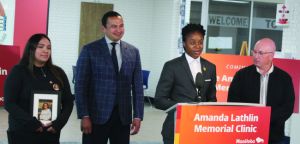
The Province made a formal announcement on Monday, June 22, 2026, with Premier Wab Kinew and Health, Seniors and Long-Term Care Minister Uzoma Asagwara announcing the commitment of a new primary health clinic for The Pas and that it would be named in honour of the late NDP The Pas-Kameesak MLA Amanda Lathlin. Present during the announcement were Elise Lathlin, Amanda’s daughter, and Town of The Pas Mayor Andre Murphy.
“Amanda Lathlin broke barriers as the first First Nations woman elected to Manitoba’s legislature and spent her career fighting for the people of northern Manitoba,” said Kinew.
Local businesses help each other out in times of flooding
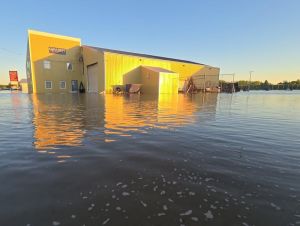
This flash flood has taken its toll on everyone in the Valley, including residents, farmers, and local businesses. Several businesses sustained damage as a result of floodwaters and are working together to try to salvage what is left. Dan Grazier of Grazier Manufacturing was one of the businesses that took a hard hit from the flooding in the area.
“My business was literally and figuratively underwater,” said Grazier. “There is substantial building damage and we’re just starting to sort out the equipment damage. It’s fairly substantial and so is the damage our neighbours have sustained.”
Grazier knew there was some heavy rainfall in the forecast and that it had created some flooding issues, but he had no idea of the magnitude of how much water and how quickly it would come his way.
“We had a regular work day on Monday, June 8, and I had some suspicions the water might come, but I actually didn’t think it would,” said Grazier. “There were some flooding issues at the Cargill turnoff, but that is a fair distance away. There were lots of ditches for that water to fill up along the way, so I didn’t think it was actually possible. I was where the flood started.
“I had started scratching around the storm drains in case the water did come, it would start flowing in there. That afternoon, the roads were bare and dry. At 4 p.m., I noticed some trickling down the roads, along the outer sides. Then by 5 p.m., there were thick streams coming down both sides of the road and shortly after, there was some pooling between my shop and Co-op.
“Whenever we see a heavy rain or spring thaw, it will usually flood out across the street,” said Grazier. “I started to realize that this was beginning to be a bit of a problem. I talked to Mayor Jacobson to confirm that water is coming in and that there might be a problem. I sent him a picture and had already gone home for the day. When I checked my security cameras, I noticed the water around it and told him I was about 10 minutes away from losing our office.
“He activated things very quickly and got sandbags down here. By the time I got to our office, it had already been swallowed up by the water. People were showing up to sandbag, including an army of young people. We were too late to save our office, so we started helping our neighbours sandbag. There were an unbelievable number of people from the community helping out. I was shocked by the number of young people who came to help out and did a lot of grunt work.”
In a time of a natural disaster and crisis of this magnitude, Grazier is proud of the efforts made by those who were helping each other out all around the Valley. Thanks to the teamwork efforts by everyone in the community, people are starting to get back into their homes and businesses.
“We tried to minimize the damage and I think everyone is doing ok,” said Grazier. “There is some building damage all around; further up the street, it looks a little better. Most of the businesses in this area are back in the buildings, cleaning up with a lot of work ahead of them. We’ve been stripping walls all week here at our office.
“Louisiana Pacific has been really good to us and offered some labour and their summer students to help us with stuff where we needed some more hands. We’ve been helping each other as we go. It has been a couple of late nights, but a real community effort. Countless people came to help who had no real affiliation with the businesses per se, but came as good people trying to help out. For once, I’m at a loss for words.
“We were shoulder to shoulder in mud and water, helping one another out,” said Grazier. “It might not be our property, but we are friends and work with these people every day, and care about each other here. Even though our property took in a lot of water, people still wanted to try and help us any way they could.”
Through community efforts, the water is subsiding and moving on.
“We were pumping water steadily last Friday,” said Grazier. “I figure we took in about eight inches of water. When they cut the railway and bypass, it really lowered the level of water around here. Now we have water just on the sides of the roads. There’s still lots of work to be done.
“We’ve been trying to pump out the low spots of water because whenever people would drive through the water, it would send it back into buildings. So people driving down here to take a look at what happened was a real problem in terms of the water coming back in. Once the road got cut, we saw the water drastically drop, so we cut back on the pumps. At the time, we weren’t sure if that was going to happen, and we were focused on trying to get the water away from the buildings so people could get back in them. Until the water went down, businesses couldn’t put forward a full effort into cleaning up.
“I just want to put a focus on the help that has been offered to us personally and around town,” said Grazier. “It has been remarkable. We are in the process of testing out our equipment to see what needs replacing. We are like a lot of people, not insured for overland flooding and a lot of people are scared about that and what it means for them.
“We were working to get to a point where we could set up some fans and dehumidifiers and dry things out over the weekend. We needed a bit of a breather and hoped this would help dry out our building, and then we plan to go help others in the Valley. There are a lot of people who are looking for and need help right now.
“I am so proud of everyone here and the community support,” said Grazier. “We will get through this.”