

Getting Dauphin Regional Health Centre back up and running is not as simple as plugging in a generator and firing up the x-ray machines.
Prairie Mountain Health CEO Treena Slate said all systems in the hospital are intertwined and operating such a facility requires a significant amount of power.
“The medical gases, for instance, so the oxygen, the suction and the gases that are required in the operating room and obstetrical care, they alone require probably the most significant amounts of power. All of the diagnostics services in the building require a significant amount of power,” Slate said.
“Those two systems have to be in place before we can do anything in the building. We need to have our electrical infrastructure in place before we can power up the HVAC systems and the mechanical structures in the building. It’s not as simple as hooking up an external generator and turning everything on. The building requires so much power that that’s not an option. We do need to have that electrical infrastructure and the mechanical infrastructure in place before we can resurrect services.”
Slate added, as the building is a clinical space, ensuring the hospital is safe and healthy for occupation is essential.
“Safety guides all of our decision-making as we move through this process,” she said.
“This is a clinical space. It is not a residential space. We need to ensure that everything is safe.”
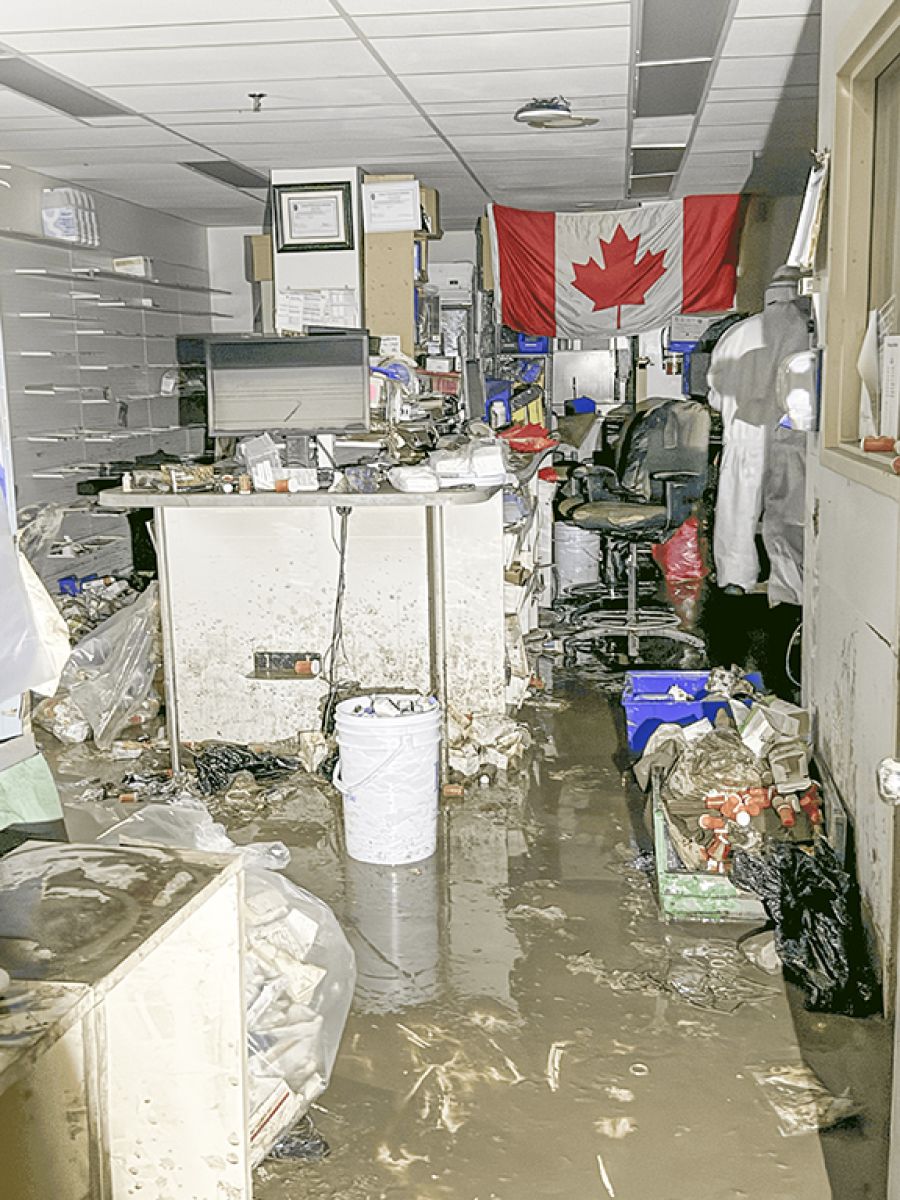
The DRHC was closed at the beginning of July due to extensive flooding affecting the basement of the facility. Recent indications are that it will take months to get the hospital back functioning fully.
However, the health region is working hard to restore as many services as possible, as quickly as possible, with the focus currently on establishing a functioning emergency department and diagnostic services, said Dr. Abdi Sokoro, the chief operating officer of Provincial Diagnostic Services.
“The work is continuing as a priority for diagnostic services, basic diagnostic services in the community,” Dr. Sokoro said, adding the focus is on services for non-urgent, non-symptomatic patients, who are less likely to need physician interventions.
“Patients who are ill are advised not to be seeking these services. For those patients, we continue to urge them to report to the nearest emergency department which has the appropriate diagnostics.”
Again, safety takes the wheel when it comes to identifying a space in the community to house such services, Dr. Sokoro added, citing the Health Standards Act as a guiding piece of legislation.
“Which means that the facilities in which we operate has to meet the safety requirements of infection prevention control stability, but also are not a source of harm to the patients,” he said, adding work is underway to provide phlebotomy services - the medical procedure of puncturing a vein to draw blood - as well as an EKG service and X-ray options.
“It is our priority and we hope to have those in the next while. We don’t have an exact concrete timeline, but that is something we’re working on with PMH and government, as well.”
Slate added PMH and Shared Heath staff are also working to provide dialysis and oncology services in the community as soon as possible. Possibilities under consideration include vacant buildings in Dauphin and the surrounding area, or even mobile options.
“We are looking at every possible option. We have to consider safety first and ensure that we’re meeting clinical standards by providing those services. It is not as simple as moving equipment over to a building in Dauphin,” she said.
“So much work and clinical experts are involved in that planning.”
In the meantime work will continue on properly assessing the damage at DRHC to determine a more concrete timeline for the return to normalacy.
Slate said a restoration company is evaluating the damage as it cleans the space. Photos of each room and an inventory of items to be replaced through insurance are being compiled as the work progresses.
“Really painstakingly working to clean spaces in a way that we can access the electrical and mechanical equipment and the clinical equipment that was damaged during the flooding,” she said.
“One of the main barriers to getting that completed is they can’t yet access the crawl space. It s still full of water and silt and so they are working to remove that so they can fully evaluate the wiring and the infrastructure in those spaces to understand the degree of damage.”
Slate added PMH and its engineers are eagerly awaiting that report so reconstruction work can begin.
Hospital rehabilitation is underway, but complicated
Published in Dauphin Herald News
Published in
Dauphin Herald News
Tagged under
