
Dealing with struggles by sharing culture

Many of us don’t realize the power and healing that can come by sharing lived experiences and one’s culture with others. This has been a powerful journey that Steven Nipin-Muskwa has been on and discovered through the course of his life. He didn’t grow up immersed in his Indigenous culture, but he has taken the time to rectify that and share it with others.
“My family is originally from The Pas and my mother was a Sixties Scoop survivor,” said Nipin-Muskwa. “She was raised in the U.S. by a non-Indigenous family. I grew up knowing nothing about my Indigenous culture and about 15 years ago I went to my first pow wow with some friends. I didn’t know anything about where I was from or my family, but watching the pow wow, I was drawn into it and it was amazing.
Gurdeep Pandher stops in The Pas as part of tour

Canadian social media sensation, Gurdeep Pandher, has caught the eye of many followers online with his Bhangra dancing and spreading messages of joy, hope and positivity. Pandher makes videos of his Bhangra dancing and shares them on his social media. This all started as a result of the pandemic and as a means of lifting people’s spirits up.
“I live in the Yukon territory, in an off the grid cabin in the wilderness,” said Pandher. “When the pandemic started, I became passionate about Bhangra dancing and sending out positive and joy during that time when it was very much needed. I started making a video each day, dancing in the wilderness around my cabin and posting it on social media as sending messages of joy, hope and positivity across the country and beyond.
Town welcomes new museum director

The Town of The Pas is thrilled to warmly welcome the new Sam Waller Museum Director, Jaxon Baker! Jaxon possesses a Master in Museology from the Université de Montréal and a Bachelor of Arts with a Major in History from the University of New Brunswick. He has also completed Fleming College's Museum Management and Curatorship Program.
READ FREE: Dauphin Herald Fall Total Market Coverage
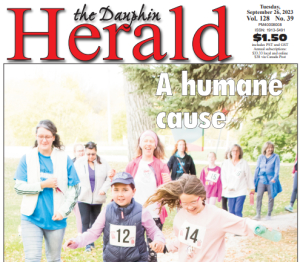
Ever wonder what the Dauphin Herald online papers look like? Ever thought about switching from your paper copy to an online edition?
Now is your chance to check it out and see how you like it with the Dauphin Herald's Total Market Coverage for September 2023.
Read below, enjoy!
Disability Matters Vote
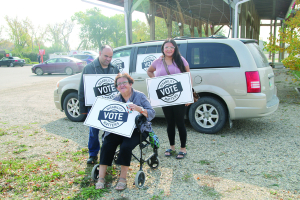
On Sept. 19, community members gathered in support of Disability Matters Vote. The public awareness campaign has the goal of ensuring all Manitobans with disabilities can participate in election activities and those who are eligible to vote can do so, to promote priority attention for disability issues in the provincial election, and to support Manitobans in making informed voting decisions.
25th Season Begins
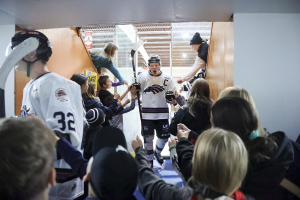
The Swan Valley Junior A Stampeders kicked off their 25th Season last week with their season home opener happening on Saturday (Sept. 23). Rebounding from a loss in Dauphin the night before, the Stampeders picked up a 6-3 win in front of an enthusiastic crowd...
Kings open the MJHL season with two straight wins

The Dauphin Kings dominated their home and season opener, Friday night, against the Swan Valley Stampeders.
It took the Kings more than eight minutes to find the net, but when they did, they opened the flood gates, building a 4-0 lead after the first period and extending it to 6-1 after 40 minutes.
Three players - Logan Walker, rookie Gavin Nemis and Blake Boudreau - each scored twice in the victory, while Gabriel Bugeaud had a single before he was tossed on a checking from behind minor in the second frame.
Truman Boettiger had the lone goal for the Stampeders.
Cole Sheffield was solid in goal for the Kings, making 24 saves, while his Swan Valley counterpart Elias Giaccan-Dimitriou stopped 33 shots in the loss.
Kings head coach and general manager Doug Hedley felt there were a lot of good things for the Kings to build on coming out of the season opener.
“If you start off in the D zone, our D unit was controlling the game. A lot of good reverse plays, a lot of good quick ups, up through the dots, one touch passes and good first passes,” he said. “We had so many good exits tonight that were out of our zone and then three passes later we were going in for a shot on net.”
That, Hedley added, was the result of good puck support, including support through the middle, and players putting pucks up along the boards and making smart plays.
“I liked our speed. I liked our attack in the middle lane. We started right off the hop with Carter (Zalischuk) driving the middle lane and making some plays. It’s contagious,” he said. “And when young guys like Nemis and (Rhett) Perrin work like that and catch guys from behind, it makes your D unit’s job so much easier.”
All four lines, Hedley said, played well. Bugeaud played well before he was ejected, and Josh Schmidt worked hard and never quit.
“We’ve got a bunch of guys like that this year. The experience is one thing. But obviously, it’s the first game of the year, so you take it with a grain of salt. But at the same time, I really liked the effort, I liked the speed, the compete. Just being teammates together and working hard,” he said.
The big thing now is to continue to play strong no matter who the opponent is.
The next challenge came Sunday night in The Pas, when the Kings faced the OCN Blizzard.
Naaman Hofer’s goal 4:21 into the third period stood up as the winner in a 2-1 Kings victory.
Boudreau staked Dauphin to a 1-0 lead on a penalty shot just 43 second into the second period.
Mathew Langdon made it a one-goal game a little more than three minutes after Hofer’s goal.
Sheffield stopped 20 shots in the win, while Loic Morin had 24 saves for the Blizzard.
With 28 players still in camp, more cuts were made early this week.
“We’ll be down to 25 by Monday or Tuesday,” Hedley said.
Friday, the Kings face the Portage Terriers in Portage at 7:30 p.m., before hosting the Selkirk Steelers, Sunday at 4 p.m. Prior to that, the Kings wil continue to focus on their systems including special teams.
“We’re ahead of last year, because our exhibition games were spread out. So we started teaching earlier and we started implanting our systems a little bit and our forecheck and neutral zone and D zone. We’ll just reinforce that during through the week and try to get our special teams going,” Hedley said.
End of an era: Two family-owned businesses wrapping up their time in Dauphin
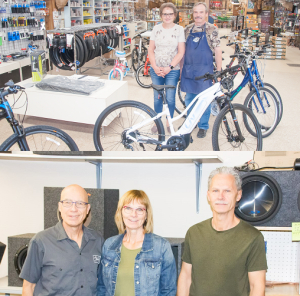
When Lorne and Bernice Black first took over the family business, they had to figure out where their interests laid so they could better focus their efforts.
And now as they prepare to walk away from Blacks Cycle and Sporting Goods at the end of this year, they have to again go through a self examination to focus their retirement.
“We don’t know what we’ll do or what we want to do,” Bernice said. “We are going to have to go find out who we are, I guess.”
"Maybe do more fishing and maybe some hunting,” Lorne added.
There were many factors which went into the decision to call it quits, Lorne said, such as supply chain issues, shrinking profit margins and competition from bigger companies and online sellers.
“And I’m worn out. I’m wearing out from it, it’s a long time to do retail. Forty-two years I’ve done,” Lorne said, adding he used to make the daily trek from Barker School to work in the store with his father.
And while they do have fond memories of their own children growing up in the store and interacting with customers, there really is not an opportunity to hand down the business to them.
“The boys are not interested, really. They have pretty good careers of their own,” Lorne said, adding they never pressured their children towards taking over the business. “We kind of steered them away from it because we saw what the ’90s were like. The ‘90s were not fun trying to make a living here, honestly. But in some ways it’s kind of sad, too, because we are making money, but we’re just out of time and out of life.”
The business was launched in 1945 as a bicycle repair shop with $800 Lorne’s father Ernie borrowed from a family member.
In 1948, Ernie moved the business to its present location, renting the southern half of the front of the building from the Oddfellows Lodge. As he expanded the lines of sporting goods he carried, Ernie acquired space in the building as it became available and in 1960 was able to purchase the building from the Oddfellows.
Continuing to grow the business, Ernie added a workshop in the 1970s and a full basement under the back portion of the building in the 1980s.
The business has changed over the years, Lorne said, as his father carried a wide range of sporting goods and over the last 30 years he and Bernice have narrowed the focus.
That history, however, makes it difficult to just lock the doors and walk away.
“This old building is full of stuff, that I have to go through. It’s going to take time. I’m closing the door, but I’m still going to be here for a few years to clear out this building. So we’re hoping to sell online and things like that. If not we’re going to have to do an auction or something like that,” Lorne said.
“The attic is full. We are a family of keepers of things and my dad kept everything. I cleaned out some of the garbage, so to speak, but there’s still a lot of junk in the attic I want to go through and I can’t just do that in a month or two. It’s going to take time.”
With only a few tire kickers showing interest in the business it didn’t make sense keep trying to find a buyer.
“It was going to be a tough brand to sell off,” Lorne said, adding when they originally started in the business, he and Bernice planned to stay for 20 years.
“As much fun as it’s been, it’s time to live our lives and have some freedom. People don’t realize what a ball and chain it is. (Lorne’s) dad was in retail his whole life and his dad always said he saw it like a prison sentence running your own business,” Bernice said. “There’s a lot of good memories. And our customers were going to miss so much. That’s going to be the hardest part. But what do you do? It’s time.”
Meanwhile, after 77 years in business, Dauphin Music and Electronics is also closing its doors.
Co-owners Danny, Dave and Theresa Zabiaka first began talking about a possible closure about two years ago, when they put the business up for sale.
“We’re all getting up in age, so it was time to move on,” Danny said, adding there was a little bit of interest, but nothing worked out. “Without any buyer for the business, we had to make the decision to shut down and put the building up for sale.”
Danny plans to move to Alberta to be closer to family, while his sister Theresa will move on to something else.
“That’s why the decision was made. I have family calling my name. The big thing for me was I have family calling my name out to Alberta,” he said. “And it wasn’t as much fun as it used to be coming into work every day. It started feeling more like work. For years it was always fun coming in. Lots of people around. It was turning into more work and I wasn’t enjoying it as much.”
Zabiaka admits it is a sad moment for him to see the store close after 77 years of operation.
“I’d like to see the legacy carry on. We’ve been here a long time. Of course, none of us had any family that are interested in taking over, so we had to go looking elsewhere for someone to take over. That didn’t happen,” he said. “It’s a sad day for me and my siblings, because we’ve all been here for so long. But that being said, I’m ready to move on. I’m at the point in my life when I need to do other things.”
The final day the store will be open has yet to be determined. Before that can happen, there will be four weeks of liquidation.
Zabiaka estimates the middle of October, around Oct. 15, will be the last time they will officially be open, offering the biggest discounts.
“There will still be some stragglers and we’ll make some arrangements to take care of whatever is left. So probably, the last day would be at the end of October or there abouts,” he said. “No nailed down actual date yet.”
The liquidation sale has already begun, but Zabiaka said they don’t have a lot of stock, because word has gotten around and people have been stopping by to pick up some deals.
“A lot of our products were discounted to some degree. And we haven’t been ordering stock for the last little while, so we don’t have tons of stock to get rid of. But everything has to go, so we can close,” he said.
Zabiaka said it has been a great run, while he has been at the store.
“It’s been a lot of fun, with meeting a lot of people. It’s been awesome that way,” he said. “It’s mixed emotions, of course, but I’m ready to move on. I came to that conclusion about a year-and-a-half ago that it’s time. So that’s the way it is.”
Indigenous student finds her political voice in fashion project
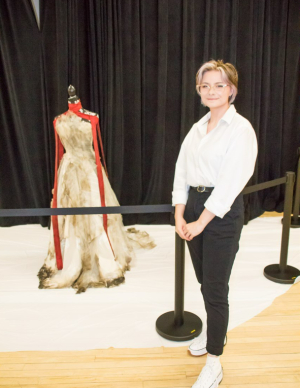
A former Dauphin resident now going to school in the United Kingdom is making her mark in the fashion world.
Amelia Rempel is originally from Portage and moved to Dauphin, last year.
When she was 15, Rempel entered the cosplay community, meeting a lot of people who are creative in that industry. One friend she met attends the University of the Arts London (UAL).
“So I did some research on the University of the Arts London and found out it’s the top art school in the world for undergraduates, so for bachelor degrees. And for something that I want to get into, I thought that was perfect,” she said.
About three years ago, Rempel moved to London with her mother for business.
“And when I was out there, just the atmosphere and the people and how they prioritize creativity a lot, which is something you don’t really see here in Canada. The museums are free, there’s more creative expression out there rather than here in Canada,” she said. “Don’t get me wrong. I love Canada, but it’s moreso forests and wilderness rather than architecture and museums.”
While doing her research into UAL, Rempel decided to apply to the school, never thinking she would get accepted.
“I just did it for fun. But I ended up getting in. They only have a 22 per cent acceptance rate, so I’m really, really lucky to have been accepted into their courses,” she said, adding she is currently studying costume design, having just completed her foundation year at UAL at Camberwell College. “That’s basically like University 1. And then I applied to Wimbledon, which is the top costume design school in England. So I applied and I got in,” Rempel said.
Using missing and murdered Indigenous women in Canada as her inspiration, Rempel designed a dress called The Wanderer, which was on display in Dauphin at a Meet the Artist event, Aug. 24, at the Métis Community Centre.
The Wanderer, Rempel said, was based off the myth of Melmoth, a character created by author Sarah Perry.
“It’s a myth about a person who is cursed by immortality and is cursed to forever walk the earth alone. And so The Wanderer I based off of that is an Indigenous woman who wears the dress,” she said. “And the dress is covered in articles that I found off the Internet of women that have gone missing and has their names and their ages and their stories and who they wanted to be. The Wanderer witnesses these tragedies of these women that are murdered or killed and raped and she takes on their stories, so they can pass on into their second life, essentially, without the burden of that. And her dress, as she walks across Canada, her dress gets heavier and heavier, because even as we speak, there are women going missing. There are women being taken. We, as a country, need to stand up against this.”
For their final major project, Rempel said, students were encouraged to push themselves out of their comfort zones.
“And I don’t like speaking about politics. It makes me very, very nervous. But it was an issue close to my heart because I grew up around an Indigenous tribe back in Portage, the Ojibwe, and we were close friends with the Chief, Donny Smoke,” she said.
So as she grew up, Rempel was invited to powwows and being around the Ojibwe culture.
“I thought it was so beautiful and I wanted to introduce that culture to the people in London. But as I delved deeper, I found out a lot of people didn’t know about residential schools,” she said. “They didn’t even know they existed. Didn’t know that the last one didn’t close until 1996. Didn’t know that women are still going missing to this day just because of their skin colour. And this was an issue I need to talk about, because I didn’t even know about missing women until last year.”
As someone who grew up in Canada who did not know about the missing women, Rempel feels it is important that people speak about the tragedies that are still ongoing.
So Rempel designed the dress, which drew rave reviews from people in London, many of whom thought Canada was a sort of utopia, a perfect place where nothing goes wrong.
“They don’t know the mass cultural genocide that happened just a couple decades ago. They didn’t know that people are still recovering from that. It didn’t happen a long time ago,” she said. “There are still residential school survivors that can share their story, that lived through that trauma. And to find out that they’re still trying to find all of their children now. It really changed their view of Canada. Not in a bad way, but it’s like, I guess every country has it’s flaws.”
But the issue needs to be talked about, Rempel said, adding what has happened needs to be acknowledged and we need to heal as a country, rather than just ignoring it.
The dress was on display at the Camberwell College of Arts at Wilson Road, which is the foundation school, for about a week.
Rempel was then one of eight students chosen to present her final major project on display at the Camberwell College of the Arts with other all the bachelor students.
“So it was on display for about a month, there. So about two million people would have seen it, because if you look at the statistics, lots of people go because UAL is a top art school. So you have producers and you have different companies coming in to scout out students,” she said.
To have that many people view her dress was a big surprise for Rempel. She knew it would be on display at her school, but she originally wanted to give the dress as a gift.
“Because I knew that an issue like this, a movement like this was so important to the Indigenous and Métis people. And so I wanted to give it as a gift,” she said. “And for them to give me gifts like this in return, too, to put it on display and to speak at conferences about gender-based violence, I am so grateful that they’re giving me this opportunity to speak about it. I just felt like I’ve been welcomed into the Métis community with open arms, because I am Métis myself, but when I was making the dress, a lot of people told me that I was white passing. They continuously reminded me that I looked white, so therefore I am white.”
But when she returned to Canada, Rempel was told that it doesn’t matter that she looked white, she was Métis by blood.
“And to be welcomed like that, it was really heartwarming,” she said.
The dress was purchased by the Manitoba Métis Federation, and itwill be on display at the Heritage Museum in Winnipeg next summer.
Rempel has returned to London for her second year, her first towards her bachelor degree. Her goal for this year is to push herself out of her comfort zone even more.
“This project, when I did push myself out of my comfort zone, it did cause me a lot of anxiety. But the end result was beautiful. And to see how it brought the community here in Dauphin, they invited me in like that, I want to do that more. I don’t want to be scared to do what my heart tells me to do, because this entire project, it was something that was close to my heart and I wanted to speak about it, but I was told not to. But I’m glad that I didn’t listen” she said.
Manitoba Health gearing up to fight bugs

Manitoba Health is providing an update to Manitobans about respiratory viruses expected to circulate in the province over the coming months, as well as the provincial plan for COVID-19 and seasonal flu vaccinations.
COVID-19, flu and other respiratory viruses will be circulating this fall and winter. Manitobans can take important steps to help protect themselves, their families and their community.
Find out more in this week’s paper.