
MHRN releases annual report

Manitoba Harm Reduction Network (MHRN) released their 2023-2024 yearly report with the focus being to create a safer, more inclusive Manitoba by challenging harmful systems and advocating for respect and safety for all.
“There are many positive outcomes which you can see in our annual reports and evaluation on our website at mhrn.ca,” said MHRN Executive Director Shohan Illsley. “We have engaged people who use substances and are impacted by colonial and structural harms, also known as peers. We have over 800 peers engaged in the province, most of who were not accessing any services before connecting with MHRN. This has increased in peers engaging with social and health care services, including STBBI testing and linkage to care through peer-led events and access to addiction services including RAAM and treatment.
“There has also been an increase in education through community-based outreach and education events in line with national and international activities such as Sexual and Reproductive Health Awareness Week and others. We have over 300 service and health care providers engaged in local harm reduction networks where they identify and address local community needs regarding sexual health, STBBIS, and substance use.”
PMH working to reduce agency nursing costs

As the health region spending the most, Prairie Mountain Health has been directed to reduce private agency nursing costs by 15 per cent by the end of this fiscal year.
Health, Seniors and Long-Term Care Minister Uzoma Asagwara issued the directive last week as part of a systemwide effort to refocus funding on nurses in the public system.
“Prairie Mountain Health has consistently been dealt a bad hand,” said Asagwara.
“Alongside the challenges in the area, the previous government gave the region little to no support by cutting services, closing ERs and firing nurses resulting in millions overspent on private nursing agencies. Enough is enough. It’s time to put a hard stop on private for-profit nursing agency over-spending and re-invest in the public system. Our government is committed to working with all health regions to bring nurses back into the public system.”
In an emailed statement Prairie Mountain Health indicated patient care will be a priority as it works to fulfill the government’s directive.
“Prairie Mountain Health (PMH) is committed to providing consistent, safe, reliable and quality care. PMH commends the work of the Province in reducing reliance on agency nursing. We are diligently working to reduce our dependency on private agencies,” the statement read.
“The recent issue of the request for proposal referenced in the provincial announcement is a step toward redirecting nurses into the public system. In addition, reducing the number of agency organizations will assist in streamlining administrative processes, and in reducing costs. Utilizing the provincial travel nurse team is also proving to be an effective way to reduce agency nurse usage.”
The statement also indicated the health authority remains committed to hiring nurses into the provincial system.
“We remain focused on recruitment strategies including promoting the advantages of working for PMH versus agency. PMH offers robust staff wellness resources, a pension plan and benefits that are not usually available through private employers,” the statement read.
“Regional recruitment initiatives also include attendance at career fairs, offering student practicums, and local and provincial grants and incentives.”
PC Health Critic Kathleen Cook said attempts by the government to shift the focus to PMH is simply a distraction from their own failures to address problems in the system.
Documents obtained through Freedom of Information Act requests show agency nursing costs in PMH have increased by 25 per cent this year, with the province on track to spend more than $25 million on agency nurses in Prairie Mountain Health alone.
Read the full story in this week’s edition of The Dauphin Herald.
My Vision 4 My Education

Grade 4 students from the Swan Valley and area converged at the SVRSS on Wednesday (Jan. 29) for My Vision 4 My Education, where the elementary-level students get a sneak peek at the opportunities that await them at the secondary regional school where they are projected to attend in less than five years...
Raiders hosting benefit game

The Roblin Grandview Gilbert Plains Raiders high school hockey team is hosting a benefit for the Van Wingerden family later this month.
The Raiders will be taking on the Russell Trojans Tuesday, Feb. 25 at the Centennial Arena with all proceeds of the game going to the family. Game time is 1 p.m.
More in this week’s issue.
Former Gilbert Plains CAO charged after lengthy investigation

The former chief administrative officer of Gilbert Plains Municipality has been officially charged in connection with allegations of fraud following a two-year investigation.
On Jan. 16, as part of a joint investigation involving the Dauphin RCMP detachment and Manitoba RCMP Cyber and Financial Crime Unit (CFCU), Amber Fisher, 40, was arrested and charged with fraud over $5,000, theft over $5,000 and use of proceeds knowing it was obtained by the commission of an offence.
The investigation began following a complaint in 2022 that Fisher had defrauded the municipality of upwards of $500,000 while employed there.
Reeve Jim Manchur said the municipality has been anticipating this day for some time.
“We initiated this process over two years ago, so we had hoped it would happen sooner than it did, but we’re glad that we’re at this point,” Manchur said.
The investigation involved numerous witness statements, along with the obtaining and review of extensive financial records and other reports.
“Any time you have an investigation of this duration that reaches the charge stage it’s a major milestone. However, the work is not complete,” said Const. Ricky Perkins of the Manitoba RCMP CFCU.
“We realize for the people affected, a lengthy investigation can feel as if there is no progress being made. In reality, there are many investigative steps taking place behind the scenes, and we’ll continue to work with the Dauphin RCMP Detachment until it’s conclusion.”
However the municipality has not been idle while they have been waiting for the investigation to process.
One step they have taken, Manchur said, was to sue Fisher in an attempt to recoup their losses.
“We’re still in the process of that. That’s another, kind of, frustrating thing, it takes time so we’re hoping that will move forward as time goes by,” he said.
He added the municipality has also been working closely with it’s insurance company in an effort to minimize its losses.
“I would say that of the $500,000 plus that we lost, $400,000 did come back from insurance, but we still have other funds to recover in terms of legal fees and interest and those sorts of things,” Manchur said.
“Ultimately, we’d sure like to recover all our funds and go back to business as normal.”
But it will not be business as it once was.
“We’ve really tightened up everything on our financial side. We revamped our whole administration staff and all our financial controls are really, really tight now. So I really don’t think this could happen again, certainly in our municipality,” Manchur said.
Those changes include eliminating the ability to etransfer from municipal accounts without dual authorization and requiring council approval on all financial reports. There have also been increased controls put in place to ensure bank statements are reconciled on a regular basis, as well as requirements for regular and up-to-date audits.
“You wouldn’t believe the stress and the frustration that this did cause for us on council over the past few years and, you know, it’s hard to believe that we’d be the victim of it, but that’s what we ended up with. I think a lot of ratepayers aren’t totally happy with how it happened, but in the end we have to continue to be vigilant and go from there,” Manchur said.
“We appreciate the efforts of the RCMP. We were in contact with them through the whole process and they did a great job.”
Fisher was released from custody with conditions and will appear in Dauphin Provincial Court on Mar. 18.
Meals on Wheels provides more than a service
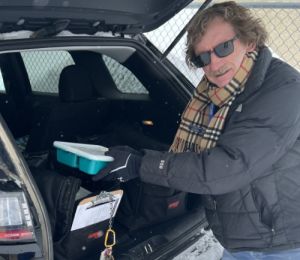
There is a program dedicated to ensuring people can get help with meals being delivered to their homes if they are facing challenges cooking for themselves. The Meals on Wheels Program has been long-running in the community and has seen only a few minor changes since its conception.
“The Meals on Wheels Program started in The Pas 36 years ago,” said the NHRA Client Service Coordinator Brian Duncalfe. “Originally it was run by a board and was independent of the Regional Health Authority (RHA). The only thing the RHA assisted with was the meals prepared by the kitchen.
“The RHA took up the billing for the program around 20 years ago, so there was no need for a board. I stayed on to help run the program. If anyone wanted to join, it all went through me. This allowed me to deliver the meals to clients for seven months straight as part of my job. I enjoyed doing this and visiting with people when I delivered their meals.
“At that time, we didn’t have a team of individuals, but I did have a few friends I could call on to cover for me when I was away,” said Duncalfe.
RCMP staffing crisis impacts The Pas

Many communities in Manitoba are crying out about police shortages, but very few are faced with the level of RCMP officer vacancies that The Pas has been experiencing. Some communities are complaining about having anywhere from two to five positions vacant. Meanwhile, The Pas is operating with only 12 of its 23 budgeted RCMP positions filled for a community of over 5,300 residents.
This has led to inadequate coverage with only three officers on duty during night shifts and two during the day. The Town of the Pas pays $3.5 million annually for policing services in the community and the Community Safety Program faces even more costs as they plan to fund this investment for the future.
As a result, the tri-community area has seen a rise in criminal activity from drug trafficking operations and altercations involving weapons and firearms. Just last December, Opaskwayak Cree Nation implemented a curfew in their community in hopes of controlling the criminal activity taking place in the early morning hours.
Ponask’s work on display at Sam Waller Museum

Sam Waller Museum has done an excellent job showcasing some extremely talented artists, especially local ones. Their most recent exhibit features work done by local artist Shauna Ponask. Ponask’s work has been on display throughout Manitoba at various points and over the past few years, she has been featured in some prominent art showcases in Winnipeg.
“This is my first exhibit at the Sam Waller Museum,” said Ponask. “I was asked to create an exhibit by a previous curator, which I happily agreed to.
“The title of the exhibit is Journey Home. I wanted to tell the story of how I started sewing and creating, which all started four years ago when my husband was battling cancer in Winnipeg. I created my first pair of mukluks beside him at the Health Sciences Centre. I found it to be a form of healing and comfort during a very difficult time.
Poole well accomplished during time in Town of Swan River

The Town of Swan River is in another period of transition as CAO Derek Poole stepped out of his role and away from the Town of Swan River this week, making way for the incoming CAO that is scheduled to begin his duties in March.
Mayor Lance Jacobson announced the hiring of Will Tewnion last week. Tewnion is a retired RCMP member who worked in Swan River once before as Detachment Commander from 2007 to 2010, and is excited to return back. For the past five years, he has worked in various Director roles with the Yukon Government.
Until Tewnion is able to return to Swan River, Darren Harvey has been appointed Interim CAO. Harvey was otherwise working as the Director of Public Works.
Poole’s exit from the Town of Swan River ends a 16 year tenure that saw him start as Superintendent of Public Works when he was 28 years old. He kept that role for 12 years. During that time he had some stints serving as Interim CAO until finally taking on the job full time in 2021.
“I was young for the position but now I’m 42 and have 16 years of Municipal Administration under my belt,” said Poole. “I’ve achieved a lot and I’m proud of it.”
During his time as Superintendent of Public Works and later Director of Public Works, Poole was focused, of course, on public works but also the utility, which saw a lot of improvements during Poole’s time.
“I did what any manager would do, I did a large assessment, and discovered that the number one priority was the utility, the lift stations, the lagoon, the well control sites,” said Poole. “All of it was aging. That was the focus for a good 10 years to get everything retrofitted. It took millions of dollars of grants. It was lot of work but the people didn’t really see it because it was a lot of underground work and might only see it at budget time.”
Even during crisis times when the Ross Lift Station failed in 2012 during the Manitoba Summer Games or in 2018 when a well control site failed, Poole sees the management of those crises as one his proudest moments because, through careful water management and conservation from everyone that uses the utility, the Town was able to make it through that time without a boil water advisory.
“Everyone did what they were supposed to do,” he said. “Even council was able to help get an O-ring that we needed for one of our wells that we could only locate in Phoenix, Arizona. Council did what they had to do to get a plane to cross the border through customs directly from Chicago to Swan River.”
Once he stepped into the role of CAO, he found it to be, naturally, more political, and did a lot of work in updating policies and bylaws.
“We did full reviews of our bylaws and policies, everything from the enforcement of it, to the filing of them, so it’s easily changeable when its time to review it for council,” said Poole. “It’s so important for our operation and it saves time, keep everything running smoothly and your employees can enforce a policy without a fear of missing a process.
“There has also been changes in the general professionalism of the Town of Swan River and how council carries itself. That of course I can’t take the credit for that, as Mayor Jacobson deserves credit for that. It was his vision and I implemented it through orientations with council and we got our strategic plan fixed, a proper one with objectives.”
Looking back on his tenure as leader of the Town’s administration, he sees the Town of Swan River being put in a positive light.
“A lot of the time, if you’re struggling, it’s in the news and it’s loud,” he said. “Your failures are in the news. I don’t believe that was us. I believe we were in the news for things that we controlled. We spoke loudly and lobbied loudly. We weren’t so much in the news for HR issues or legal battles. And, we do have our fair share of legal issues, but not because of operational missteps.
“During my tenure, I feel I wasn’t loud as a leader. Behind the scenes, everyone was doing their job.
“I think the Town’s greatest asset is their employees.”
Poole also added that he feels the most important relationship in a municipality is between a Head of Council and a CAO, and he feels that he and Jacobson were able to accomplish a lot during their time together.”
The Classic Tunes

The Swan Valley Historical Museum held their Winter Warm-Up event this past weekend (Jan. 24), welcoming the band, The Pugs, featuring Steve (Left), Ken
(Middle), and Claude. The Swan Valley Co-op provided appetizers and along with some craft beer sampling courtesy of Black Wheat Brewing