
Young entrepreneurs at EMC
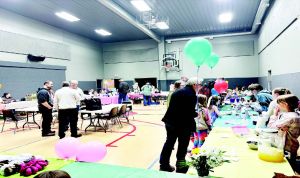
Harvest Hill Homeschool Co-op wrapped up their Junior Achievement financial literacy class called “A Business of Our Own” this past week. In this class 9 to 14 year old's were learning the basics of how to write a business plan. They were able to apply these skills to their own businesses and create products and market them on Sunday, April 12 at Evangelical Mission Church in Roblin.
There were 27 vendors featuring bird feeders, perogies, herb gardens, key chains, sandwiches, lemonade, baking, sewing projects, and woodworking projects. Literally something for everyone!
Over 100 people came to support the young entrepreneurs and it was a huge success! The students were then able to determine their net profits and through studying God's word as a class it has created an opportunity
for the students to learn how to manage their money through a biblical lens. There were students from Roblin, Russell, Binscarth and Rhein, SK who participated in the “A Business of Our Own” class.
Showcase Held - Hillman Dance Studio
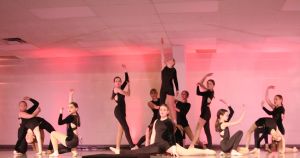
Hillman Dance Studio finished off the Dance season by presenting their 13th Annual Showcase on April 19th. Hillman has 104 students ranging in age from 3 to 18. 56 dancers in Roblin and 48 in Churchbridge, SK.
Teaching this year, were Giny Hillman, Jessie Laroche, Danica Bowley, Tori McGinnis, Michaela Alyward and Dani Rands. As well as student teacher Emery Laviolette (pictured on the left).
The Studio’s dancers competed in Russell, Virden, Brandon and Yorkton this year, coming home with many awards, among them a Platinum award from the Parkland Dance Festival held in Yorkton every year - a first for the studio. Dancers showcased their award-winning dances to a crowd at a filled to capacity Roblin Community Centre. See next week’s edition for more pictures.
Countryfest finalizes 2026 lineup
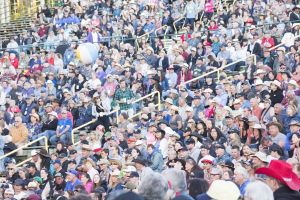
The last of the acts are signed and the countdown to Dauphin’s Countryfest 2026 is on.
Canada’s longest running country music festival takes place, June 25 to 28, at Selo Ukraina south of Dauphin.
Headlining the 2026 festival are multi-platinum country stars Jelly Roll, Tyler Hubbard, and Nate Smith, each bringing their high-energy performances to the Play Now Main Stage.
Joining the headliners on the main stage will be the Hunter Brothers, Owen Riegling, Jade Turner and the Sean Taylor Band on Friday.
Sturday will feature Cameron Whitcomb, Hailey Benedict, Noeline Hofmann and Alli Walker, while Sunday will see Brett Kissel, Thelma and James, Blackhawk and The Martin Boys.
With a mix of international headliners, celebrated Canadian talent, and rising local artists, this year’s festival promises an unforgettable experience for music fans across the country.
“Each year our goal is to build a lineup that truly captures the spirit of Countryfest, bringing together world-class talent, Canadian artists, and the rising stars in our own backyard,” said Colette Hykawy, Programming Committee lead.
“We’re excited to welcome fans back to the hill for four days of great music and fun activities.”
The festival will get underway, June 25, with a Rockin’ Thursday Kickoff Party, featuring Canadian rocker JJ Wilde, a Kitchener, Ont., born artist, who will set the tone for an electrifying weekend, alongside Manitoba performers Leddwyn and The Haileys.
Additional highlights on the hilltop stages include acclaimed Canadian artists Charlie Major and Aaron Pritchett, along with a drink-raising, head-banging performance from Eddy and the Dirty Boys, a rising Canadian rock band compiled of members from both The Glorious Sons and Boston Levi.
Toque will return to the hilltop stage to bring their high-energy classic rock performance.
The remainder of the weekend features home-grown talent, and out of province rising stars, such as Josh Stumpf, Club Wagon Creek, Ryan Keown, Austin Ryder, Morgan Grace, Kates Outlaw, Sarah Vanderzon, JR Charron, Kris Anders and the Flatlanders, Irvin Miller, Petric, Brandi Vezina, Cassandra Star and Mitchell Makoons and Desiree Orvis.
Dauphin’s Countryfest has now entered Tier 3 pricing with weekend passes available at $369 plus fees and taxes.
Tickets and camping can be purchased online at Countryfest.ca or by calling toll-free to 1-800-361-7300.
Buck takes Swampy Cree Hand Drum to international audiences
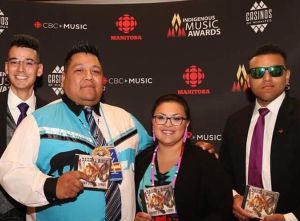
Many musically talented and culturally gifted individuals hail from the tri-community area. These talented folks share with others their gift of music and art, or share their culture with many people. Opaskwayak Cree Nation (OCN) member Darryl Buck has been singing and playing the hand drum as a young adult. He wants to share this cultural tradition with others.
“Growing up in the Mosakahikan and Opaskwayak Cree Nations (OCN), I was immersed in our culture,” said Buck. “In my early twenties, I began learning about the drum and singing within the local community of The Pas and the OCN. I had the privilege of witnessing the spiritual aspects of ceremonies and the drum. Being raised in a Cree-speaking home was a cornerstone of my identity, and I frequently saw the drum at gatherings, ceremonies, and performances.
The Storytellers’ Festival showcases Canadian films for free

If you love films, you will have the chance to take in some Canadian-made films at this year’s Storytellers’ Film Festival, being held in The Pas.
“The Storytellers’ Film Festival is being held on April 15, 2026, in The Pas Regional Library Annex beginning at 4 p.m.,” said Cheryl Antonio. “We will have refreshments, free admittance. It is being held in conjunction with Canada’s National Film Day.”
Every year, a selection of films is chosen for this event.
Spring Break Skiing
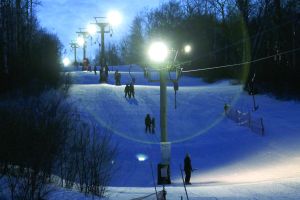
No fooling here! With the weather and snow conditions remaining favourable for skiing and snowboarding, the Thunderhill Ski Area was still open on select days during spring break, which coincided with night skiing on the evening of April 1, as well as a full day of operations on Good Friday (April 3). (TOP) The JB Construction Lift brings skiers and snowboards up the first slope. (CENTRE) The Easter Bunny comes out to entertain the crowds on the last day of the season. (BOTTOM LEFT) A snowboarder carves around the last corner. (BOTTOM RIGHT) A skier takes a jump in the snowboard park.
Turning a hobby into an international career

Many talented and creative people have come from the Swan Valley and have gone on to have remarkable careers in fields that many only dream of. Former resident Brad Caruk had an interest that he was passionate about from his days growing up in the Valley and took it to an international level.
“I was born in Swan River and moved around for a bit in Manitoba and Saskatchewan as my Dad worked in the mines,” said Caruk. “Then we came back to Swan River when I was in Grade 3. We lived on Third Street North, only a short walk to Swan Valley Regional Secondary School, which I graduated from in 1983.
“Immediately after graduating from the SVRSS, I moved to Winnipeg to attend Red River Polytechnical, Advertising Art, graduating from there in 1985. I wanted to go into film, but art was the most affordable option I had, and they had accepted my portfolio submission, providing me with an in-person interview.
“I received an acceptance letter to attend, so I was all in,” said Caruk. “It wasn’t easy. Classes were 8 a.m. to 5 p.m., with no spares and the homework was a little different from what it is today.”
What drew Caruk into creating experiences and design features stemmed from George Lucas’ cult classic movie – Star Wars. He was also very fortunate to have some very influential instructors both in Swan River and in his post-secondary studies.
“I sketched a lot through my school years, but honestly, seeing Star Wars in the local theatre in 1977 changed my life,” said Caruk. “Yes, as geeky as that sounds, it was the imagination and creativity of such visuals that I really wanted to be a part of.
“Once I entered high school, I enrolled in a course called Commercial Art, under Doug Stout. He was my mentor and honestly inspired me. I luckily had his twin brother, Andy, at Red River for graphic design; he led me to continue that pursuit. I had other very influential teachers as well, like Tony Klein for band, and music is also a big part of my career. Cliff Gussie, Mr. Yaroway, and others who were not even my teachers had an influence on me.”
Caruk’s career started on Manitoba soil and led him to work on some design concepts for museums in Winnipeg. From there, he worked on several projects on a global scale, many of them being world-renowned tourist attractions.
“In 1989, I had started my own company in Winnipeg, which several years later led to embellishments and designs for exhibits at the Manitoba Museum and another project for The Royal Aviation Museum of Western Canada,” said Caruk. “I remember the stress of those first multi-million-dollar budgets, but in parallel, the excitement and pride that followed. That was just the beginning; my ultimate goal was to get onto the world’s stage.
“I invented a technology to put on subway tunnel walls and installed the prototype in Kuala Lumpur, Malaysia, which led to travel to over a dozen other countries around the globe. We were about to go public, but then the stock market crashed. That was a tough life event.
“I went on to work on concepts for Moana and Tron for Walt Disney, Orlando, Florida; attractions for Universal Studios, Singapore and Beijing, China; and designed several attractions for Ocean Flower, Hainan, China,” said Caruk. “I’ve also developed a whole theme park in Jurong, China, another in Tokyo, Japan and a Panda VIP animal park.
“I travelled with my wife, Crystal, up the mountains of Chengdu to the Panda Research Base. Not many get that kind of opportunity and it was a very special project dear to us.
“More recently, I developed an aquarium in Khobar, The Line, The Mukaab and Six Flags Qiddiya City Park, all in Saudi Arabia,” said Caruk.
The projects that Caruk has worked on take years to complete. Like anything else, the bigger the project, the longer it takes to finish.
“A lot of blood, sweat and tears literally go into designing and developing these kinds of projects,” said Caruk. “You’re always thinking how to make it better. These days, I’m responsible for multi-billion-dollar projects. You need to get it right. It’s all about the guest experience.
“Starting with the concept, then leading disciplines in schematic design like architecture, structures, engineering, area development, audio, lighting, etc., then on into construction supervision. It’s like a symphony. I get to be that conductor. If we are not all in tune, it falls apart. You need to create something unique, entertaining, and especially memorable.
“It starts with the executive strategy, pre-concept, concept, schematic design, design development, construction drawings, then onsite there’s preliminary works, infrastructure, etc., until opening day,” said Caruk. “Some projects can be two years or so, while other larger ones take upwards of five to seven years. It’s a major commitment of time and travel.”
Caruk focuses on delivering the most enjoyable experience for guests. He strives to design an attraction or theme park that people want to come back to and experience it again. He finds inspiration in challenging himself to outdo what he has done in the past and from his spouse.
“I work with the most brilliant people on the world’s stage,” said Caruk. “I get to imagine and build things people have never seen before. Create worlds from within my head and make them a reality. I’ll hang out by an exit of an attraction and listen to the guests’ reactions. The ultimate compliment, when I hear someone say, ‘let’s go on it again’, then I know I did something right.
“I think the energy comes from the passion to outdo myself on the next project. It’s not so much what I have done, I’ve had my share, but more about what I am doing now. It’s in my DNA. I live, eat, and breathe it. My ideas come from everywhere, everything. I credit a lot of it to Crystal. She is my muse and the most creative person I know. And, she puts up with my crap, to some degree, which lets me do what I do best.”
Caruk has worked on many notable projects over the span of his career and each one has something about it that ties him to it.
“When it comes to having a favourite project that I’ve designed, that’s a tricky question, as I have favourites for different reasons,” said Caruk. “It’s like asking me my favourite movie, not a short answer. Six Flags Qiddiya was an opportunity unlike anything else. I was the only creative director on that entire project. That park is completely my world, from the stories to the characters I created, such as Professor Screamore, to even the design and painting of ride vehicles. Even the music. I was in Prague with the symphony orchestra recording original compositions for this project.
“It came with a huge sacrifice, though. We lived on Vancouver Island during the pandemic and worked remotely from 10 p.m. through the night, finishing at 9 a.m., almost seven days a week, for two years. Then we relocated to the Eastern time zone and I was in the air more than on the ground for the next three years. That’s a lot of time away from family.”
Caruk still has projects on the go and plans to continue doing what he loves for as long as he can.
“Unfortunately, I can’t say much about current or future projects, as we are under non-disclosure agreements, typical of this genre of work, but I can tell you there’s more to come,” said Caruk. “My plan is to do this as long as I can, so retirement really isn’t in my vocabulary. I am very fortunate to do this type of work. My job is my hobby, and my hobby is my job. It doesn’t get much better than that.”
Someday my Spring will come
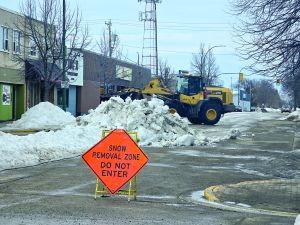
The snow plows, tractors, loaders, snow shovels and snow blowers continue to be in active duty mid-way into April, with a major dump of snow landing on the Swan Valley Tuesday and Wednesday (April 7 and 8). Environment Canada estimated an additional 30 cm had accumulated on the ground by Thursday (April 9) – totalling as much as 64 cm – accompanied by gusts as fast as 59 km/h. Despite several days of melting temperatures and the beginnings of spring flooding, the area is forecasted to receive as much as another 13 cm later this week. Pictured here, crews continue to clear the temporary snow median on Fifth Avenue North that still remained on Monday morning five days after the flurries ended.
Multiple vehicles damaged in Rossburn by drunk driver
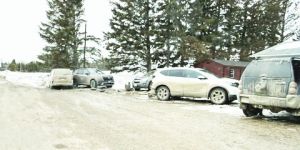
On April 2, at approximately 3:05 p.m., Russell RCMP responded after a van collided with three parked cars in Rossburn.
The collision occurred on Victoria Avenue, in the vicinity of a local daycare at a time of day when young children and their parents are entering and exiting the building.
Investigators have determined the van was travelling at a high rate of speed, causing severe damage to all four vehicles.
Shortly after the collision, RCMP learned a male suspect matching the description of the driver had just assaulted a male at a nearby hotel. The victim of the assault went to hospital for treatment of non-life-threatening injuries.
At approximately 3:30 p.m., multiple bystanders waved officers down and pointed out the suspect, who was walking in the community. He was arrested without incident.
Lawrence Jade Shingoose, 31, of Keeseekowenin, has been charged with:
• Assault causing bodily harm;
• Uttering threats;
• Failing to stop after an accident;
• Impaired driving; and
• Operating a vehicle while over .08.
Shingoose was remanded into custody.
Municipalities advocating collectively for rural health care is the only real long term solution
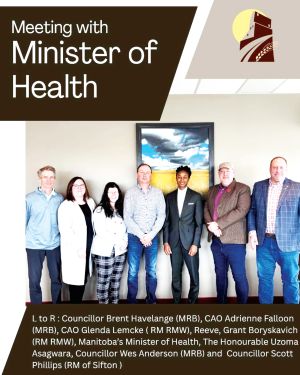
The municipalities of Riding Mountain West and Russell/Binscarth are again working together to tackle long-held issues in health care for our area communities, hoping to expand to include the communities further afield, many of whom are dealing with the same issues of health care coverage.
“We’ve established a new initiative between the Municipality of Russell Binscarth and the RM of Riding Mountain West called the Assiniboine Valley Health Board,” Adrienne Falloon, CAO of the Municipality of Russell Binscarth explained at a joint meeting with members of the two municipalities with the Russell Banner.
“It’s like a reincarnation of what used to exist, which was called the Banner County Health Foundation,” she explained, adding that for now, recruitment and retention of health care professionals is one of their main priorities. “We’re going to start with doctors and move onto the rest of the health professionals like nurses, radiologists, lab techs etc.”
Together, councillors and CAO’s of both municipalities will continue to lobby for infrastructure and capital projects like improvements to the hospital - especially the ER, diagnostics and counselling area, and improvements to the hospital as well.
That’s part of the message they took to the Minister of Health on the first Wednesday of the month.
“We had been sending letters to the Minister of Health about the state of rural health care and their staff had reached out and said that they will be in Brandon for MLA Day at the Brandon Winter Fair and asked if we could meet with them there,” Falloon said
“We reiterated our concerns about the lack of health care professionals, the availability of ambulances in rural Manitoba as a whole as well as the need for support in infrastructure and capital projects,” Adrienne added.
“And they seemed to be really receptive.”
“Initiatives to support EMS training and recruitment were discussed,” said councillor Wes Anderson
“We did offer Russell/Binscarth to become a training hub and a host community for the new EMR program that they had successfully launched in Arborg,” Anderson added.
“And they did ask how many students we might be able to accommodate here, so that seemed to be very positive.”
“Overall, they seemed very receptive and willing to work together at the provincial level for both recruitment and retention of health care professionals,” Falloon said, explaining that the province now has their new recruitment office which is a step above Prairie Mountain Health.
“It's like a provincial agency where the Minister, and their Chief of Staff, is putting us in contact with them to work together on attracting doctors and keeping them here through their provincial recruitment agency.”
With that cooperative effort between the province and the two municipalities established, the conversation here turned back to the idea behind the Assiniboine Valley Health Board as a very necessary cooperative effort not only between our two municipalities but others in the surrounding area who have availed themselves of medical services in place here.
Be informed! Get the whole story in this weeks Russell Banner on page 2.