
Big Buck Night returns
The MacNutt Hotel hosted its 21st annual Big Buck Night back in December after a two-year hiatus due to the pandemic with 11 sets coming in for judging and 40 guests in attendance.
The Non-Typical winner was Ryan Andres while Deven Andrews took top spot for Typical.
Check out the pictures in this week’s Review.
Gaber up for award again
It’s been another successful hockey season so far for North Dakota Fighting Hawks’ Riese Gaber.
Riese is the son of Mike Gaber and grandson of Ken and Marion Gaber. His peers, prior to the season, named Gaber an assistant captain of the team.
Details in this issue.
Parkland Acupuncture opens in Grandview

A new therapy service will be based out of Grandview and offering acupuncture services.
Parkland Acupuncture is operated by Steve Payne and opened up this month. Payne, his wife and children recently moved to Grandview from Australia to be closer to his in-laws, the Grextons.
More in this issue.
Free provincial park access
The Manitoba government will once again offer free park entry for the entire month of February so Manitobans and visitors can take advantage of the many winter activities available in provincial parks, Environment, Climate and Parks Minister Jeff Wharton announced.
“In Manitoba’s provincial parks, winter is a season worth celebrating,” said Wharton. “Our government is pleased to make it easier for Manitobans to participate in invigorating, enjoyable winter experiences surrounded by our province’s natural beauty.”
Trappers’ Chair spills the tea

The 76th Annual Northern Manitoba Trappers’ Festival is quickly approaching with opening ceremonies taking place two weeks from today.
This year’s board of directors has been working diligently to ensure that the 2023 Festival is as exciting as last years event, and with no COVID restrictions in place, organizers are excited to be able to hold the events just like before the pandemic.
“Our board has been spending hundreds of hours preparing for all the usual Trappers’ Festival events,” 2023 Festival Chairperson Desarae Lambert commented. Lambert explained this year’s Festival will be full steam ahead and she hopes the community is as excited as the board is
Spiny Waterflea, Zebra Mussels detected in samples

The fisheries branch of Natural Resources and Northern Development released an update on Aquatic Invasive Species (AIS) for Foot Print and Cedar Lake recently. They have detected the Spiny Waterflea from five samples taken from Foot Print Lake during the 2022 open water season. The sample was confirmed in the laboratory in late November.
A total of 25 Spiny Waterfleas were found in five out of seven samples from Foot Print Lake. This detection indicates there could be an established or reproducing population of Spiny Waterflea in the lake.
OCN invests in affordable housing apartments
A joint partnership between the federal and provincial governments, and Opaskwayak Cree Nation (OCN) will provide affordable housing in Winnipeg for Indigenous students, elders and young families. The project is estimated to cost around $17.4 million, with the federal government contributing $15.6 million, OCN spending $1.8 million and the Province committed $105,000 through Efficiency Manitoba.
Council has many irons in the fire
The Town of The Pas Council met last week and has lots on the go, in terms of managing projects and operations for the community. Every week the Council makes a point of recognizing the efforts of organizations or events within the community for the work they do either on a certain project, event or situation.
“We wanted to throw out some recognition to our local RCMP and all the local members they brought in to help with an incident that resulted in loss of life. I’m sure it was a difficult situation with lots of long hours of work involved.
Church goes the distance with his sled dog team
Leon Church of Bowsman is a trainer who has spent the last few years conditioning his athletes and perfecting his lines so he could take them across Canada to participate in a considerable challenge. That challenge would be a 100-mile and 200-mile race in the Yukon and British Columbia, and the athletes would be a team of 12 husky/ labrador-mix dogs that Church would drive across Canada so that together they would make the incredible trek as a team of sled dogs and their musher.
“We’ve been developing a team that I feel comfortable taking travelling and racing, seeing what they can do up against other groups,” said Church. “I want to see how my dogs will do on the long trails and how things will go.”
Church has spent a few years growing his team. His oldest dog isn’t more than five years old, but through acquiring rescues and doing some selective breeding with the dogs he had, he was able to develop a team that he felt could go the distance.
“Last year, we did the Torch River Run, out of Christopher Lake, Sask.,” said Church. “It’s a 40 mile race two days in a row, so you run 40 miles one day and 40 miles the next.” That was Church’s first attempt at competitive sled dog racing, but this year brings additional challenges with a greater distance. The first race that Church will take part in at the end of this week is the Caledonia Classic in Fort St. James, B.C., from Feb. 3-5. This race will be 200 miles.
Church will follow it up on Feb. 11 with a 100-mile race in Whitehorse, Yukon at Yukon Quest. He noted that even though the second event had higher distances available, he wanted to take it easy on the second go around because he still wanted to participate in the Canadian Challenge that starts in Prince Albert, Sask. on Feb. 20. Church will be racing a team of 10 at each event, but will be bringing along two spare dogs in case he needs to change out his scratch list between races. “Each race is a little different,” said Church. “Each has mandatory rest amounts per race based on the distances you go.” He noted that the Caledonia Classic has a total of 14 hours worth of mandatory
rest periods divided between three checkpoints.
The mandatory rest periods ensure the health and safety of the dogs to make sure they can complete the whole thing. “I’m depending on my dogs to go about 50 miles in about six hours,” said Church, noting that training runs are currently running at an average pace of nine miles per hour.
“It’s very much a learning thing to see where we size up and find out what I can and can’t expect from them. I’m pretty confident in the group that we’ll have a good showing. “This has been something I’ve wanted to do for as long as I could remember,” Church continued. “This month coming up is a pretty big thing for me. The excitement level is high to get out there.” When Church started raising and training dogs to be sled dogs, he didn’t necessarily do it
in order to race them, as he felt it might have been a pipe dream. “That was the ultimate goal, but it didn’t seem like a possibility at the time,” he said. “The reason I got into it was because I’m a third generation trapper in the Porcupine Mountain and I don’t like relying on Ski-doos and machinery. I do a lot of things with hand tools and self-powered things, even boats in the summertime.
“I know that I can trust my dogs to get where we need to be no matter what. (Sled dog racing) is definitely a unique sport, but it’s one I really enjoyed since I got into it.” Church’s younger dogs have gotten used to the idea of being harnessed to the sled right from young, but serious training begins closer to when they were two years old, when they are more mature and able to focus on the task at hand.
Conditioning began in late summer, with Church getting his dogs to follow him on his quad, free running beside. Once the weather cooled down and the snow fell, then he could hitch them to the lines and incrementally get them running longer distances, just like any long-distance runner would. He conveniently has been able to run them up and down the Woody River located behind his acreage near Bowsman. “It’s very much how any other athlete would
go about training,” said Church. “Just consistent activity, good diet, good exercise and good rest. These guys have an unbreakable will to harness up and run. They love to go. No one wants to stay home when it’s time to go.”
Church also makes sure that he trains his dogs with an appropriately weighed down sled, to get them ready for the trail. During these competitive events, there is often mandatory gear to take, such as a sleeping bag, tent, first aid, boots and jackets for the dogs, an alcohol cooker to melt water, and the like, to ensure that the musher and the dogs are prepared for the long journey over the cold and remote terrain.
Church also makes good use of the Swan Valley Veterinary Clinic to check up on his team and double check that everyone is in good health for the big trip. “Some of the bigger races even have vet checks before and after the races as well,” said Church. “The dogs are very well monitored and safe.” In order to keep his athletes in tip-top shape, Church has also started making his own dog food, using meat and items from his garden to put together a product that he found to be more nutritious and more easily digestible by the dogs than the commercial dog food he had been feeding to them prior.
Of course, as is natural on any team, Church has to deal with the different personalities of the dogs and putting them in roles that they work best to create a better team overall. “The dogs all have their own way to be and even their own preferences of whether they want to be on the right side or the left side,” he said. “One of them can’t run or focus with anyone behind him, so he has to be at the back. “It’s like picking a hockey team. You monitor them to see who works well with each other and some don’t gel so you keep them apart. “The dynamic in my group is nice because everyone here has been together for three or four years,” Church continued. “Now that we’ve trained as much
as we have, when I get home from a run, instead of putting them away one at a time, I can just let them all go and they run around the yard doing their own thing. There’s no fights and everyone gets along. And, they come to me when I walk to their spot to give them food.
“It’s all a matter of how much time you put into them. If you really put the work in, they’ll reward you with the best behaviour you can imagine. It’s amazing what these dogs have been able to learn the last couple of years.”
Not all the dogs that Church has had were suited for his A-team, but he has made sure that those dogs were able to find alternative homes. Church also has enough dogs for him to train a second line, and then some so that he has a backup squad when it’s time to retire his stars.
At publication time, Church was packing up his dogs and gear and heading out onto the open road, hoping to come back with new experiences and stories to tell as he progresses further in his pursuit of sled dog racing.
DEEP FREEZE
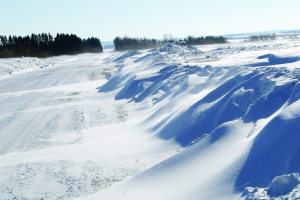
The Swan Valley entered the polar vortex last weekend, with temperatures getting as cold as -35.7C on Sunday (Jan. 29). Forecasts indicate that the cold snap is short lived, with weather returning to single digit temperatures by the upcoming weekend.