


Submitted
The Rest is Still Unwritten
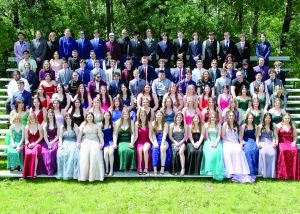
Presenting Swan Valley Regional Secondary’s Class of 2024! Graduates celebrated their final year of high school on Thursday, June 20 with ceremonies, a banquet and dance...
A Takedown on the Mat
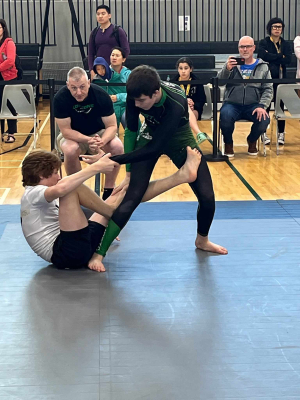
Lidstone Combat Sports Academy’s Lucas Hurren (right) takes down his opponent while one of his coaches supports him through the match at the Manitoba Open in Winnipeg on June 8 to 9.
Celebrating Coaches and Managers
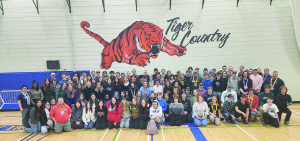
The first ever SVRSS Coaches Appreciation Lunch was held on May 23. All 53 coaches and managers from the 2023-24 season were invited. The students put flower lays on the coaches with a Tiger paw that read ‘You’re Tiger-ific!’ The coaches received a key chain token with a ‘Coaches can change a life’ message. The athletes created an aisle for the coaches to run down slapping hands followed by complimentary lunch for the coaches. Coaches left with smiles on their faces with a definite feeling of appreciation from the athletes and SVRSS.
Local doctor honoured

A local physician was honoured by her peers as part of a Society of Rural Physicians of Canada (SRPC) national event in Edmonton, Alta., Apr. 19. Dr. Trina Mathison received a Rural Long Service Award recognizing her long-standing contributions and commitment to serving the community.
In order to be eligible for the award, a physician must be a past recipient of the Rural Service Award, have worked in rural and remote Canada for 20 years or more and be a member of the SRPC and have been a member for at least five years. Founded in 1992, the SRPC is the national advocate for Canadian rural physicians.
The organization’s mission is to champion rural generalist medical care through education, collaboration, advocacy, and research.
Governor General makes a well received stop in Dauphin

A beautiful Manitoba morning and a large gathering of citizens greeted the Governor General when he arrived by train at 10 o’clock on Tuesday, October 22, 1925.
The Governor General, Julian Byng, was accompanied by the Hon. John Bracken, Premier of Manitoba, and his A.D.C. Captain Chaplain.
They were greeted by mayor Palmer, judge Bonnycastle, magistrate Hawkins, members of the town and rural municipality, as well as other local dignitaries. An honour guard of World War I veterans formed a line from the railway station to the town hall.
The official party proceeded to the town hall where “school children were assembled to full capacity.” After the singing of O Canada, mayor Palmer read an address to His Excellency and extended a loyal and heartfelt welcome from the town and municipality. He assured His Excellency of “our deepest gratitude for so kindly and graciously honouring us with the visit.” (October 25, 1925, Dauphin Herald)
As commander of the Canadian Army Corps from May 1916 to June 1917, Byng helped to transform the troops into a well-trained and effective force on the Western Front and gained his greatest glory with the Canadian victory on Vimy Ridge in April 1917. Mayor Palmer noted of the Governor General’s World War I gallant conduct on the battlefield and the close association he had with “our brave troops many of whom laid down their lives.”
Mayor Palmer added that the Governor General’s service to Canada as His Majesty’s representative “still further won our respect, our esteem and our admiration.” The mayor also noted the Governor General’s gracious visit showed a personal fondness for the Canadian citizens in the process of home and empire building.
A copy of the mayor’s address was engraved on a scroll designed by Harold Atkin of the post office staff and was presented to His Excellency at the conclusion of the reading.
The Governor General then spoke and expressed his appreciation of the welcome extended to him and addressed the “young folks in the town hall by talking in a quiet and plain language. This brought closely to them a true realization of the dignity of the King he represented.” At the end of his talk he noted that he had requested the mayor to arrange a holiday from school for the next Friday and called for three cheers for His Majesty.
The Governor General was then driven to the Great War Veterans Association headquarters where he was received by World War I veterans. On behalf of the veterans Rev. Cousins welcomed the esteemed guest stating of the great satisfaction that the ex-servicemen had in a person who himself had known the stress and strain of World War I. Throughout his travels across Canada the Governor General was always enthusiastically greeted by the men that he once led.
He started his address with, “My old comrades, ladies and gentlemen it is quite unnecessary to tell you how much I have wished to see you here at Dauphin at a time like this. As a representative of His Majesty it gives me the greatest pleasure to come and recognize your very loyal sentiments so ably expressed. I also wanted to see what you look like now after these years we have been separated.” He also spoke of a united Canada especially after the victory at Vimy Ridge. At the conclusion of the speech Governor General Byng shook hands and chatted with the war veterans, “endearing himself to them by his wonderful memory of incidents and names which were recalled when he was informed of the battalion in which each man had served.”
Before boarding the special train, a thank you was given to mayor Palmer for his initiative and arrangements that made possible the official visit.
Several weeks later a large photograph of Lord and Lady Byng was received by mayor Palmer as a memento of the visit to Dauphin. The signed photograph was earmarked to hang in the council chamber.
Julian Hedworth George Byng served as Governor General of Canada from 1921-26. He died in 1935 and was mourned by Canadians including those that he led successfully in battle.
Doggy Donation

Swan Valley Animal Protection League (SVAPL) member Nikki Chartrand (left) receives a $10,000 cheque from Dan Grazier (right) who is a member of the Swan River Kinsmen Club as well as the SVAPL. “These are two organizations that I am proud to be affiliated with and who do such great things in our community,” said Grazier. “After a presentation, the Kinsmen voted unanimously to fully fund the “Kinsmen Kennel,” a large dog run that will be constructed behind the shelter to help our pooch friends. Thank you so much to these two groups for all that you do, and a real “Big Kin” to the Swan River Kinsmen Club for stepping up on this project that would have taken us years to fund otherwise!”...
National Champions

The Swan Valley boasts two new national champions as members of Lidstone Combat Sports Academy (LCSA) return from the World Association of Kickboxing Organizations (WAKO) Canada National Championship with two championship belts. Here, competitors Liam Peterson (left), John Walsh (second from left) and Cole Lumax (right) are pictured with coach Travis Lumax (second from right) in front of Niagra Falls where the competition was held.
Travelling the “Turkey Trail” was always an adventure

By Ed Stozek
For the Herald
Provincial Trunk Highway 45 has greatly improved from its original narrow and winding nature.
The Russell-Erickson road was dubbed by locals as the “Turkey Trail” claiming it reminded them of the bush paths commonly found on Prairie farms.
Another possible name origin stemmed from an incident where “a truck loaded with live turkeys went off the road and rolled over, from which the turkeys escaped.” (The Manitoba Historical Society Archives)
Construction began in 1937 and eventually the Turkey Trail linked the communities of Russell, Silverton, Angusville, Rossburn, Vista, Oakburn, Menzie, Elphinstone, Sandy Lake and Rackham.
By 1966 the road generally aligned with the railway line. Many of the sharp curves and unnecessary turns were removed allowing for a more stream-lined journey.
As a young boy growing up in the Oakburn district sections of the Turkey Trail were utilized on a Saturday afternoon for family outings to the surrounding communities. A longer adventure included the annual spring trip to Russell to pick up chicken and turkey chicks at Berg’s Hatchery.
From 1967 to 1970 my Grades 10 to 12 high school routine included a daily school bus ride on the new and upgraded PTH 45 from Oakburn to Elphinstone. In my Grade 12 year I drove my parent’s car in the latter part of June to write the Provincial exams at the collegiate. I can still recall taking the short cut and driving the side roads of the original Turkey Trail to Elphinstone.
Automobile travel during the winter months on the Turkey Trail presented problems for the locals.
“A variety of horse-drawn vans were regularly coming to town due to poor road conditions. All week the Turkey Trail had been blocked to car travel owing to extremely heavy snow and drifting. The mail-truck driver certainly merited commendation for getting the mail through even when the bus didn’t make it. The condition of side roads was hopeless as far as car travel was concerned.” (Dec. 15, 1955, Rossburn Review)
The winter of 1955-56 continued with more major storms. An article in the April 5, 1956, edition of the Rossburn Review indicated that highway isolation ended on Apr. 4 when the Royal Mail truck reached town over the Turkey Trail which was opened from Russell by bulldozers.
It was the first mail received since Mar. 26, and it was also the date when a passenger bus was last seen in town. The fact that mail was not received for seven days magnified the situation. Rail service had been established five days ahead of highway traffic.
“The delay in opening the road until the sun had caused the snow to pack had the townspeople and surrounding area residents practically up in arms. Something definitely slipped in the allocation of snowplows. It is thus that Easter 1956, in part as it affects the re-uniting of families for a few days, was a disappointment to hundreds of families in the Rossburn, Angusville, Vista and Oakburn area.”
The area had been completely isolated except for the one passenger train arriving at Rossburn packed with holidayers.
“Many had started the first leg of their journey by bus in complete belief the government road equipment would open the highway and then they could return by bus on Sunday.”
The editor of the Rossburn Review expressed the time had come for communities located along the Turkey Trail to take immediate action with regards to the numerous benefits of gaining provincial highway status. Thousands of dollars in the past month had been added to provincial coffers from these communities from licenses for cars and the recent gasoline tax increased by two cents. He also noted the local MLA’s present lack of a stand publicly to date regarding the Turkey Trail’s status was damaging every affected community.
By 1959 the Russell-Erickson road officially became PTH No. 45 and today it is a well-travelled two-lane paved highway.
Driving past my old stomping grounds evokes memories of the Turkey Trail and the trip with my father to Berg’s Hatchery. Using the Chevy sedan we brought the chicks home in special perforated cardboard boxes. None escaped but they were a hungry and a thirsty bunch when we arrived home.
Hoppy Easter

Captured during Easter weekend, a wild rabbit sits around a silage pile on a Swan Valley West farm
Can you Imagine?
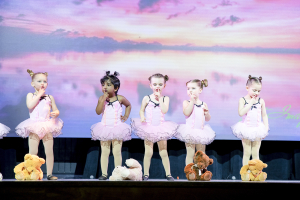
Swan School of Dance held their annual recital last Wednesday (March 20) at the SVRSS gymnasium. Dancing to songs that related to the theme ‘Imagine...’ the performers put
on a spectacular show for the audience who filled the space.