


Shawn Bailey
Tax bills are in the mail, payments are due by July 31
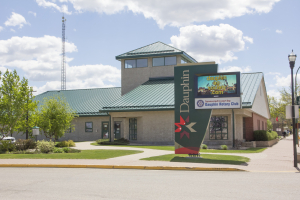
Dauphin property owners should be watching their mailboxes as the City has sent out its 2023 property tax notices.
Taxes are due by July 31, Dauphin’s director of finance Scott Carr said, adding people are normally very good at providing the money the City uses to fund its operations on time.
“Generally speaking we have over a 90 per cent collection by July 31. When the bills first go out usually we’re really busy and then there’s a bit of a pause. And then late July it starts to get really busy again. But by the end of July, in a typical year, we will have collected 90 per cent or more,” Carr said. “It depends on the year. If you have a few large tax bills still outstanding it could impact that quite a bit, but generally speaking we see it around 90 per cent collected.”
About five years ago the City began offering an automated withdrawal program which allows property owners to pay their taxes through monthly withdrawals right from their bank accounts, Carr said the program is starting to catch on.
“Right now about 10 of people are on it. It started off slow, but as time goes on it’s picking up, Carr said, adding banks are starting to refer customers to the process rather than collecting taxes as part of a mortgage payment. “It just facilitates the collection both from the customer paying point of view and then our collection point of view. It really streamlines the process.
“It’s good for us, it’s good for the customer and it really helps with the collection side of things.”
Those wanting to take part in the program have a couple of options to get started.
“Simply call city hall,” Carr said. “Or we have forms online. Go to dauphin.ca to sign up and we’ll get you set up.”
Breakfast with benefits
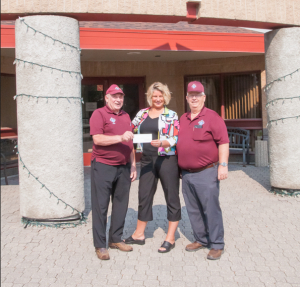
With St. Viator’s Roman Catholic Church as a backdrop, Dauphin Knights of Columbus Grand Knight Ken Yakielashek presents a cheque for $1,200 to Parkland Crisis Centre and Women’s Shelter executive director Kari Prawdzik, while Deputy Grand Knight Lloyd Hudson looks on.
The donation represents the proceeds of a pancake brunch hosted by the local Knights to mark Mother’s Day in May. Prawdzik said the organization will use the funds to help pay for programming.
Consultant announced for Dauphin's Community Safety and Well-being Plan
Dauphin’s long-awaited Community Safety and Well-being Plan is one step closer to being completed with the appointment of a consultant, last week.
After waiting more than a year for the process to get going, Dauphin learned the Canadian Municipal Network on Crime Prevention (CMNCP) will help guide them through the development of the plan.
City manager Sharla Griffiths was pleased with the announcement, not only because it marks a step forward in the process, but because the city is familiar with CMNCP.
“We have been learning from them for maybe three years, maybe more. We became a member of that network in 2019 or early 2020, and have been learning about community safety and well-being plans and programs and community safety concepts through webinars for all that time,” she said. “I truly think that they’re the gold standard and they are the best of the best.”
Upon hearing the news, Griffiths immediately reached out to the CMNCP executive director, but has yet to hear back. She added she suspects that the group was awarded the contract to develop all of the community safety and well-being plans on the schedule.
“I did want to position the City of Dauphin, to identify ourselves as ready to go and excited to work with them now as opposed to being further down the line on their priority list,” she said, adding Dauphin might actually be ahead of most communities in the process. “This council is extremely interested in getting going on addressing crime and addressing social issues and we’ve been meeting with social service groups, with RCMP, with Manitoba Housing, with groups like that. What we thought is that we don’t have to introduce the concept and try to sell our community on it. The community is already excited about getting going on consultations and creating plans and looking at action items and to do items.”
Local historian pushes for cemetery improvements
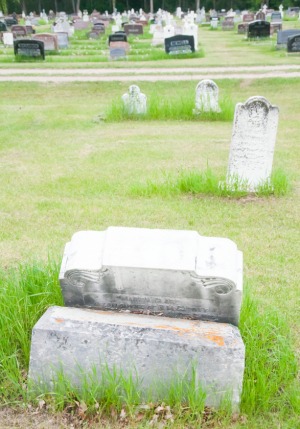
For Al Gray, a desire to improve the aesthetics of Riverside Cemetery in Dauphin all comes down to simple respect.
Recently, the founder of Friends of Riverside, a volunteer group with a mission to help improve the environment at the local cemetery, has been concentrating his efforts on headstones which are leaning, or fallen and broken.
“The thing of it is, is that like most cemeteries, the cemetery holds no legal responsibility for the stones. It’s a family thing and most people don’t understand that,” Gray said, adding he has taken on the task of contacting family members where possible to let them know the loved one’s marker needs attention.
“What I’ve maintained all along is that you can’t expect people to know what they don’t know if nobody’s telling them what they don’t know.”
In most cases the response is positive, Gray said, and many stones have been repaired as a result.
The problem is that in many cases there are no family members to be found, Gray said, pointing to the large spire of a former Dauphin resident.
“Dr. Law was buried in 1901, his wife was buried in 1902 and they had no children. The stone there, to lift it up is probably about $1,500, to put a new foundation underneath it. There’s no family, so who’s going to do it?” Gray asked. “So that’s where I’m at with this stuff, is to try and get people to understand that.”
Compounding the problem is the sheer number of stones which need attention.
In block one, the oldest block in the cemetery, there is more than 400 stones which need attention, Gray said.
“This is block one, this is 100 tears of neglect. There is over 400 compromised stones in this one block alone, 400, over 400,” Gray said. “Which, at an average of $250 dollars a stone, is $100,000 of repair work in one block. And there’s 14 blocks in this cemetery.”
There are two companies in the area which perform headstone restorations, Gray said, adding repairs can range from around $150 for a simple resetting to several thousand dollars for large stones which have toppled and broken.
To help facilitate some of the work, Gray has reached out to the councils of the City and RM of Dauphin to consider providing some funds over the next few years.
“I went to a (City and RM) liaison committee meeting and I said, ‘while we have two councils that look like they’re going to work together I would like to consider you guys putting in between $4,000 and $5,000 a year per municipality for four years,’ for mandate,” Gray said, adding he has yet to hear back from the councils on the proposal.
“That would give us about $40,000 to put into the cemetery.”
Riverside Cemetery operates under provincial legislation, which was passed in 1964, one of only two cemeteries in the province in that situation. As such, while representatives of the two municipal councils make up the majority of the cemetery board, they have no financial responsibility for its operation, Gray said. Operating funds, he added, come from the sale of burial plots and interest earned on the Perpetual Care Fund.
Gray has received some support from the public on the issue, citing a group of five ladies who, following one of his History Night presentations, provided funds to fix up one neglected stone.
“They not only picked the stone, but they did the research on the person, too. That’s been some of the good stuff,” Gray said, adding while such gestures are greatly appreciated he is banking on elected officials making a financial commitment to the cemetery. “There’s nothing we can do if we don’t have a nest egg to do it with. I need the financial support. We can do the family contact and we’ll keep plugging away at the families. But to get really active out here you need the City and the RM.”
A celebration of music

Students at Ecole Macneill celebrated the conclusion on Music Month with an outdoor concert for family and friends, May 31.
Those attending were treated to a variety of songs celebrating music before enjoying a picnic in the school yard for those wishing to attend.
While music is an important part of the Manitoba school curriculum throughout the year, its role in education is highlighted during Music Month.
Dauphin Adventure Fund in place to support local events, organizations

Building upon its brand, Adventure From Here on Out, the City of Dauphin has launched the Dauphin Adventure Fund, an initiative they hope strengthens the community’s position as a destination for events.
Funded through the accommodation tax, the Adventure Fund will provide financial assistance to organizations involved in the planning, execution, and hosting of regional, provincial, national, or international events within the City of Dauphin and the Rural Municipality of Dauphin.
The fund will focus on fostering overnight stays in the community, Dauphin Economic Development manager Martijn van Luijn said.
“If you are a local organization and you want to put on an event that, at least, has some sort of overnight stay attached to it, because that is really what feeds our economy, then you can apply for some funds and we will help you get this project going,” he said.
van Luijn said as a vibrant community that values the power of events to stimulate economic prosperity, Dauphin recognizes the importance of attracting and nurturing diverse events that draw visitors.
Financial assistance will be available for a wide range of events, including, but not limited to sports tournaments, cultural festivals, art exhibitions, conferences, and more.
“We firmly believe that investing in events is investing in our community’s future. By supporting event organizers through the Dauphin Adventure Fund, we are empowering them to create unique experiences that attract visitors, stimulate our local economy, and showcase all that Dauphin has to offer,” mayor David Bosiak said.
“We invite event organizers to seize this opportunity and partner with us in driving Dauphin’s success as a thriving event tourism destination.”
The fund started with a balance of $40,000. The allocation of funding will be administered by the Sports-Tourism subcommittee of the Dauphin Economic Development Committee, working in close collaboration with the Economic Development Manager.
Through a thorough evaluation process, funding amounts will be determined based on the potential impact of the event, its ability to attract overnight visitors, and its alignment with the city’s strategic goals, van Luijn said.
Funding requests exceeding $5,000 will require approval from city council.
“We’ve already received three applications. There is a need,” van Luijn said.
For more information on the Dauphin Adventure Fund and the application process, visit tourismdauphin.ca/meetings-special-events or contact van Luijn or Ember Kutcher by email at This email address is being protected from spambots. You need JavaScript enabled to view it. or by phone at 204-622-3216.
Pounding the pavement

Crews from Stirling Enterprises have been in the community getting going on the City’s 2023 road improvement program.
Watch for barricades through the community as they complete some pavement patching and milling and overlay projects in the city core.
Here’s the play at the plate
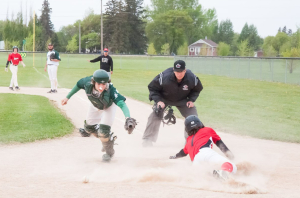
Dauphin Clippers catcher Cash McCallum can’t come up with the throw home as a Goose Lake Raider scores on a play at the plate during the Zone 8 playoffs, last Wednesday.
Dauphin beat Goose Lake, 14-10, and advanced to the zone final where they faced the Swan Valley Tigers, who earned their berth into the final with a 13-11 win over Ste. Rose.
The Tigers clawed their way to a spot at provincials with a 14-1 win over Dauphin.
Bike Week activities promote cycling culture

Dauphin residents are being asked to hop out of their cars and onto their bikes next week.
June 5 to 11 is Bike Week and Dauphin Recreation Services and the Dauphin Derailleurs Cycle Club (DDCC) have organized a number of activities to celebrate.
Monday is Bike to Work and School Day, while Tuesday is Bike to a Park or Playground highlighted by a gathering at Fusion Credit Union for coffee and cookies from 9 a.m. to 11 a.m. The gathering is an opportunity to find out everything that is going on to celebrate Bike Week and join DDCC and mayor David Bosiak for a “slow roll through Vermillion Park,” said spokesperson J.L Guillas.
“The Derailleurs will have some of our fat bikes there if people want to try that,” he said, adding the exact itinerary for the ride has not been set. “It’s depending on who shows up. If it’s families, if it’s kids, we’ll take them over to Vermillion and have a gentle ride. It’s not a time trial.”
Wednesday will feature a bicycle based scavenger hunt, while an open house will be at Northgate Trails on Thursday at 7 p.m., providing an opportunity to tour one of the micro cabins at the site, try out a fat bike, get information about programming, learn about the trails and volunteer opportunities, and chat with a board member.
Guillas encourages everyone to bring a bike and a friend.
“I believe the Kids of Mud will have their race that night, as well. So there’s going to be lots of activity,” Guillas said. “People shouldn’t be shy if the parking lot is full. Come on in.”
Finally, Friday has been designated as Bike to Get Your Favourite Treat day, Guillas said, adding more activities and contests are being added all the time.
For example, he said, the Parkland Chamber of Commerce is asking employers to encourage their staff to ride their bikes and track the kilometers they cover for the week. The business with the most accumulated kilometres will win $50 per employee to a maximum of $500.
All of the activities add up to an opportunity to promote Dauphin as a bicycle-friendly city, Guillas said.
“Dauphin, it’s very accessible by bicycle and if people get in the habit of it, it just becomes more of a culture change for individuals and families and it’s just a positive thing,” he said. “Bike Week itself is to just remind people how much fun it can be to be on a bike, how accessible the city is on a bicycle and then also the great facility we have over at Northgate.”
The city is regularily adding to its active transportation routes making cycling even more of an option, Guillas added.
“There’s another piece that’s coming, that’s going to be constructed this year linking up right to (Assiniboine) college from the Kingsway Trail,” he said. “It’s about the culture of biking and also the infrastructure. Vermillion Park is a great place to take young kids to learn biking in a safe place to get them off the roads. We’ve got lots of great opportunities in town and also the big facility south of town.”
Whether you are an experienced cyclist or just starting to seek two-wheeled adventures, Guillas encourages everyone to take in all that Bike Week has to offer.
“It’s a good workout and it’s good lifestyle choice. It can be fun, you do it with your friends and you see things in town that you don’t see when you’re speeding by in your car,” he said.
“Whether you’re on a $100 used bicycle, a hand-me-down bicycle or a top-end bike, it doesn’t matter, it’s all fun and it’s for everybody.”
Squeaky clean
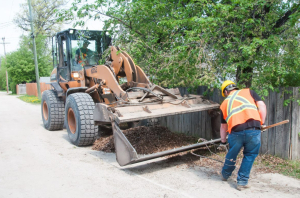
City crews conducting a spring cleaning of the community have moved on to Day 2 on the garbage and recycling schedule.
During one pass through the city, crews will collect accumulated garden waste, grass clippings and leaves, as well as shrubs and tree branches less than six inches in diameter at a maximum length of eight feet, last week.
These items will only be collected if they are free of household waste, hazardous waste and recyclable materials and are in a clearly identifiable pile.
The spring clean up campaign will occur in the back lanes, so place the items near your back lane for pick-up.
Those residences that do not have a back lane, place your items on the boulevard near the curb.
Large equipment will be used, so it is important to place the items close to the lane or curb to avoid property damage.