Ratepayers living within the boundaries of Mountain View School Division (MVSD) are preparing for an increase in the education portion of their property taxes.
At the division’s 2024-25 Public Budget Forum, Mar. 7, secretary-treasurer Lori Slepicka indicated the mill rate for the special levy will rise to 13.87 in the coming school year, an increase of one mill from the previous year.
While the effect the increase will have on individual ratepayers will depend on changes in assessment of their property over the past year, it will mean and additional $45.02 per $100,000 value on residential property, $26.01 on farm land and $65.03 on commercial property. The effect on farm property and residential properties will be mitigated by provincial rebates.
“The province is still promising a rebate of 50 per cent for residential and farmland, so that would be an increase of $13 for residential. On farmland the effect would be about $22.51 after the rebate,” Slepicka said.
The increase will raise an additional $2.98 million dollars for the 2024-25 budget, Slepicka said.
The additional funds will be used to increase educational assistant hours, while maintaining all other staffing levels, support informational technology infrastructure upgrades, increase the budgets for maintenance supplies and services and cover anticipated contractual obligations for both educators and non instructional staff.
“The contractual obligations are difficult to predict right now. Teachers’ bargaining is being done at a provincial level, so we have no idea what those salaries are going to come in at and the contract has been expired for a couple years already. And then our non-teaching union is also expired, so we don’t know exactly what that’s going to be for next year either,” Slepicka said. “So we’re putting what we think is a fair and reasonable amount into the budget to be fiscally responsible so that we have money to cover the salaries when we get the settlements of the contracts.”
The hope is the province will come through with extra funding to cover the added costs of the contract it negotiates with teachers, but even if it does not, the division will have to raise all the funds required for retroactive pay this year, she added.
“Our hope is that we won’t be, but (the province) are not yet indicating that they will cover those expenses,” Slepicka said, adding some provisions have been made in past years to help mitigate the effects of the new contracts. “We budget a little bit each year, so we just keep adding to it as we go along.”
Overall, MVSD’s balanced budget proposal calls for $50,816,934 each of revenue and income, up 8.1 per cent for last year.
On the revenue side, provincial grants are budgetted at $30,093,626, while municipalities will be on the hook for $18,449,048. First Nations revenue has been budgetted at $1,023,225, income from private organizations at $532,900, school division revenue at $478,420, federal revenue at $19,715 and income from other sources at $220,000.
At 57.08 per cent, the majority of expenditures come in the area of regular instruction, with student support services accounting for an additional 14.36 per cent. Maintenance comes in as the next highest budget line at 12.19 per cent of total expenditures followed by transportation at 7.12 per cent, instructional support at 3.65 per cent and administration at 3.11 per cent. Fiscal services at 1.76 per cent and community education at .23 per cent round out expenditure categories.
A vast majority of spending - 83.3 per cent - takes place to cover salaries and benefits, while the remaining 16.7 per cent is earmarked for services, materials and supplies.
“We spend slightly less than the average on personnel costs. We have more schools, smaller schools and our insurance costs and utility costs are slightly higher,” Slepicka said, adding a contributing factor is the fact that almost half of MVSD students require transportation.
In fact the division ranks the sixth highest total annual kilometers driven in the province, while sitting 20th out of 36 divisions in terms of enrolment.
“We have more buses, more mileage, which puts our supplies budgets up higher.”
When it comes to money spent in the classroom, there are two main areas of focus, MVSD superintendent and CEO Stephen Jaddock said.
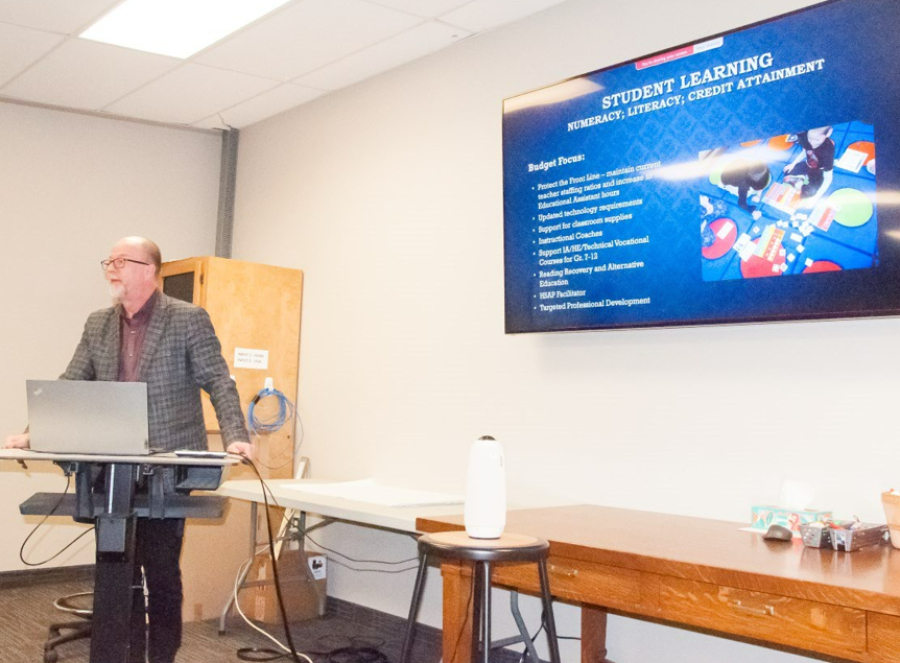
In the area of student learning - which involves numeracy, literacy and credit attainment - protecting front line services by maintaining teacher ratios is the main focus for 2024-25, he said, along with adding education assistant hours.
“We are looking at a little bit of a pressure point on our educational assistance and this will bring us up to where we’re actually more in line with what we’re actually paying out for our educational assistance throughout the school year,” he said. “So we needed to do a little bit of a correction there. When we have students that come to our schools from other school divisions or they’re just new to the system and they require additional support then we do need to put in often times educational assistants to help with them, so we are wanting to make sure that our funding includes an increase for those hours.”
Other strategic initiatives include updating technology requirements, support for classroom supplies, instructional coaches, supporting industrial arts, human ecology and technical vocational instruction for Grades 7 to 12, reading recovery and alternative education, a high school apprenticeship facilitator and targeted professional development.
In the area of student well-being, strategic goals include safe and caring schools, student voice, indigenous education, and mental health and wellness.
The top budget focus for 2024-25 is proactive programming, Jaddock said.
“We want to make sure that our schools are continuing to participate in proactive programming. We do have an overall goal in Mountain View School Division to see a reduction in out-of-school suspensions, where we would like to make sure that students are in school and that we move to more of a restitution type model,” he said. “I mean there are situations where, for safety sake, we do need to have a not-in-school suspension, but we certainly want to reduce them overall, so that students can remain in school and have that contact time with the individual classroom teacher.”
With the provincial announcement around school nutrition, programming in that area is also a priority.
“To augment what is already happening in our schools, we have approximately an additional $275,000 to spend in that area,” he said. “The Province has stated that their goal is that no student should come to school hungry, and if they do, that they are being able to be looked at, looked after for breakfast and lunch. So that is the goal of the program in all of our 16 schools in Mountain View School Division.”
Budget attention was also given to the MVSD Student Voice Committee, resource and guidance, indigenous education framework, community connectors, social workers, staff wellness and mental health first aid.
“Coming through the COVID pandemic we find ourselves in what we call the echo pandemic, where the effects of the pandemic are now being felt and actually now coming out in the behaviors of students. Staff are on the front lines to have to deal with that. Also it’s no secret that many of the adults in our society have been affected by the pandemic, as well, and they need to remain healthy and they need to have support,” Jaddock said.
“So we want to make sure that we’re attending to that in Mountain View School Division.”
MVSD has until Mar. 15 to set its special levy and an adopted budget must be submitted to the province by Mar. 31.