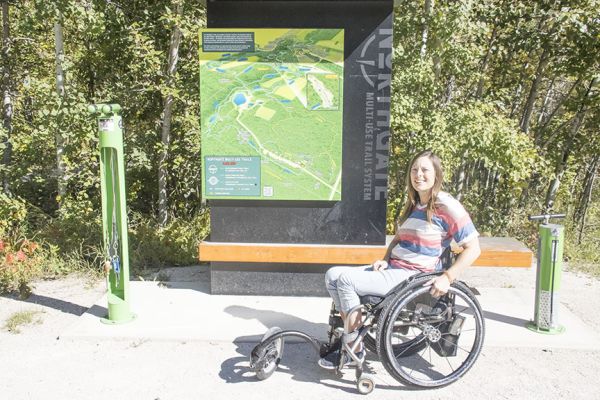
A Canadian paralympic world record holder spent the last two weeks at Northgate Trails, helping to assure the trails are wheelchair accessible.
When she was 14, Lisa Franks was diagnosed with arteriovenous malformation, a condition that caused clusters of blood vessels to prevent blood from properly passing by her spinal cord. As a result, Franks lost the use of her legs.
But that didn’t keep her down, as Franks began training as a Paralympian and went on to set world records in the 100m, 200m, 400m, 800m, 1,500m, 5,000m, and marathon events, winning six gold medals and one silver medal in her career.
Prior to her spinal injury, Franks was active in sports.
“And when I was going through rehabilitation, I actually met a bunch of Paralympians and got to try out different sports. And wheelchair racing, it turns out I had some skills in wheelchair racing,” she said, adding she participated in two Paralympic Games in 2000 and 2004.
After her success in wheelchair racing, Franks decided she needed a different challenge and turned her attention to wheelchair basketball, making Team Canada in 2006 and competing in the Paralympics in 2008.
“I would have kept going with that, but I had a pretty severe injury at the end of 2008 and just couldn’t. I had four shoulder surgeries and wasn’t competitive at that same level anymore. And then I discovered outdoors, and that’s been my new passion,” Franks said.
Franks is willing to do anything when it comes to outdoor activities, but her favourites are mountain biking, surfing, kayaking and hiking.
“I’ll try anything, like sky diving, paragliding, zip lining, snowmobiling, downhill skiing. I’m always looking for something new to try,” she said.
Franks was contacted by Parks Canada through Riding Mountain National Park (RMNP) to assist with the trail system in partnership with Northgate Trails.
“A few people with Parks Canada had heard me speak at a conference in the spring and it was all about accessible experiences and facilities are just better for the community overall,” she explained.
“And they were wonderful. They just realized that could really benefit the new trail system they were working on, so they asked me to come out and view the trails as an adaptive mountain biker and adaptive wheelchair user and see what advice I could give and what insights I could offer. I’m really excited that they’re being really inclusive right from the start. It makes their job that much easier in the long run.”
Franks rode the Northgate trails with the trail designer and volunteers using her own mountain bike, which gave them an idea of the capability of her equipment.
“They’re going to apply a lot of what they saw going into that. There’s an organization that has an adaptive mountain bike standard that they can fall back on,” she said.
Most of the trails are already wheelchair accessible, with a couple of areas that just need some tweaking.
“The boardwalks were pretty narrow, but I could make it across them, but don’t have much room for error on those. But it’s very much meeting in the middle between what the equipment we ride can do and what the trails offer. And when you get that in sync, there’s usually minimal changes that need to be done to make it more inviting,” she said.
Franks was impressed with the trails she has been on, noting a lot of upkeep has been done to rework some of the older trails in RMNP.
“I went to the Boreal Trail and then the bog trail or the boardwalk in there. It’s amazing that they’re just even thinking about it and trying to be more inclusive,” she said.
Franks used her regular wheelchair on the family loop at Northgate, which was flat and easy.
“But still a workout, just because you can add length with the different segments on it,” she said.
Franks has one wheelchair for every day use, with accessories that can be added to make it easier to use on the trails.
“There are lots of options for hiking wheelchairs. I just can’t travel with them all at the same time. In the summers I have my personal bike,” she said, adding she lives in a camper van, which is outfitted around her bike.
“I also have another bike on the outside on a bike rack that I let other people ride.”
Franks encourages anyone with disabilities that require them to use a wheelchair to get out and use the trails, especially the family loop.
“That family loop is really neat. There’s a lot of these different little nodes where you can see little things. There’s one clearing that has all these beautiful little tree houses. And even just getting out to the firepit in the communal area and watching everybody ride around or cook some hotdogs. It’s been a neat experience,” she said.
Franks sent a video of the Northgate Trails to people who work on trails in and around her hometown of Moose Jaw, Sask., to showcase what the Northgate trails are like.
While regular wheelchairs can be used on the family loop, more specialized wheelchairs would be needed for other trails.
Franks pointed out Parks Canada has a hiking wheelchair that people can borrow to use on the trails and enjoyed her time at Northgate.
“It’s wonderful Everyone here has been so excited about inclusion. What benefits myself might also benefit someone with a stroller or towing their kids in a trailer behind their bike. The wider boardwalks and things like that would also benefit everybody, I think,” she said.
Print this page
Paralympian’s perspective a gift for local trail developers, users
Published in Dauphin Herald Community
Published in
Dauphin Herald Community
Tagged under
